
By ForumHairTransplant Editorial Team · Prepared with AI assistance · Sources checked: 19 October 2026
Hairline and crown transplants follow the same basic process, but their results behave differently. The hairline usually grows faster and looks fuller for the number of grafts used, because it frames the face and the hair overlaps when you look from the front. The crown usually grows more slowly, often needs more grafts to look full, and tends to look thinner because the hair grows in a spiral that exposes more scalp. Knowing these differences helps you set realistic expectations and plan how to use your donor hair.
Key takeaways
- Hairline results are usually easier to judge at around 12 months. The crown often takes 12-18 months or longer to mature.
- The same number of grafts looks denser at the front than in the crown, because of how hair overlaps and how light hits the scalp.
- Crown loss can keep expanding over time, so many surgeons are cautious about using a lot of donor hair there, especially in younger patients.
- A natural hairline depends mostly on design: soft, irregular, age-appropriate and made of single-hair grafts at the edge.
- In both areas, most transplanted hairs shed in weeks 2-8. This is expected and does not mean the grafts have failed.
Why the two areas look different
The hairline
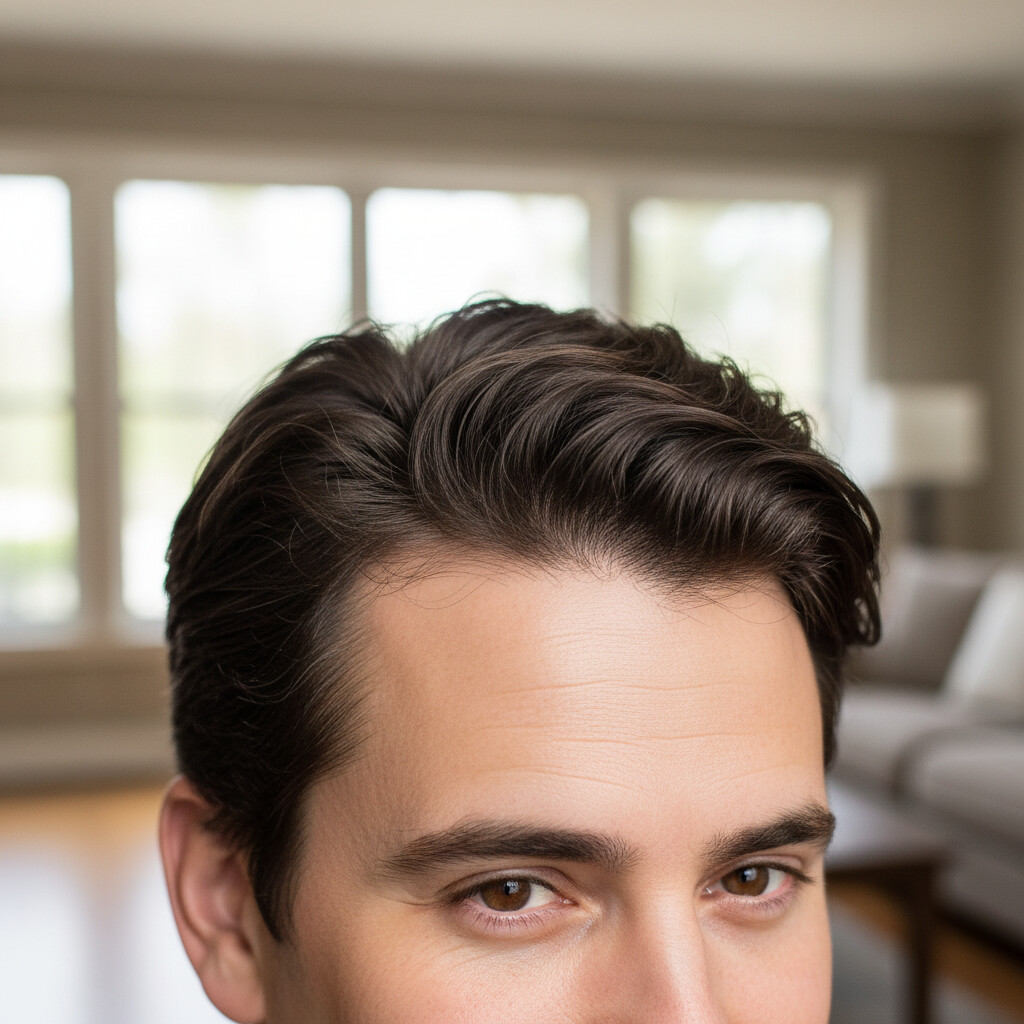
The hairline is the first thing people see. Even modest density can make a big visual difference, because the hairs lie forward and overlap, covering the scalp behind them. When viewed from the front, a well-designed hairline gives the whole face a frame. Its success depends mostly on design:
- Height and shape that suit your face and age. See facial proportions and hairline planning.
- A soft, slightly irregular edge, made mostly of single-hair grafts, instead of a straight line.
- Correct angle and direction, with hairs lying low and pointing forward.

The crown
The crown (vertex) is the area at the top-back of the head where hair grows in a whorl. Here the hairs radiate outwards in different directions, so they don’t overlap in one direction the way hairline hairs do. More scalp shows, especially under overhead light. As a result:
- the crown usually needs more grafts to look reasonably full,
- results often look lighter than a similar number of grafts at the front,
- the whorl pattern has to be recreated carefully, or the hair will stick out or part oddly.
The crown is also often the area where hair loss keeps progressing. A crown transplant surrounded by native hair that later thins can end up looking like a patch. This is why crown work is often described as needing long-term planning.
Growth timeline: front vs back
Both areas follow the same general pattern:
- Weeks 2-8: most transplanted hairs shed. The follicles stay in place and regrow later.
- Months 3-4: new growth usually starts at the front.
- Months 6-9: the hairline often shows a clear change.
- Around 12 months: the hairline is usually close to its final look.
The crown often lags behind. New hairs there can appear later, thicken more slowly and keep improving until 18 months or more. Our guide on why the crown takes longer to grow explains the reasons. If you had both areas done, it is normal for the front to look finished while the crown still looks patchy.
Some people also notice shock loss, a temporary loss of native hair around the operated areas. It is more noticeable where there is a lot of existing thinning hair, which can include the crown. It usually recovers over the following months.
Realistic density expectations
The number of grafts your donor area can supply is limited, and your surgeon has to share it between areas. In general:
- The front and hairline are usually given priority, because they have the biggest effect on how you look.
- The crown may get a lower density that reduces visible scalp rather than making it look fully dense.
- Hair characteristics matter. Thick, wavy or curly hair, or hair colour close to your skin tone, gives better coverage than fine, straight hair that contrasts strongly with the scalp.
For an overview of how surgeons decide what to treat first, read crown vs hairline prioritisation.
Planning for the long term
Transplanted hair from the safe donor zone is generally permanent. Your native hair is not. Questions worth discussing with your surgeon:
- How is my crown likely to progress? If loss is still active, adding grafts there now may not hold up visually.
- Should medical treatment come first? Treatments such as finasteride or minoxidil can help protect native hair, especially in the crown. Ask a doctor whether they suit you.
- What if I need a second session? Many people treat the front first and return for the crown later, once they know how their loss is developing.
- How much donor hair will remain? Using a large share on the crown can leave too little for the front later.
Judging your results
When you assess your result, compare like with like:
- Use the same lighting, angle and hair length as in your “before” photos.
- Judge the crown from above and behind, and under both soft and overhead light. Overhead light is less forgiving in every scalp.
- Wait until at least 12 months for the hairline and 18 months for the crown before deciding whether you need more work.
Common questions
Will my crown look as full as my hairline?
Usually not, even with good growth. The spiral pattern and viewing angle make the crown look lighter for the same density. The aim is to reduce visible scalp and look natural.
Should I do the crown and hairline in the same session?
It depends on your donor supply, how far your loss has progressed and your age. Some patients have both done at once. Others prioritise the front first. Follow the plan your surgeon explains for your case.
My hairline has grown but my crown hasn’t at eight months. Is that a problem?
Not necessarily. The crown commonly lags. Speak to your surgeon if there is still little growth after 12 months.
Does a perfect hairline need to be symmetrical?
No. Natural hairlines are slightly asymmetric and irregular. A perfectly straight, symmetrical line often looks less natural.
Discussion
If you had both your hairline and crown transplanted, how did the growth compare? At what point did each area start to look “finished” to you? Share your timeline and what you would do differently.
Sources
- Logic of Hair Transplantation, Journal of Cutaneous and Aesthetic Surgery, 2017
- Approach to Hair Transplantation in Advanced Grade Baldness by FUE: Retrospective Analysis of 820 Cases, Journal of Cutaneous and Aesthetic Surgery, 2018
- Androgenetic Alopecia: A Guide to Pattern Hair Loss, ISHRS
Related guides
- Why the Crown Area Takes Longer to Grow After Hair Transplant
- Crown or Hairline First? How to Prioritize a Hair Transplant
- How Is a Natural Hairline Designed for a Hair Transplant?
- Hair Transplant Growth Timeline: Month-by-Month Progress
- Does Hair Loss Continue After a Hair Transplant?
About this guide: ForumHairTransplant.com is an independent patient community. We are not affiliated with any clinic or surgeon, and we don’t accept payment for rankings, reviews or recommendations. This article is general information, not medical advice. Talk to a qualified doctor about your own situation.