
It is very common for the crown to look behind the hairline for months after a hair transplant. Transplanted crown hairs often start growing later, and the crown usually needs 12-18 months, sometimes longer, to reach its final look, compared with roughly 12 months for the front. Much of the delay is about appearance rather than biology. Crown hair grows outward in a swirl, lies flat and is seen from above under overhead light, so it needs more length and thickness before it looks full. A slow-looking crown at 6-9 months is usually normal.
Key takeaways
- Most surgeons advise waiting 12-18 months before judging a crown result, and some crowns keep improving after that.
- The whorl pattern, the large area to cover and the way light hits the top of the head make the crown look thinner for longer, even when grafts are growing.
- Shedding of the transplanted hairs in weeks 2-8 is normal everywhere, including the crown.
- Ongoing loss of native hair at the crown can mask new growth. Protecting that hair is part of a good crown result.
- If your crown shows little change at 12 months, ask your surgeon for a proper review, with photos.
How transplanted hair grows
After a transplant, most transplanted hairs fall out between about weeks 2 and 8. This is normal shedding. The follicle stays in the skin, rests for a few months, and then starts producing a new hair. It is different from shock loss, which is temporary loss of your own native hairs around the treated areas. The difference is explained in shedding vs. shock loss after a transplant.
New hairs usually appear from around month three or four. They start thin, short and sometimes lighter in colour, and they thicken over the following months. Not every follicle restarts at the same time, which is why growth looks patchy at first and fills in gradually.
The crown follows the same biology as the rest of the scalp, but in many patients it seems to restart later and to take longer before it looks full.
Why the crown takes longer
The whorl pattern
Crown hair grows outward from one or more swirls (whorls), and the hairs lie flatter and point in many directions. Where hairs fan out from a central point, there are always gaps between them, so the scalp shows through until the hairs are long and thick enough to overlap. At the hairline, hair points forward and stacks up, so even short new hairs make a visible difference. Correct placement of angle and direction at the crown is technically demanding; see unnatural hair direction after a transplant for what happens when it goes wrong.
A large area with limited grafts
The crown is a broad, curved area, and it can grow as hair loss progresses. Because donor hair is limited, crowns are often transplanted at a lower density than the hairline. Lower density means each hair has to reach more length and thickness before the area looks covered. See strategic prioritization of crown vs. hairline.
How you see it
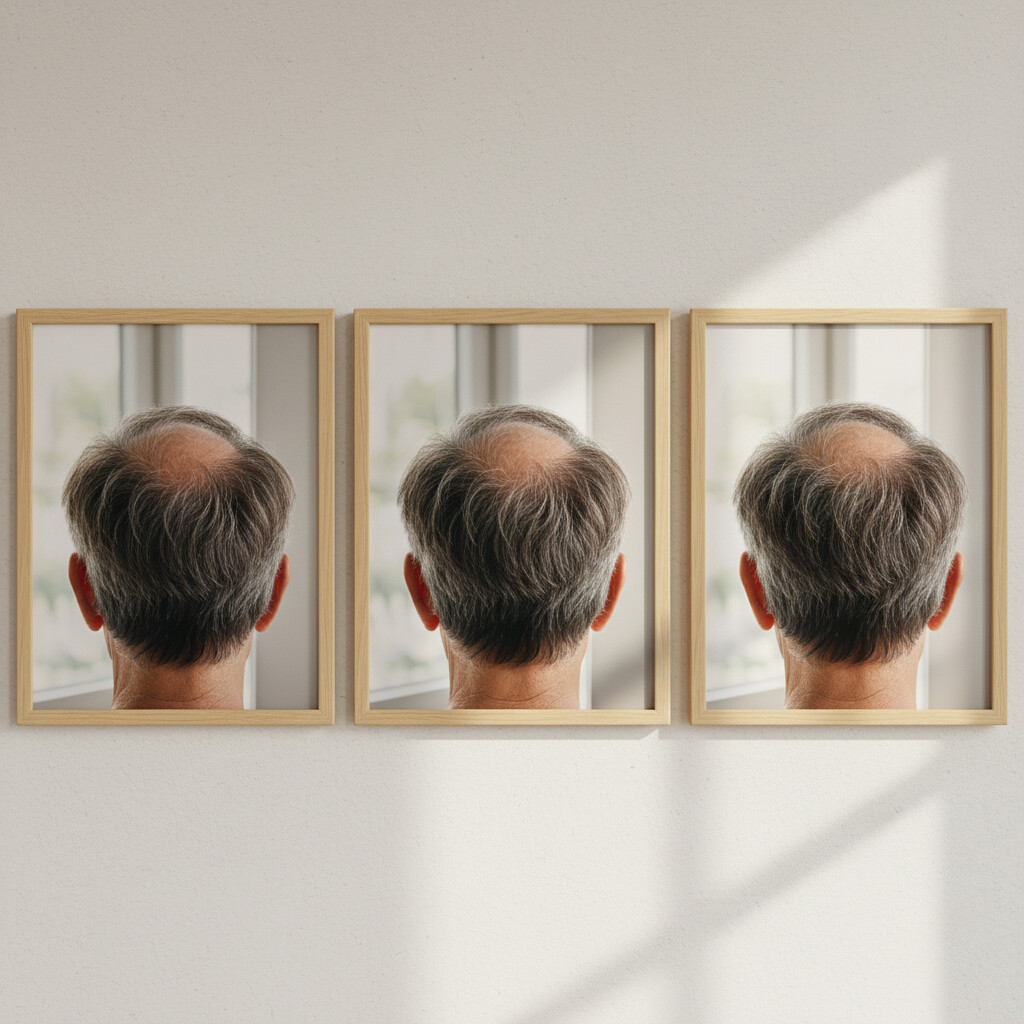
You look at your hairline in the mirror every day, but you usually see your crown in photos taken from above, often under bright overhead light. That is the least flattering view for any crown, transplanted or not. Wet hair, short hair and harsh lighting all exaggerate the gaps. How lighting affects how results look explains why the same result can look very different from one photo to the next.
Native hair loss in the same area
The crown is often an area of active pattern hair loss. Native hairs around the grafts may keep thinning, or shed temporarily after surgery (shock loss), while the transplanted hairs are still coming through. This can make the crown look no better, or even worse, for a few months.
Other possible factors
Some surgeons think differences in skin tension or blood supply at the crown may also slow things down. This is not well established. Individual factors such as hair calibre, colour contrast with the scalp, age and overall health affect how quickly any area looks full.
A typical crown timeline
Every patient is different. These are rough ranges, not targets:
- Weeks 2-8: most transplanted hairs shed. The crown may look much like it did before surgery.
- Months 3-5: fine new hairs start to appear. The hairline often shows progress first, and the crown can look almost unchanged.
- Months 5-8: crown growth becomes more visible, but it can still look thin, especially when wet or photographed from above.
- Months 8-12: hairs thicken and lengthen, and coverage improves noticeably.
- Months 12-18: the crown approaches its final result. Some people see continued thickening beyond 18 months.
For the whole-scalp picture, see our crown vs. hairline results guide.

What you can do while you wait
- Take consistent photos. Use the same place, lighting, camera distance and hair condition, about once a month. Compare month to month, not day to day.
- Follow your aftercare. In the first days, avoid pressure on the crown, for example from sleeping on the back of your head if your surgeon advises against it.
- Protect your native hair. If you are still losing hair at the crown, a doctor can discuss medical treatment to slow that loss. Many long-term plans include it.
- Grow it a little longer. Once your surgeon allows normal hair care, a bit more length usually helps crown hairs overlap and cover the scalp.
- Be wary of shortcuts. No supplement, shampoo or device has been shown to make transplanted crown hair grow meaningfully faster. A healthy diet and not smoking support normal healing, but they don’t change the biological timeline.
When to contact your surgeon
The crown is usually slow, but some problems need attention. Contact your surgeon or clinic if:
- in the first weeks you see spreading redness, pus, increasing pain or have a fever,
- you have many painful spots, cysts or persistent redness in the crown during regrowth,
- you notice sudden new bald patches or rapid thinning of native hair,
- there is still very little visible growth at the crown by about 12 months, or clearly less than expected by 18 months.
At a review, ask your surgeon to compare standardised photos and to look at the crown up close. Magnification can show whether new hairs are present but still fine. Slow growth after a transplant explains what a surgeon will usually check.
Should the crown be transplanted at all?
This is a planning question, not a growth question, but it affects expectations. The crown can use a large number of grafts, and in younger patients with progressing loss, a crown covered early may later need more work as the surrounding hair thins. Many surgeons therefore treat the front first and the crown later, or at a lower density, once the long-term pattern is clearer. If your crown was treated conservatively, it is realistic to expect good coverage rather than the density of the hairline.
Common questions
My hairline is growing well at 6 months but my crown looks the same. Is that normal?
Yes, this is one of the most common patterns. Many crowns show their main progress between about 8 and 18 months.
Will the transplanted crown hair look natural?
If the grafts were placed in the right direction and follow your natural whorl, it usually blends well once it has grown long enough. At very short lengths, any crown shows more scalp.
Can I speed up crown growth?
Not in any meaningful way. Good aftercare, not smoking and overall health support normal growth. Medical treatment discussed with a doctor can help protect native crown hair, but the transplanted hairs follow their own timeline.
When can I have a second session if the crown is thin?
Most surgeons wait until the first result has fully matured, often 12-18 months for the crown, before planning more work.
Discussion
If you had your crown transplanted, at what month did you first see real change, and when did you feel it was finished? Did your crown look behind your hairline for longer than you expected? Share your timeline and photos. They are very reassuring for people in the middle of the wait.
Related guides
- Crown vs. Hairline Hair Transplant Results: What to Expect
- Crown or Hairline First? How to Prioritize a Hair Transplant
- Hair Transplant Growth Timeline: Month-by-Month Progress
- Uneven Hair Growth After a Hair Transplant: Is It Normal?
- Unhappy With Your Hair Transplant at 6 Months? What’s Normal
About this guide: ForumHairTransplant.com is an independent patient community. We are not affiliated with any clinic or surgeon, and we don’t accept payment for rankings, reviews or recommendations. This article is general information, not medical advice. Talk to a qualified doctor about your own situation.