By ForumHairTransplant Editorial Team · Prepared with AI assistance · Sources checked: 19 October 2026
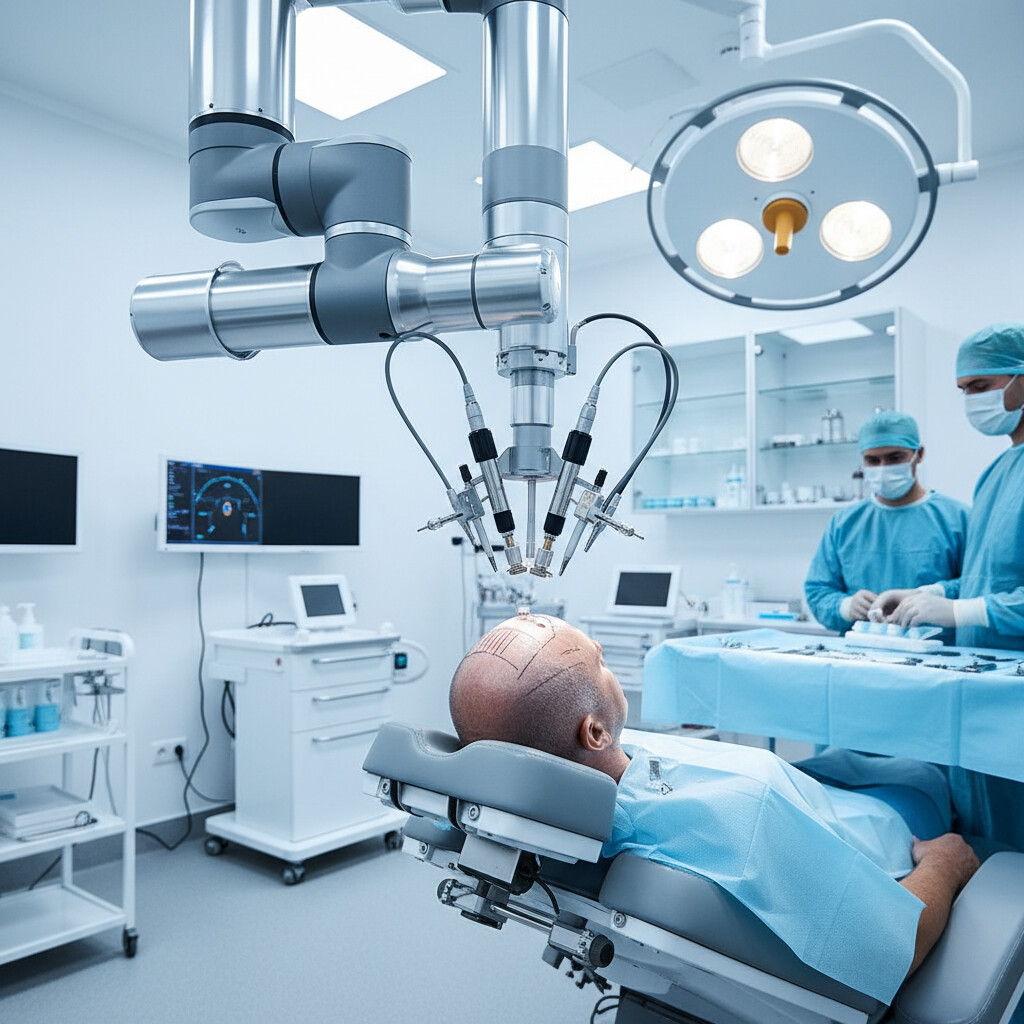
Robotic hair transplants exist today, but they are not what the name suggests. Current systems are image-guided devices that help with one part of an FUE procedure, mainly removing grafts from the donor area. The surgeon still plans the procedure, designs the hairline and, in most cases, places the grafts by hand. So the “future” is here as a useful tool, not as a robot that does the surgery on its own.
Key takeaways
- Robotic FUE is a form of follicular unit extraction in which a computer-guided arm and camera help remove grafts. It is not a different kind of transplant.
- Most systems focus on extraction. Hairline design, recipient site planning and graft placement still depend on the surgeon and team.
- Potential benefits are consistent punch depth and angle and less operator fatigue. There is no strong evidence that results are better than skilled manual or motorised FUE.
- Limitations include cost, limited availability, and reduced suitability for very curly, grey or light hair and for harvesting beyond the scalp.
- The skill and judgement of the surgeon matter far more than whether a robot is used.
What is a robotic hair transplant?
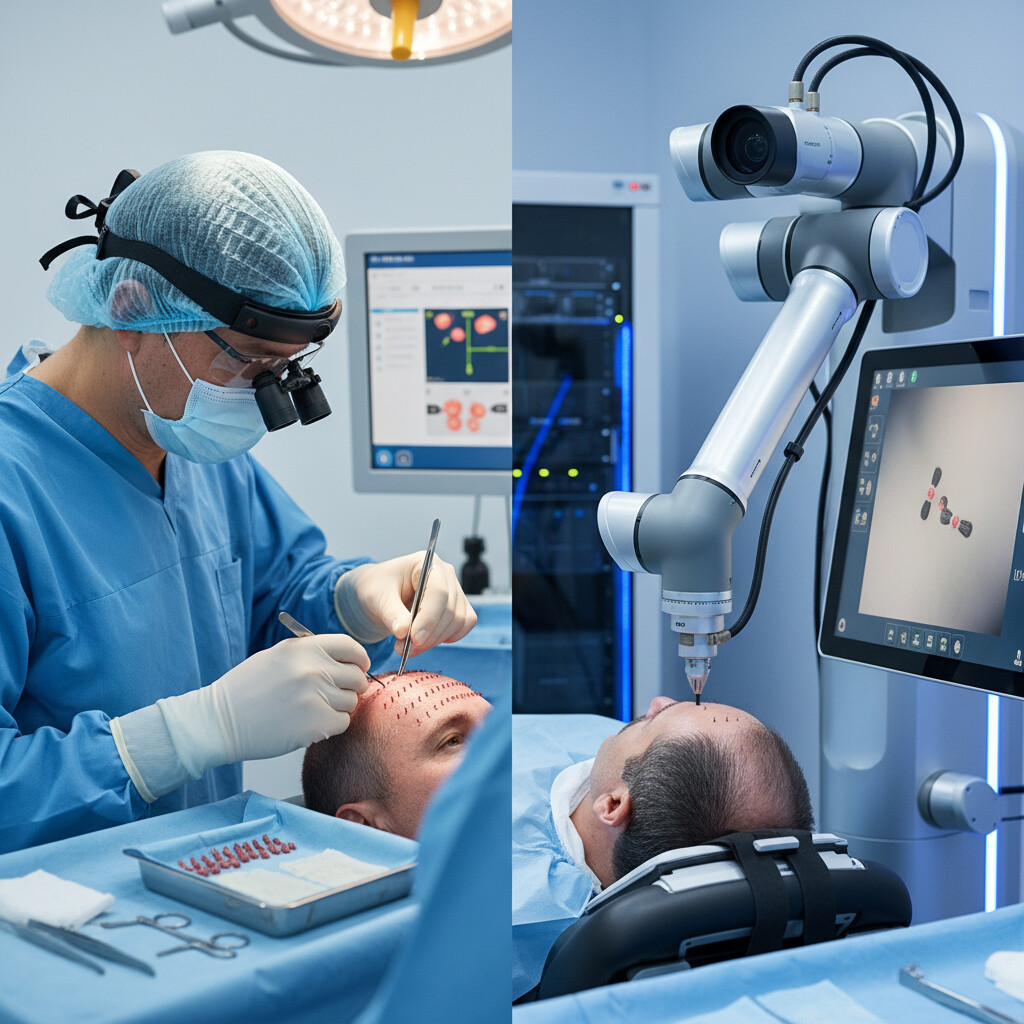
A robotic hair transplant is FUE (follicular unit extraction) with robotic assistance. In standard FUE, a small circular punch is used to free each follicular unit from the back and sides of the scalp. The punch is held by hand or attached to a motorised handpiece. In robotic FUE, a robotic arm guided by high-resolution cameras and software positions the punch and performs the extraction under the surgeon’s supervision.
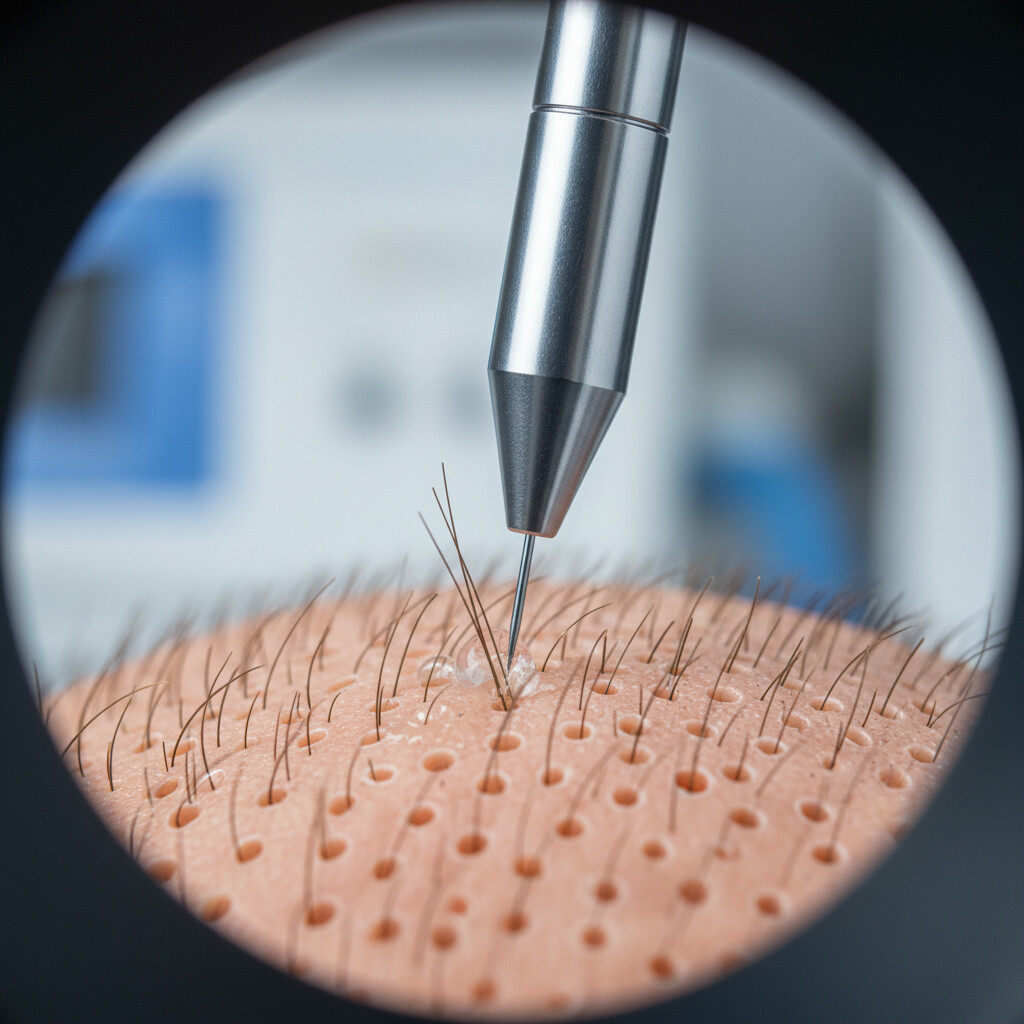
The robot does not decide how many grafts you need, where your hairline should be or how dense the result should look. Those decisions are made by the surgeon during planning. The machine carries out a repetitive task, extraction, with a consistent motion.
Our guide to SDHI, NEO FUE and robotic FUE explains how robotic FUE compares with other named techniques you may see advertised.
How the process usually works
The details differ between systems and clinics, but a typical robotic FUE procedure follows these steps:
- Preparation. The donor area is trimmed short so the camera can see each hair clearly. Local anaesthetic is given, as in any FUE procedure.
- Mapping. The system’s cameras image the donor area. Software identifies follicular units, estimates their angle and direction, and suggests which ones to harvest. The surgeon sets limits such as spacing between extractions and the area to be used.
- Extraction. The robotic arm aligns the punch with each follicular unit and scores the skin around it. The grafts are then removed, usually with forceps, and sorted by the team.

- Recipient sites and implantation. Some systems can assist with making recipient sites, but graft placement is still generally done manually by the surgeon and technicians, using forceps or implanter pens. This stage has a large effect on how natural the result looks, and it is where most of the artistry lies.
The surgeon supervises throughout and can stop, adjust or take over manually at any point.
Potential advantages
Robotic assistance can offer some real benefits, especially in the extraction phase:
- Consistency. The robot does not get tired. Punch angle and depth stay consistent across a long session, which may help reduce graft damage (transection) in suitable patients.
- Even spacing. Software can spread extractions evenly across the donor area, which helps avoid visible patches of thinning when done correctly.
- Less physical strain on the team. Manual FUE is repetitive work. Taking over part of it can help a team maintain quality over many hours.
- Objective mapping. Imaging gives a clear picture of the donor area and how many units are present in a given zone, which can support planning.
It is important to keep these benefits in proportion. An experienced surgeon doing manual or motorised FUE can also achieve low transection rates and even extraction. Robotic FUE has not been shown to produce clearly better growth or density than well-performed manual FUE.
Limitations and drawbacks
- Cost. The equipment and consumables are expensive, and this is often reflected in the price per graft.
- Limited availability. Relatively few clinics use robotic systems, so choosing robotic FUE can limit your choice of surgeon. Choosing the surgeon first is usually the better order.
- Hair and skin type. The camera relies on contrast between hair and skin. Grey, white or very light hair, and very curly or Afro-textured hair (where the follicle curves under the skin), can be harder to harvest robotically.
- Shaving is needed. The donor area must be trimmed short, which does not suit people who want an unshaven procedure.
- Scalp only. Robotic systems are designed for the scalp donor area. Beard or body hair harvesting is generally done manually.
- Implantation is still manual. The part of the operation that most influences how natural your result looks is still done by people.
Who might be a suitable candidate?
Robotic FUE is most often used for men with androgenetic alopecia who have:
- A stable, reasonably dense donor area at the back and sides of the scalp.
- Straight or wavy hair that contrasts with the skin colour.
- No objection to having the donor area trimmed short.
- Realistic expectations about how many grafts can be taken safely in one session.
Whether you are a candidate for any hair transplant, robotic or not, still depends on your age, pattern of hair loss, donor supply and long-term plan. If you are still losing hair quickly, medical treatment and a conservative plan matter more than the choice of extraction device. Before booking, it is worth reading our guide on how to choose a hair transplant surgeon.
Recovery after robotic FUE
Recovery is the same as for other FUE procedures. Expect some redness, small scabs, tightness and possible forehead swelling in the first days. Most people return to desk work within a few days to a week, depending on the size of the procedure and how visible the healing is. Your surgeon will give you rules for washing, sleeping and exercise.
Most of the transplanted hairs usually shed between roughly weeks 2 and 8. This is normal shedding of transplanted hairs and is expected. Some people also notice shock loss, a temporary loss of existing native hairs near the operated areas, which usually grows back over the following months. New growth typically begins around months 3-4, and the final result is usually judged at 12-18 months. The month-by-month growth timeline explains each stage.
Is robotic FUE worth it?
Robotic FUE is a legitimate tool, not a gimmick, but it is also not an upgrade in itself. Like other branded techniques, the word “robotic” can be used in marketing to justify a higher price. Our article Are New Hair Transplant Techniques Truly Better or Just Marketing? covers how to judge these claims.
Questions worth asking a clinic that offers robotic FUE:
- Who operates the system, and how many robotic procedures has the surgeon supervised?
- Which steps are robotic and which are done by hand?
- How is the recipient area designed and who places the grafts?
- What happens if my hair type turns out to be difficult for the system?
If the answers focus on the machine rather than the surgeon’s planning and track record, treat that as a warning sign.
Common questions
Does a robot perform the whole hair transplant?
No. Current systems mainly assist with extraction. The surgeon plans the procedure and the team places the grafts.
Is robotic FUE less painful?
Pain control comes from local anaesthetic, just like manual FUE. Most people feel the injections at the start and pressure rather than pain afterwards.
Does robotic FUE leave fewer scars?
It still leaves small round dot scars in the donor area, like any FUE. Punch size, spacing and total grafts extracted matter more than whether a robot was used.
Discussion
Have you had robotic FUE, or compared it with manual or motorised FUE during consultations? Share what you were told about the difference, how your donor area healed and whether you felt the extra cost was justified.
Sources
- A comprehensive review of evolution of advanced follicular unit excision systems, Journal of Cutaneous and Aesthetic Surgery, 2025
- FUE Instruments and Their Use, ISHRS
Related guides
- SDHI, NEO FUE and Robotic FUE: What Is Actually Different?
- Manual vs Motorized FUE: What Is the Difference?
- What Is an FUE Hair Transplant? How the FUE Method Works
- Are New Hair Transplant Techniques Truly Better or Just Marketing?
- Sapphire FUE Hair Transplant: What It Is and Is It Better?
- Robotic FUE Method: How Robotic Hair Transplant Technology Works and What to Expect
About this guide: ForumHairTransplant.com is an independent patient community. We are not affiliated with any clinic or surgeon, and we don’t accept payment for rankings, reviews or recommendations. This article is general information, not medical advice. Talk to a qualified doctor about your own situation.