By ForumHairTransplant Editorial Team · Prepared with AI assistance · Sources checked: 19 October 2026
SDHI, NEO FUE and robotic hair transplants are all variations of FUE, the method where individual follicular units are extracted from the back of the scalp and placed in thinning areas. They differ in how and when grafts are extracted and implanted, or in the tools used, not in the underlying principle. There is no standard definition for names like SDHI or NEO FUE, and little independent evidence that any of them gives better growth than well-performed standard FUE. What decides your result is still the surgeon’s planning and the team’s graft handling.
Key takeaways
- Almost every “advanced” technique on the market is FUE with a different extraction tool, implantation tool or workflow.
- Names such as SDHI and NEO FUE are used differently by different clinics. Always ask what the name means in that clinic, step by step.
- Robotic FUE is a real technology that assists graft extraction. It has limits, and a surgeon still designs the result.
- Growth depends mainly on careful extraction, keeping grafts moist and cool, short time out of the body, and a natural design.
- Judge a clinic by its results, surgeon involvement and honesty, not by the name of its technique.
The baseline: what all of these techniques share
Every FUE-based procedure has the same basic steps:
- Extraction. Follicular units are removed from the donor area with a small punch, by hand or with a motorised or robotic device.
- Storage. Grafts are kept in a cooled solution while they are outside the body.
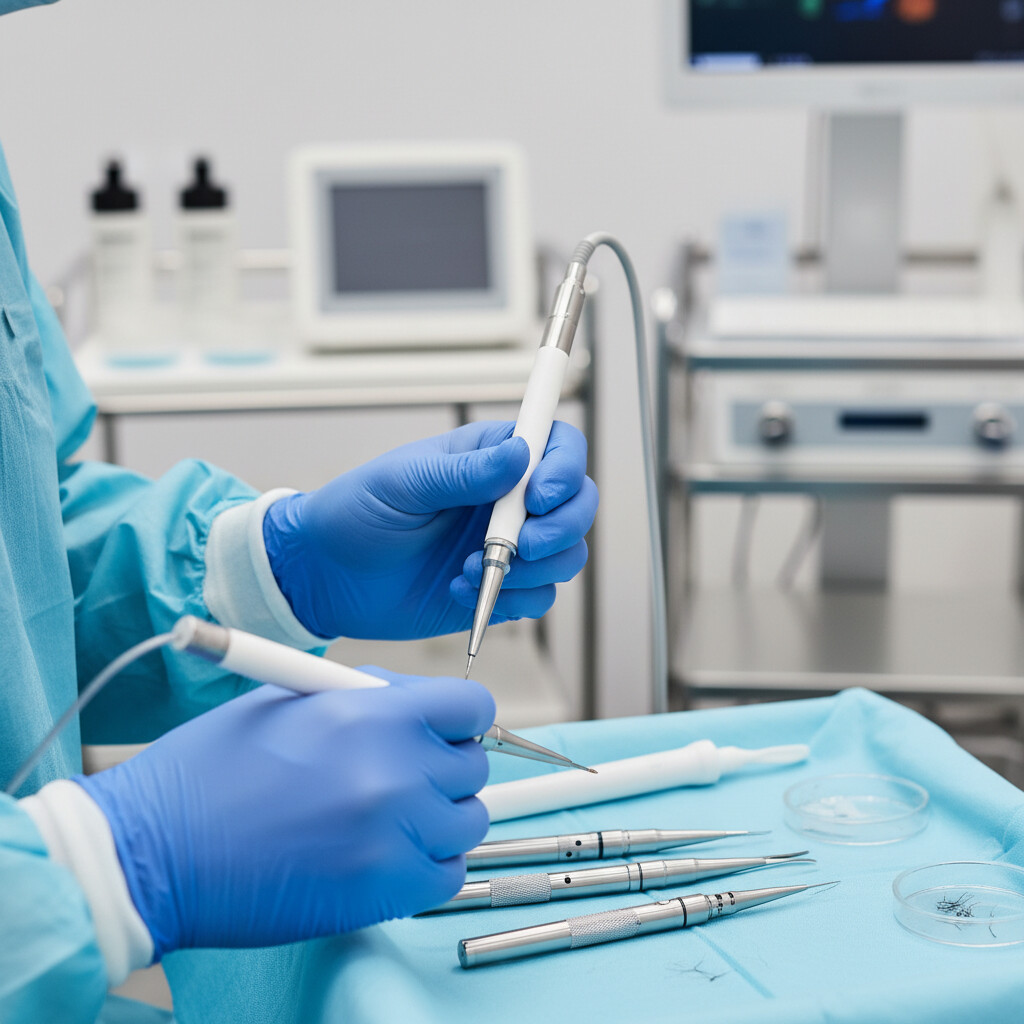
- Recipient sites. Small openings are made in the thinning area with a steel blade, a sapphire blade, a needle or an implanter pen.
- Implantation. Grafts are placed with forceps or loaded into an implanter pen.
A new technique name usually changes one of these steps. Our guide to the FUE method explains the baseline in more detail. Once you know the four steps, it becomes much easier to ask a clinic what they actually do differently.
SDHI: what the name usually means
SDHI is often expanded as “Sequential Direct Hair Implantation” or a similar phrase. There is no agreed medical definition. Clinics that use the name generally describe one or both of the following:
- Working in small batches. Grafts are extracted and implanted in sequence, a few hundred at a time, rather than extracting all grafts first and implanting them hours later. The aim is to shorten the time grafts spend outside the body.
- Direct implantation with a pen. Grafts are loaded into an implanter pen that creates the opening and places the graft in one movement, as in DHI.
What is reasonable: keeping out-of-body time short and handling grafts gently are widely accepted good practice. Implanter pens can help place grafts between existing hairs.
What to be careful about: claims of “higher density”, “faster healing” or “better survival” are rarely backed by independent comparative studies. Many experienced teams achieve short out-of-body times and good density with standard FUE and forceps. A pen-based workflow also tends to be slower and can cost more.
NEO FUE: a marketing name for refined FUE
“NEO FUE” is used by some clinics to describe their own version of FUE. Depending on the clinic, it may refer to:
- a particular punch design or motorised extraction device,
- an unshaven or partially shaven approach,
- a specific storage solution for grafts,
- or a “no-touch” style of handling where grafts are held by the surrounding tissue rather than the bulb.
All of these can be sensible. None is unique to a single method, and many are simply part of how careful FUE teams already work. The difference between manual and motorised FUE is a good example: both can give excellent results in skilled hands, and both can damage grafts in inexperienced hands.
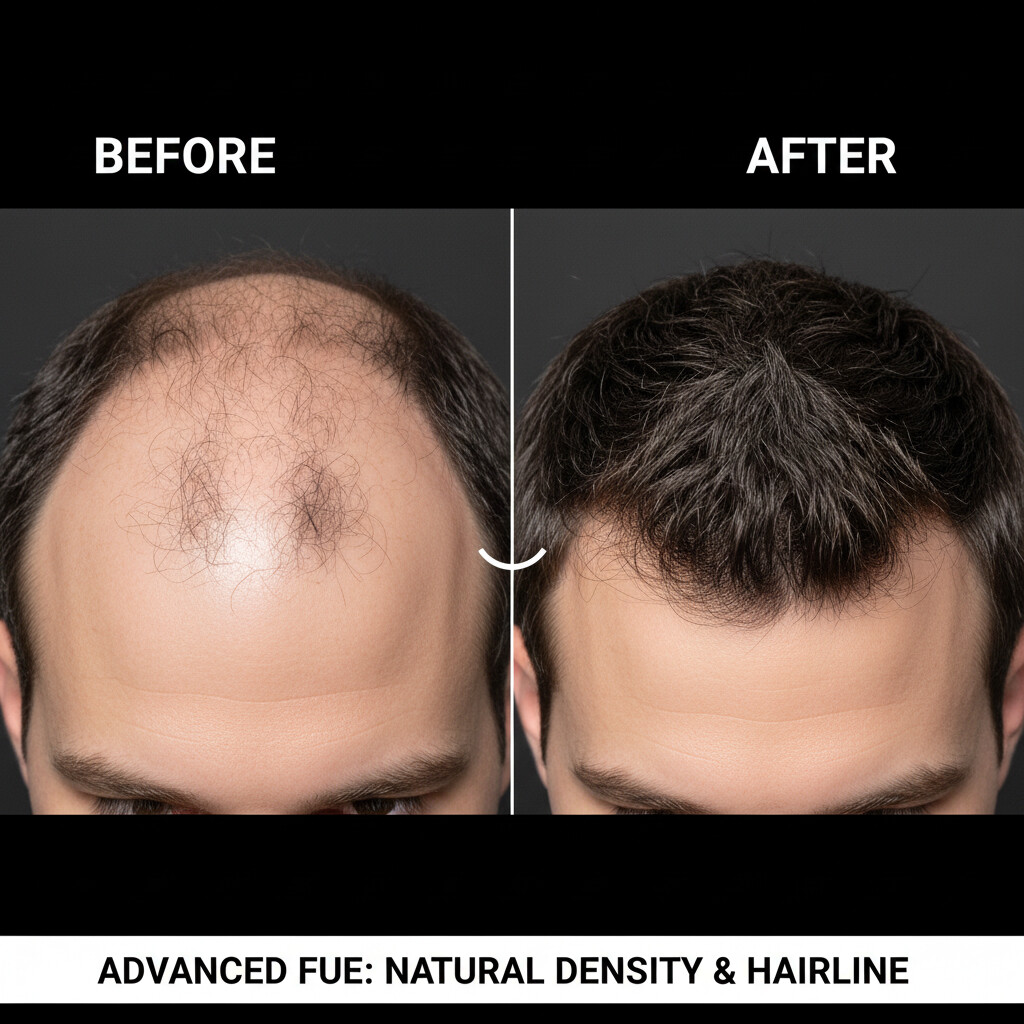
If a clinic promotes NEO FUE, ask it to list, step by step, what it does differently from its standard FUE, and whether that affects price.
Robotic hair transplantation
Robotic FUE is the most genuinely different technology of the three. A robotic system uses cameras and image analysis to identify follicular units in the donor area and guide a punch to extract them. Some systems can also help create recipient sites. For more detail, see Robotic Hair Transplant: Is the Future Already Here?
Possible advantages:
- Consistent punch alignment during extraction, which can help in long sessions.
- Less physical strain on the operator during repetitive extraction work.
- Spreading extraction sites evenly across the donor area.
Limitations:
- The system works best with dark, straight hair. Very curly, Afro-textured, grey or very light hair can be harder for it to read.
- Extraction patterns and punch sizes are set by the system and operator. A skilled manual surgeon can adapt more flexibly to difficult donor areas.
- Implantation and hairline design are still done or directed by people.
- Equipment costs are high, and robotic procedures are usually more expensive and less widely available.

A robot is a tool. It does not replace the surgeon’s judgement about how many grafts to take, where to put the hairline, or how to plan for future hair loss.
Other names you will see
Hair transplant marketing produces new names regularly. The most common are:
- Sapphire FUE. Recipient sites are made with sapphire blades instead of steel. Some surgeons like the sharpness and consistency; there is no strong evidence that growth is better. See our Sapphire FUE guide.
- DHI or Choi pen. Implantation with a pen-like device. Useful in some situations, slower in others.
- Unshaven FUE. Harvesting and implanting without a full shave. Discreet, but slower and often limited in graft numbers.
- Afro FUE. Adapted extraction for curly hair, where follicles curve under the skin and need careful punch technique.
Our article Are New Hair Transplant Techniques Truly Better or Just Marketing? looks at this pattern in general.
What actually drives results
Independent of the technique name, these factors have the most influence on how your transplant turns out:
- Surgeon involvement. Who designs the hairline, who makes the recipient sites, and who supervises the technicians.
- Graft quality. Low transection (cutting through follicles during extraction), gentle handling and keeping grafts hydrated and cool.
- Out-of-body time. Shorter is generally better, whatever the workflow.
- Design. Correct angle, direction and spacing of recipient sites, and a hairline that suits your age.
- Donor management. Taking a safe number of grafts and spreading extractions evenly to avoid a thinned donor area.
- Realistic planning. Accounting for future hair loss, with medical treatment where appropriate.
Questions to ask a clinic about its technique
- What exactly does your technique name mean, step by step, compared with standard FUE?
- Which tool is used for extraction, and who performs it?
- Which tool makes the recipient sites, and who makes them?
- How long are grafts typically outside the body, and how are they stored?
- Is there any independent evidence for the benefits you describe, or is it based on your own experience?
- Does the technique change the price, and why?
- Can I see results at 12 months or later from patients with hair and hair loss like mine?
A clinic that answers clearly, without leaning on the brand name, is usually a better sign than one that promises the “latest” method.
Common questions
Is SDHI better than FUE?
SDHI is a form of FUE. Some of its principles, such as short out-of-body time, are good practice, but there is no solid evidence that the SDHI label itself produces better growth.
Is a robotic transplant more precise than a manual one?
It can be very consistent during extraction, but it is not automatically better. Results still depend on the team and the plan, and robotic systems are less suited to some hair types.
Should I pay more for an advanced technique?
Only if you understand what you are paying for and it makes sense for your case. A higher price for a name alone does not buy better results.
Discussion
Did a clinic offer you a branded technique such as SDHI, NEO FUE or robotic FUE? What did they tell you when you asked what was actually different, and did it affect your choice? If you had one of these procedures, share how your result looked at 12 months.
Sources
- A comprehensive review of evolution of advanced follicular unit excision systems, Journal of Cutaneous and Aesthetic Surgery, 2025
- FUE Instruments and Their Use, ISHRS
Related guides
- Choi Pen vs Sapphire FUE: What Is the Real Difference?
- Afro Hair Transplant: What Is Different for Afro-Textured Hair?
- Does Hair Transplant Technique Affect Long-Term Density?
- Unshaven Hair Transplant: Who Is a Good Candidate?
- How to Choose a Hair Transplant Surgeon: 7 Key Tips
About this guide: ForumHairTransplant.com is an independent patient community. We are not affiliated with any clinic or surgeon, and we don’t accept payment for rankings, reviews or recommendations. This article is general information, not medical advice. Talk to a qualified doctor about your own situation.