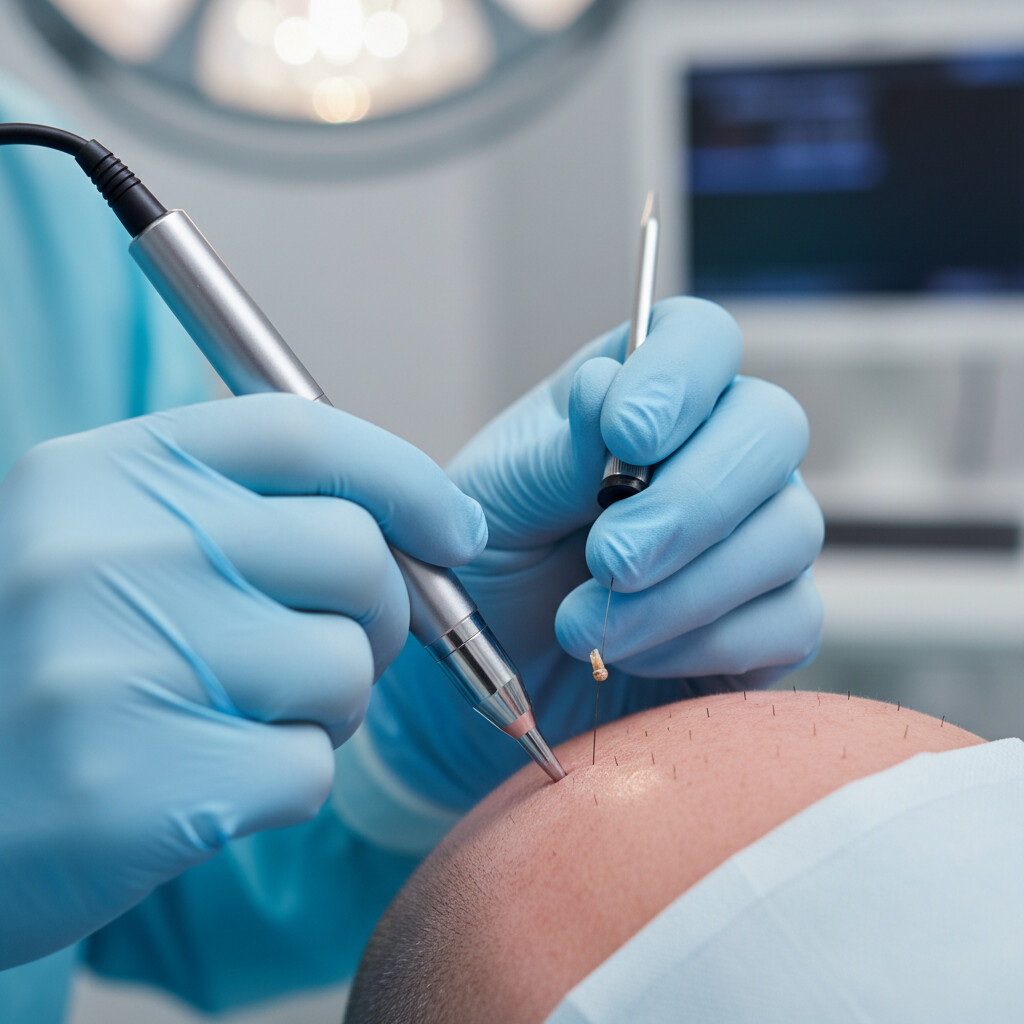
DHI (Direct Hair Implantation) is a variation of FUE. The grafts are removed from the donor area in exactly the same way as in FUE. The difference is in how they are placed: instead of opening all the recipient sites first and then inserting grafts with forceps, the surgical team uses an implanter pen that creates the opening and places the graft in one movement. This guide explains how DHI works, what it can and cannot do better than standard FUE, and what recovery looks like.
Key takeaways
- DHI is not “simultaneous extraction and implantation”. Grafts are extracted first with an FUE punch, then loaded into implanter pens and implanted.
- The main practical advantages are fine control over angle and depth, and the ability to place grafts between existing hairs without pre-made channels.
- There is no strong evidence that DHI gives higher graft survival or better long-term density than well-performed FUE. The skill of the team matters more than the name of the technique.
- DHI is usually slower and often more expensive, and some clinics limit session size because of this.
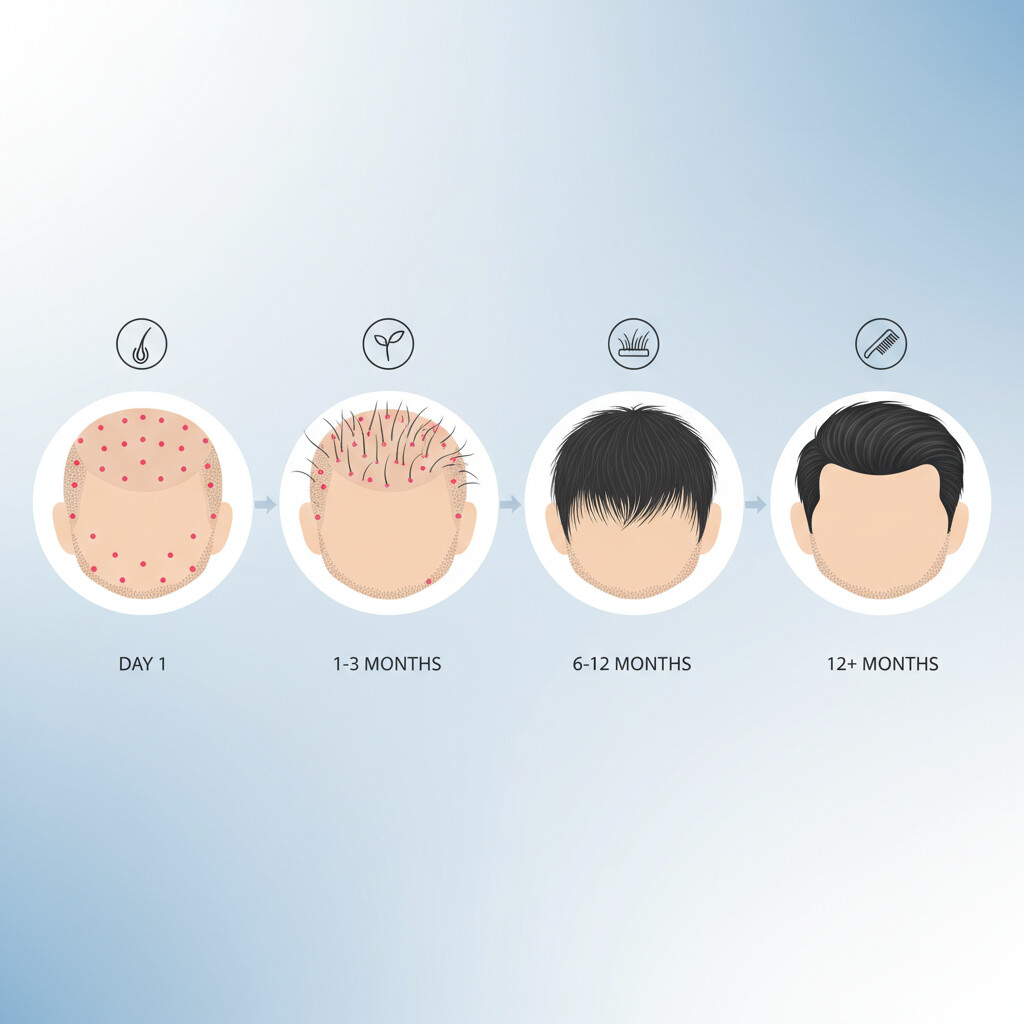
- Recovery and the growth timeline are essentially the same as for FUE: shedding of transplanted hairs in the first weeks, new growth from around months 3-4, and a final result at around 12-18 months.
What is DHI?
Every modern hair transplant has two stages: taking grafts from the donor area (usually the back and sides of the scalp) and placing them in the thinning area. In DHI, the first stage is standard FUE extraction: a small round punch, usually under 1 mm wide, is used to remove individual follicular units of 1-4 hairs.
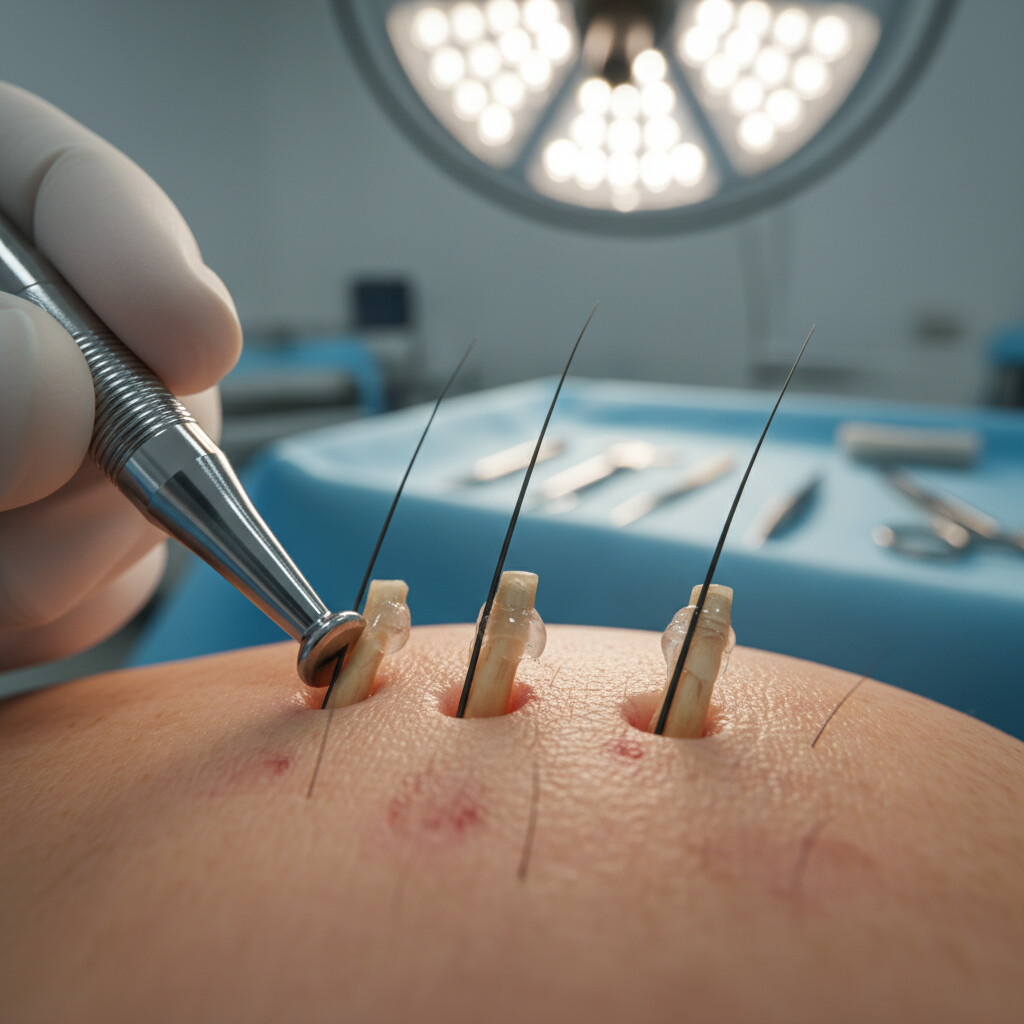
The second stage is where DHI differs. Each graft is loaded into the hollow needle of an implanter pen. The pen tip is pushed into the scalp at the chosen angle and depth, and a plunger releases the graft into the opening the needle has just made. The best-known version of this tool is the Choi implanter pen, but several similar designs exist.
Note that “DHI” is used in two ways. Many clinics use it as a general name for implanter-pen implantation, and the term is also used as a brand name by one clinic group. When comparing offers, ask exactly what the clinic means by it.
How a DHI procedure works, step by step
- Consultation and planning. Your hair loss pattern, donor density, hair calibre and likely future loss are assessed. The hairline and graft distribution are drawn on the scalp.
- Anaesthesia. The donor and recipient areas are numbed with local anaesthetic. You stay awake. Some clinics offer light sedation.
- Extraction. The donor area is usually trimmed short, and grafts are removed one by one with a punch, exactly as in FUE.
- Graft sorting and storage. Grafts are checked and sorted by the number of hairs, then kept in a cooled storage solution until use.
- Loading the pens. Assistants load grafts into several pens, usually with needles of different sizes to match single-hair and multi-hair grafts. Having several pens in rotation lets the implanter work continuously.
- Implantation. Each graft is placed with the pen at the planned angle, direction and depth. In some clinics the surgeon does all implantation; in others trained technicians do part of it. It is worth asking who does what.
- Finishing. The areas are cleaned and you receive aftercare instructions and any prescribed medicines.
A typical day lasts most of a working day, depending on graft numbers and the team.
DHI vs. standard FUE
The difference is only in implantation:
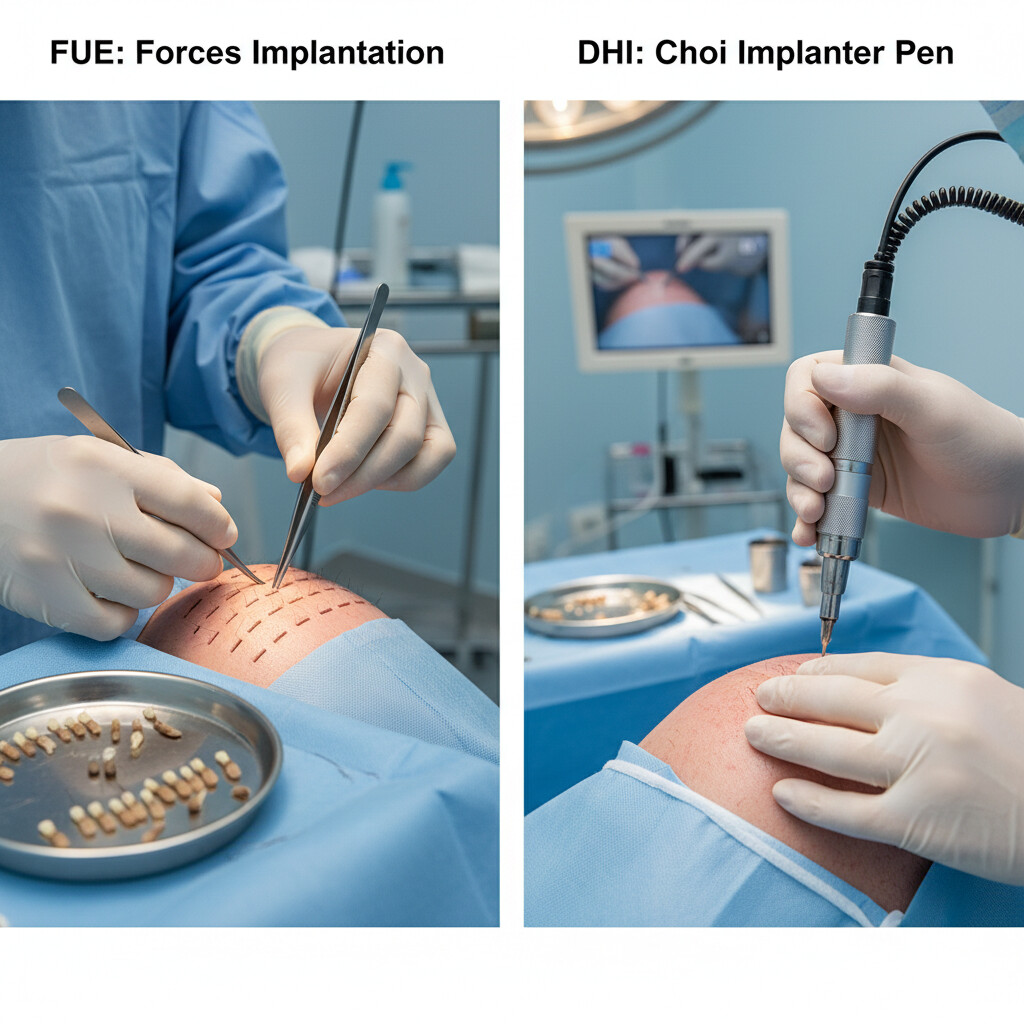
- Standard FUE: after extraction, the surgeon opens all recipient sites (channels) with a fine blade or needle, often sapphire or steel. Grafts are then inserted into these sites with fine forceps.
- DHI: no separate channel-opening stage. The pen needle makes each site at the moment the graft is placed.
Both approaches can give excellent results, and both can go wrong in inexperienced hands. With standard FUE, the surgeon sets the angle, direction and density of every site in advance, which some surgeons prefer because the design is fixed before any graft goes in. With DHI, the angle and depth are set at the moment of implantation. For a side-by-side comparison, see Choi Pen vs. Sapphire FUE.
Real advantages of DHI
- Control over angle and depth. The pen lets the implanter place each graft at a consistent angle, which is useful in the hairline and around the temples.
- Working between existing hairs. Because there are no pre-made channels, grafts can be placed among native hairs with less risk of cutting them. This is why DHI is often used for adding density to thinning (not bald) areas.
- Unshaven recipient area. In suitable cases the recipient area can be left unshaven, although the donor area usually still needs trimming. See who is a good candidate for an unshaven transplant.
- Less direct handling with forceps during placement. Grafts are pushed out of the needle rather than gripped and inserted. This may reduce one source of graft trauma, although grafts are still handled when they are loaded.
Claims to treat with caution
DHI is often marketed with strong claims. Some of them are overstated:
- “Higher graft survival.” Graft survival depends mainly on careful extraction, gentle handling, correct storage and the time grafts spend outside the body. DHI does not automatically shorten that time: grafts still wait in storage and in loaded pens. There is no solid evidence that DHI survival rates are consistently higher than in well-performed FUE.
- “Faster recovery and less bleeding.” The wounds in the recipient area are similar in size to FUE incisions, and the donor area is identical. Some patients and clinics report slightly less bleeding or swelling, but recovery differences are usually small. The number of grafts and your own healing matter more.
- “Higher density.” Density is limited by your donor supply and by how closely grafts can be placed safely, not by the tool. Very dense packing can reduce survival with any method. Read Are New Hair Transplant Techniques Truly Better or Just Marketing? for how to judge claims like these.
- “Scarless.” DHI uses FUE extraction, so the donor area has the same small dot scars. They are usually hard to see with hair of a few millimetres or longer.
Disadvantages and limitations
- Slower. Loading and implanting with pens takes longer than forceps implantation for many teams.
- Session size. Because of the time involved, some clinics cap DHI sessions at a lower number of grafts, or combine DHI in the hairline with standard FUE elsewhere. Practice varies.
- Cost. DHI is often priced higher than standard FUE. Compare what is actually included, not just the label.
- Needs a trained team. Poor pen technique can still give wrong angles, grafts placed too deep or too shallow, or popping.
Who is DHI suitable for?
DHI can be a reasonable choice for:
- hairline and temple work where precise angles matter most,
- adding density to areas that still have native hair,
- patients who want to keep the recipient area unshaven, if the surgeon agrees it is feasible,
- some women with thinning, who often have hair loss spread through existing hair.
It may be a less obvious choice for very large bald areas where the aim is to place a high number of grafts in one day. Whatever the technique, basic suitability still depends on a stable pattern of loss, a good donor area and realistic expectations.
Recovery and growth timeline after DHI
Recovery is essentially the same as after FUE:
- Days 1-3: redness, tenderness and some swelling, which can spread to the forehead. Sleep with your head slightly raised and follow your clinic’s washing routine.
- Days 7-14: the small scabs come off with gentle washing. Many people return to office work within 2-7 days, depending on how visible the redness is.
- Weeks 2-8: most transplanted hairs shed. This is normal and expected: the follicle stays under the skin and grows a new hair later. It is different from shock loss, which is temporary loss of native hairs near the operated areas. Our guide on shedding vs. shock loss explains both.
- Months 3-4: new hairs start to appear, often fine and uneven at first.
- Months 6-9: a clear improvement in coverage. Hairs thicken and lengthen.
- Months 12-18: most people see their final result. The crown often takes longer than the front.
When to contact your surgeon
Contact your surgeon or a local doctor if you notice:
- spreading redness, warmth, pus or a fever,
- pain that gets worse instead of better after the first few days,
- bleeding that does not stop with gentle pressure,
- dark, crusted or unusually painful patches in the recipient area,
- swelling around the eyes that is severe or affects your vision.
Questions to ask a clinic offering DHI
- Is DHI used for the whole area or only the hairline, and why?
- Who extracts the grafts, who loads the pens and who implants?
- What is the maximum number of grafts you would place with DHI in one day, and how long will it take?
- How does the price compare with your standard FUE, and what is the difference in practice for my case?
Common questions
Is DHI better than FUE?
Not in general. DHI is a different way of implanting FUE grafts. It has advantages in some situations, but the experience of the team matters more than the technique name.
Does DHI hurt less?
Pain mainly comes from the local anaesthetic injections and the donor area, which are the same in both methods. Most people describe the procedure as uncomfortable rather than painful once numb.
Can DHI be done without shaving?
Sometimes the recipient area can stay unshaven, but the donor area usually needs at least partial trimming. Your surgeon will tell you what is possible in your case.
Discussion
Did you have DHI, standard FUE, or a combination? Share which technique was used in which area, and how your recovery and growth compared with what you were told before surgery.
Related guides
- Choi Implanter Pen: How It Works in DHI, Pros and Cons
- Choi Pen vs Sapphire FUE: What Is the Real Difference?
- What Is an FUE Hair Transplant? How the FUE Method Works
- Sapphire FUE Hair Transplant: What It Is and Is It Better?
- Hair Transplant Growth Timeline: Month-by-Month Progress
About this guide: ForumHairTransplant.com is an independent patient community. We are not affiliated with any clinic or surgeon, and we don’t accept payment for rankings, reviews or recommendations. This article is general information, not medical advice. Talk to a qualified doctor about your own situation.