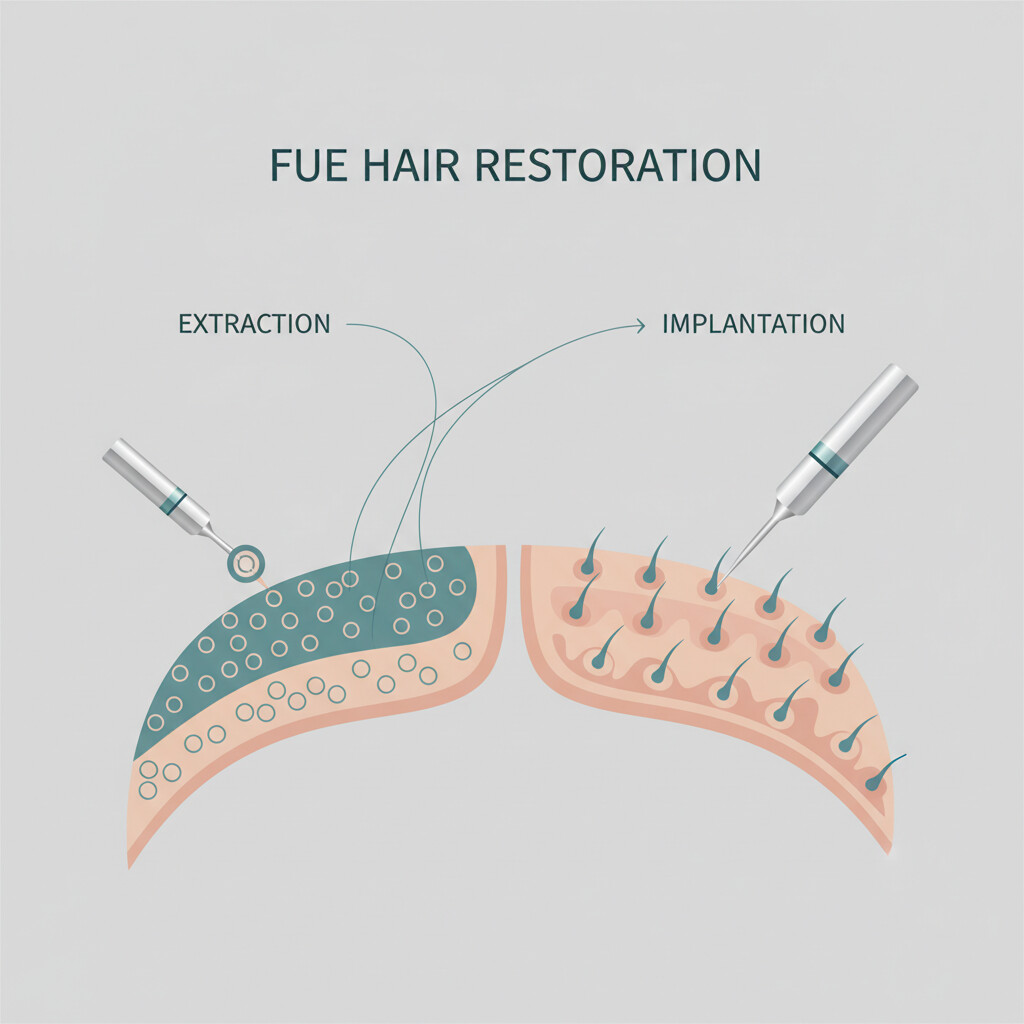
FUE (follicular unit extraction) is a hair transplant method in which individual follicular units, small natural groups of one to four hairs, are removed one by one from the back and sides of the scalp with a tiny round punch and placed into thinning areas. It is the most widely used transplant technique today because it avoids the long linear scar of the older strip method (FUT) and usually allows a quick recovery. It is not scar-free, it does not create new hair, and the result depends far more on the surgeon’s planning and skill than on the name of the technique.
By ForumHairTransplant Editorial Team · Prepared with AI assistance · Sources checked: 19 October 2026
Key takeaways
- FUE moves existing hair from a DHT-resistant donor area to thinning areas. It redistributes hair; it does not increase the total number of follicles you have.
- Each extraction leaves a tiny round scar. These are usually hard to see, but they can show with a very short buzz cut, especially if too many grafts were taken from one area.
- Your donor area is a limited, lifetime supply. How many grafts can be taken safely is decided by donor density, hair calibre and scalp size.
- “Sapphire”, “DHI”, “manual” and “motorized” are variations of steps within FUE. None of them guarantees a better result.
- Transplanted hairs usually shed in weeks 2-8. New growth tends to start around months 3-4, and the final result takes about 12-18 months.
How FUE works
Every hair transplant has the same three basic steps: removing grafts from the donor area, making small openings (recipient sites) in the thinning area, and placing the grafts into those openings. FUE describes how the grafts are removed.
In FUE, the surgeon or a trained technician uses a small hollow punch to cut around each follicular unit and free it from the surrounding skin. The graft is then gently pulled out and kept in a cooled storage solution until it is implanted. In the older FUT method, a strip of skin is removed from the back of the head and divided into grafts under a microscope, leaving a linear scar. Our guide on FUE vs. FUT compares the two in detail.
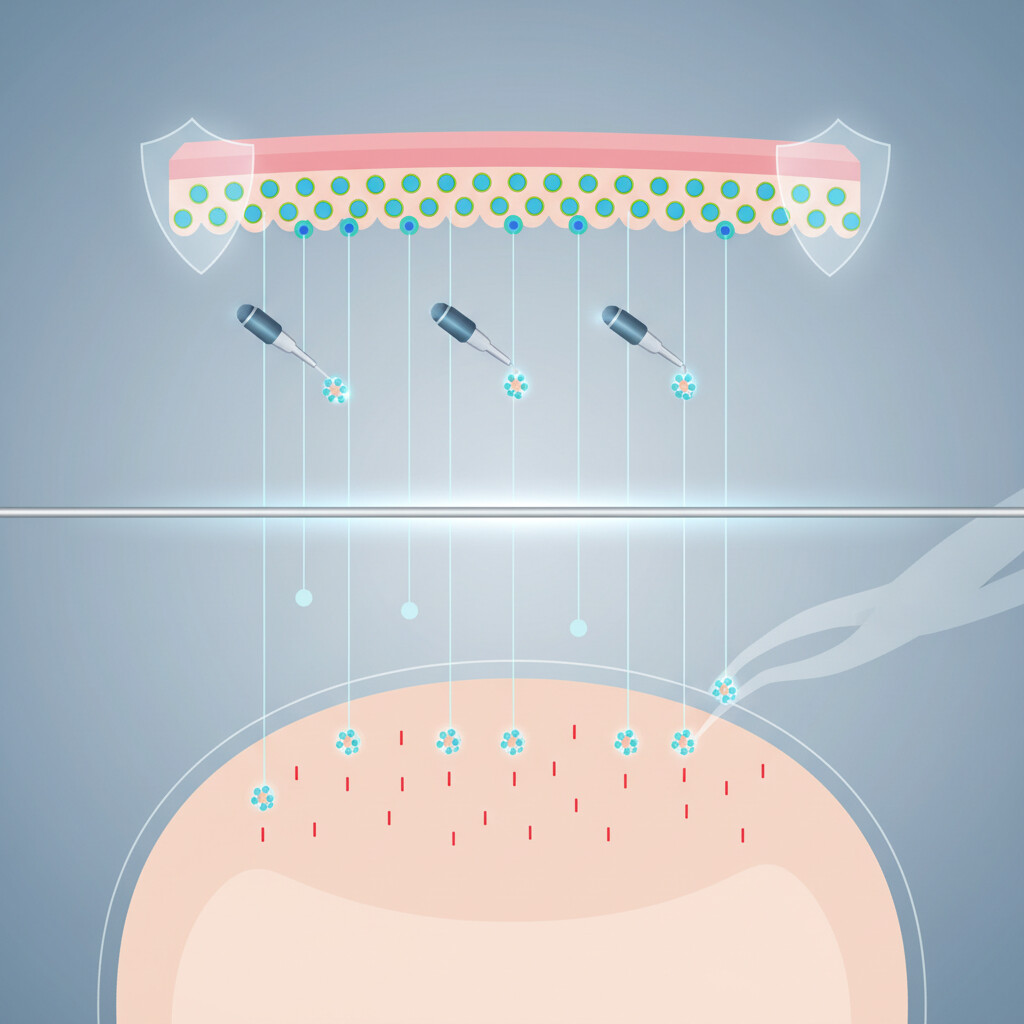
An illustration showing the FUE hair transplantation process, highlighting individual follicle extraction and implantation.
The donor area works because hair on the back and sides of the scalp is genetically less sensitive to DHT, the hormone behind pattern baldness. Transplanted follicles keep this resistance in their new position, which is why the result is generally long-lasting.
The FUE procedure step by step
- Consultation and planning. The surgeon assesses your hair loss pattern, donor density, hair calibre and likely future loss, and agrees a hairline and graft plan with you.
- Preparation. The donor area is usually shaved short. The hairline is marked, and the areas are numbed with local anaesthetic injections. You stay awake. Some clinics also offer mild sedation.
- Extraction. Grafts are removed one by one with a punch. This is usually the longest part of the day.
- Recipient site creation. Small incisions are made in the thinning area. Their angle, direction and spacing largely decide how natural the result looks.
- Implantation. Grafts are placed into the incisions with fine forceps, or loaded into an implanter pen in the DHI variation.
- Aftercare instructions. The areas are cleaned, sometimes a dressing is applied to the donor area, and you receive instructions and medication for the first days.
A typical session lasts most of a day, depending on the number of grafts and the team’s working style.
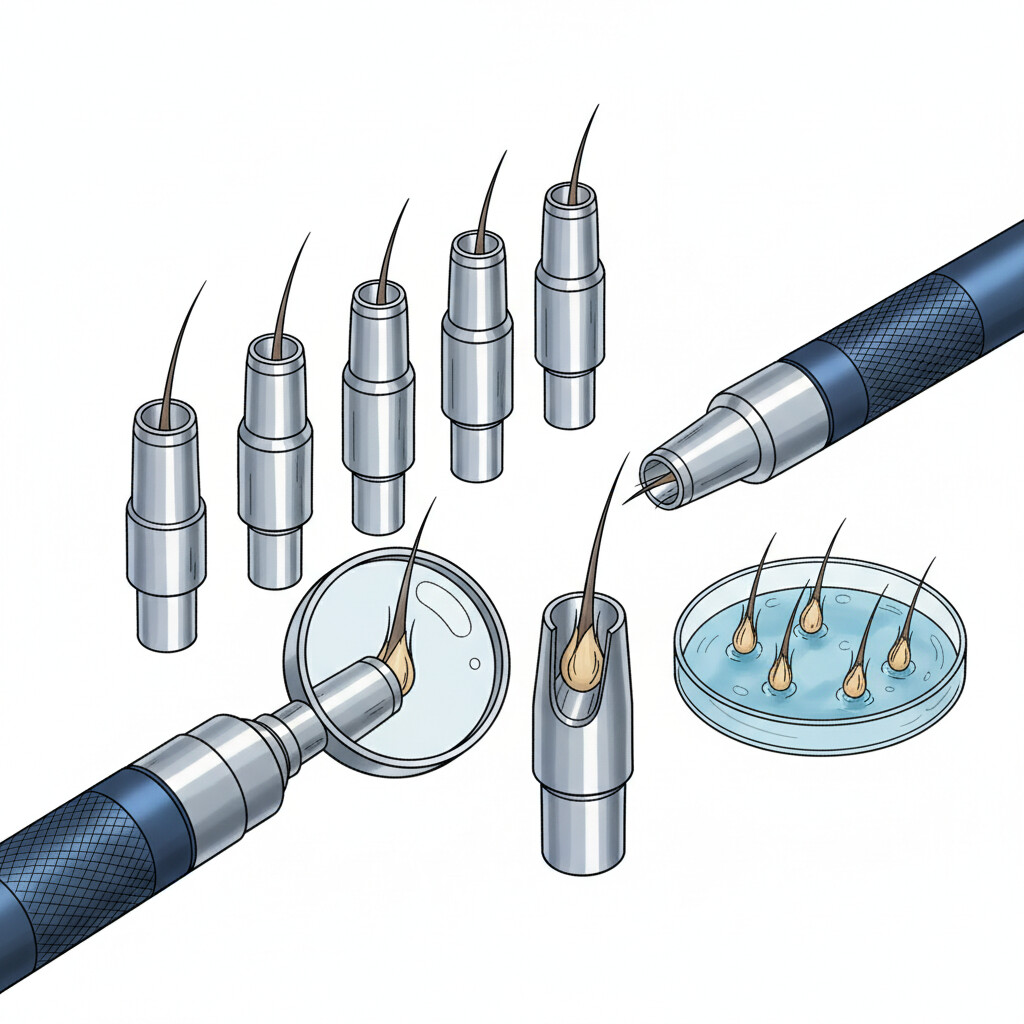
Close-up view of micro-punches used for extracting follicular units in FUE hair transplantation.
Punch size and extraction tools
FUE punches are very small, commonly somewhere around 0.7 to 1.0 mm in diameter. The right size depends on your hair: thick or curly hair and multi-hair grafts may need a slightly larger punch to avoid damaging the follicle, while fine, straight hair may allow a smaller one.
- Smaller punches leave smaller scars but can increase the risk of cutting through the follicle (called transection) if the hair curves under the skin.
- Larger punches can reduce transection but leave slightly bigger dots.
The punch can be turned by hand (manual FUE) or by a small motor (motorized FUE). Both are widely used, and each has trade-offs in speed, control and transection risk. Our guide to manual vs. motorized FUE explains the differences. In practice, the experience and care of the person holding the tool matter more than the tool itself.
Sapphire blades, steel blades and DHI
Many clinics market FUE under names that describe a single step:
- Sapphire FUE uses sapphire blades instead of steel blades to create the recipient sites. Some surgeons prefer them; others achieve the same results with fine steel blades or needles. Read our guide to sapphire FUE for a balanced view.
- DHI uses an implanter pen to place the grafts, often making the incision and placing the graft in one movement. Extraction is still done by FUE. See our guide to the DHI technique.
These can be good choices in the right hands. But a new name on a package does not change the basics: careful extraction, sensible graft numbers, natural angles and good graft handling.
Shaven vs. unshaven FUE
Standard FUE involves shaving the donor area, and often the recipient area, so the team can see each hair clearly. Unshaven or partially shaven FUE is possible for some patients. It can make the procedure easier to hide, but it is usually slower, is typically limited to smaller sessions, and is not suitable for everyone. Our guide on who is a good candidate for an unshaven hair transplant goes through the trade-offs.
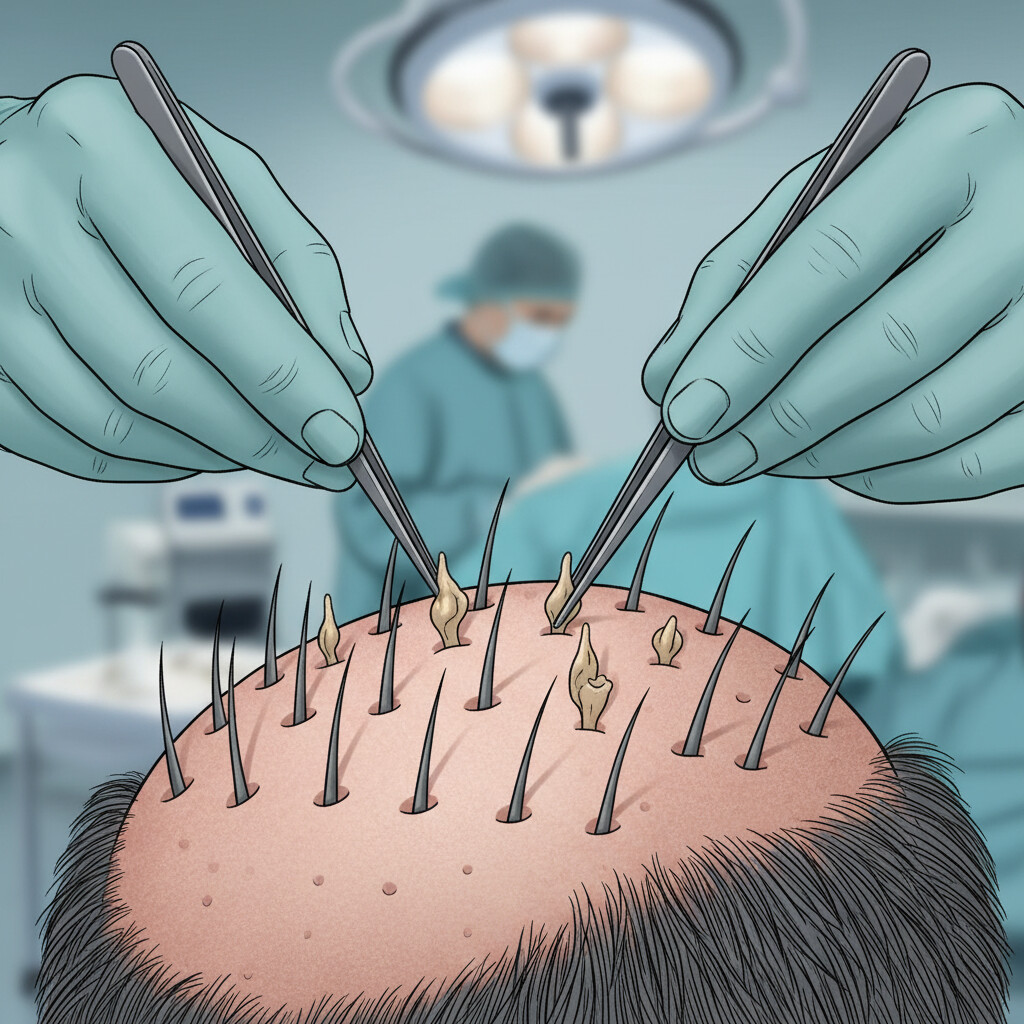
Surgeon carefully implanting extracted follicular units into the recipient area during an FUE procedure.
Who is a good candidate for FUE?
FUE is usually considered for people who:
- Have pattern hair loss (androgenetic alopecia) that has been diagnosed and is reasonably stable.
- Have a donor area with enough density and good hair calibre for the planned work.
- Want to keep the option of wearing their hair short at the back.
- Understand that they may continue to lose native hair and may need medication or a later session.
- Have realistic expectations about density.
FUE may not be the right choice, or may need to wait, for people with very young or rapidly progressing hair loss, a weak donor area, diffuse unpatterned thinning, active scalp conditions, or some medical problems. In some cases where a very large number of grafts is needed, FUT or a combination of methods may make better use of the donor area.
The donor area: FUE’s real limit
The biggest limitation of FUE is not the technique but the donor supply. Every graft removed is a follicle that does not grow back in the donor area. Taking too many, or taking them too close together, can leave the back of the head visibly thin or patchy. This is called overharvesting, and it is difficult to repair.
A careful surgeon spreads extractions evenly across the safe donor zone, stays within what your density allows, and keeps a reserve for the future. Be cautious of offers that promise very large graft numbers without a proper look at your donor area.
Scarring: small, but not zero
FUE leaves many tiny round scars rather than one line. At normal hair lengths they are usually hidden. With a very short clipper cut, some people can see small white dots, particularly on dark hair or where the donor area has been thinned by overharvesting. How visible they are depends on punch size, healing, skin type and extraction density. Our guide on FUE scars covers this in more depth.
Recovery and growth timeline
- Days 1-3: tenderness, some redness, and sometimes swelling on the forehead. Follow your clinic’s washing and sleeping instructions.
- Days 7-14: scabs usually clear with gentle washing. The donor area typically looks healed within one to two weeks.
- Weeks 2-8: most transplanted hairs shed. This is expected. Some people also get temporary shock loss of native hairs near the operated areas, which usually recovers.
- Months 3-4: new hairs start to appear, often fine at first.
- Months 6-12: density and thickness build up.
- Months 12-18: final result, with the crown often taking longer.
Most people with desk jobs return to work within a few days to a week, while strenuous exercise usually waits for longer, depending on the surgeon’s advice.
Risks and limitations
Serious complications after FUE are uncommon, but you should know the realistic risks:
- Infection, prolonged redness or folliculitis (inflamed hair follicles).
- Temporary numbness in the donor or recipient areas.
- Poor growth if grafts are damaged, dried out or handled badly.
- Unnatural hairlines or angles from poor planning.
- Donor overharvesting and visible scarring.
- Continued loss of native hair around the transplant.
Common questions
Is FUE better than FUT?
Neither is better for everyone. FUE avoids a linear scar and usually heals faster. FUT can yield many grafts in one session with little damage to the follicles. Many surgeons use FUE for most patients and consider FUT or a combination for some cases.
Does FUE leave no scars?
No. It leaves small dot scars that are usually hard to see but can show with very short hair.
Is FUE permanent?
The transplanted hair is generally long-lasting because it comes from a DHT-resistant area. The native hair around it can still thin over time.
Discussion
If you have had FUE, what punch size, tools or method did your clinic use, and how does your donor area look now at a short length? Photos of your healed donor area are especially useful for people researching FUE.
Sources
- FUE Hair Transplant: Benefits, Process & Recovery, ISHRS
- Is FUE Scarless?, ISHRS
- Controversies in Hair Transplantation, Journal of Cutaneous and Aesthetic Surgery, 2017
- FUE Instruments and Their Use, ISHRS
Related guides
- FUE vs FUT Hair Transplant: Differences, Scarring and Which to Choose
- Manual vs Motorized FUE: What Is the Difference?
- Unshaven Hair Transplant: Who Is a Good Candidate?
- Donor Area Overharvesting: Signs, Risks and How to Avoid It
- Hair Transplant Growth Timeline: Month-by-Month Progress
- Hair Transplant Stages: Before, During and After Surgery
- What Is a Hair Transplant? How It Works, Results and Limits
About this guide: ForumHairTransplant.com is an independent patient community. We are not affiliated with any clinic or surgeon, and we don’t accept payment for rankings, reviews or recommendations. This article is general information, not medical advice. Talk to a qualified doctor about your own situation.