By ForumHairTransplant Editorial Team · Prepared with AI assistance · Sources checked: 19 October 2026
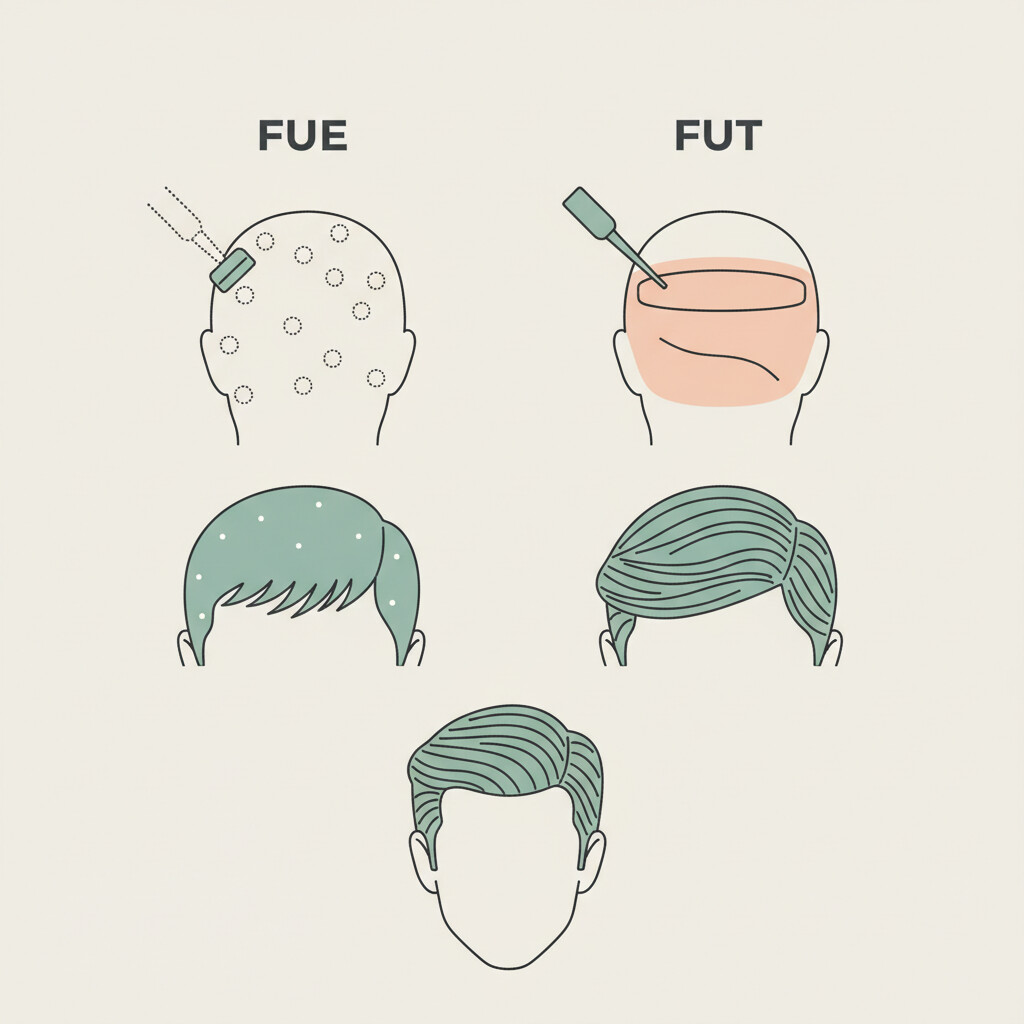
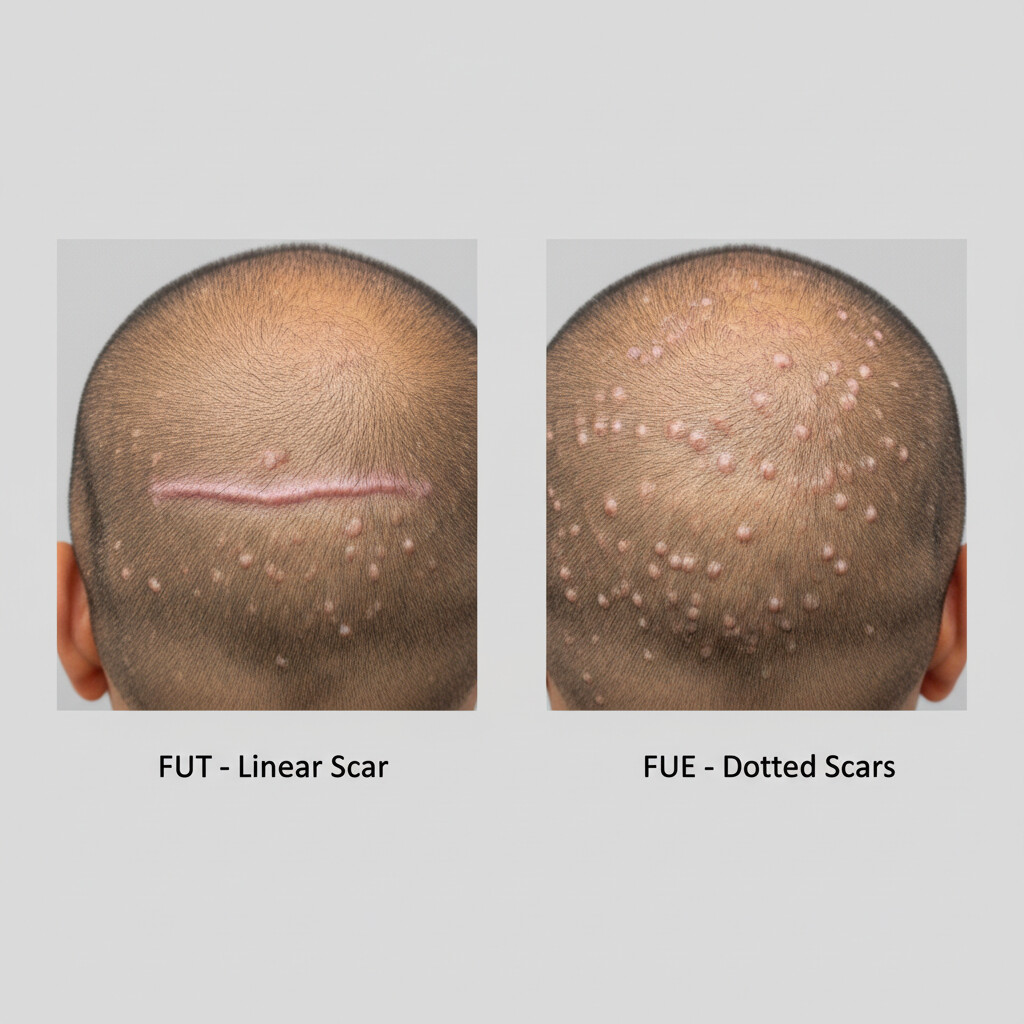
FUE and FUT are the two ways of taking grafts from the donor area. FUT removes a thin strip of scalp and leaves one linear scar; FUE removes grafts one by one and leaves many small dot scars spread across the back and sides. FUE is now the more common choice, mainly because there is no linear scar, recovery in the donor area is usually easier, and short haircuts are more realistic. That does not make FUT obsolete: for some patients it is still a sensible option, and both methods can give good results in skilled hands.
Key takeaways
- The difference between FUE and FUT is how grafts are harvested. Implantation into the recipient area is similar for both.
- Both methods leave scars. FUT leaves one line; FUE leaves many tiny dots that are usually easy to hide but can show with very short clippers or after overharvesting.
- FUE is preferred by most patients today for shorter hairstyles and a more comfortable donor recovery.
- FUT can still suit some patients, for example those who always wear their hair longer or who want to preserve the donor area for a later FUE session.
- Surgeon skill and planning matter more than the name of the technique.
How FUT (strip surgery) works
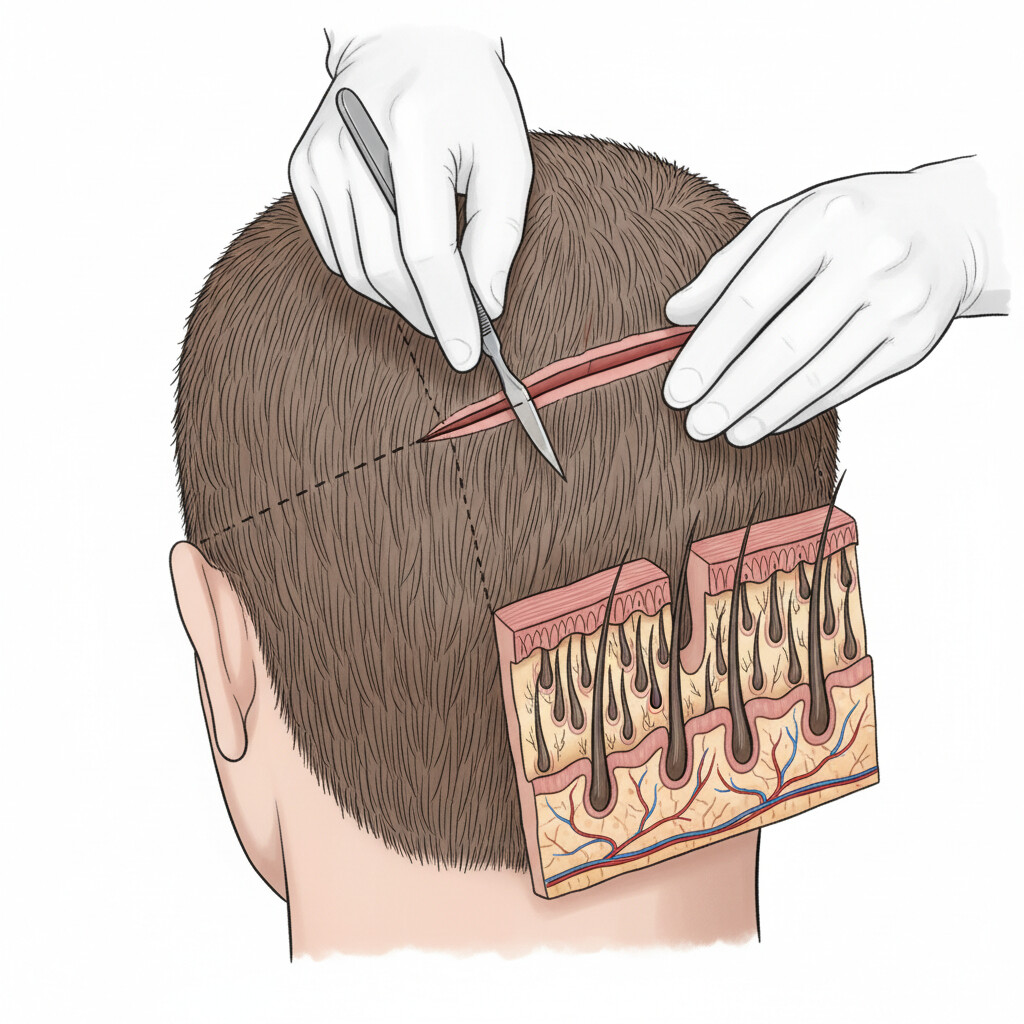
In FUT, the surgeon removes a thin strip of skin with hair from the back of the head, from the area where hair is most resistant to pattern baldness. The wound is stitched or stapled closed. The strip is then divided under microscopes into follicular units, the natural groups of 1-4 hairs, which are placed into small incisions in the thinning area.
Advantages of FUT:
- Grafts are cut from the strip under magnification, so they tend to be well-protected and intact.
- A large number of grafts can be taken in one session without touching the rest of the donor area.
- The area around the scar is left untouched, which can be useful if FUE is planned later.
- It does not require the donor area to be shaved.
Disadvantages of FUT:
- A permanent linear scar. It can be a fine line or can stretch and become wider, depending on healing, scalp tension and surgical skill. It is usually hidden by hair of moderate length but can show with a very short cut.
- More discomfort and tightness in the donor area in the first weeks, plus stitches or staples that need to be removed or dissolve.
- Some patients have longer-lasting numbness or tightness around the scar.
How FUE works
In FUE, each follicular unit is removed individually with a tiny round punch, usually about 1 mm or less in diameter. The punch can be manual or motorised; our guide to manual vs. motorized FUE explains the differences. The small wounds are left to heal on their own, with no stitches. For a full explanation, see What Is an FUE Hair Transplant?
Advantages of FUE:
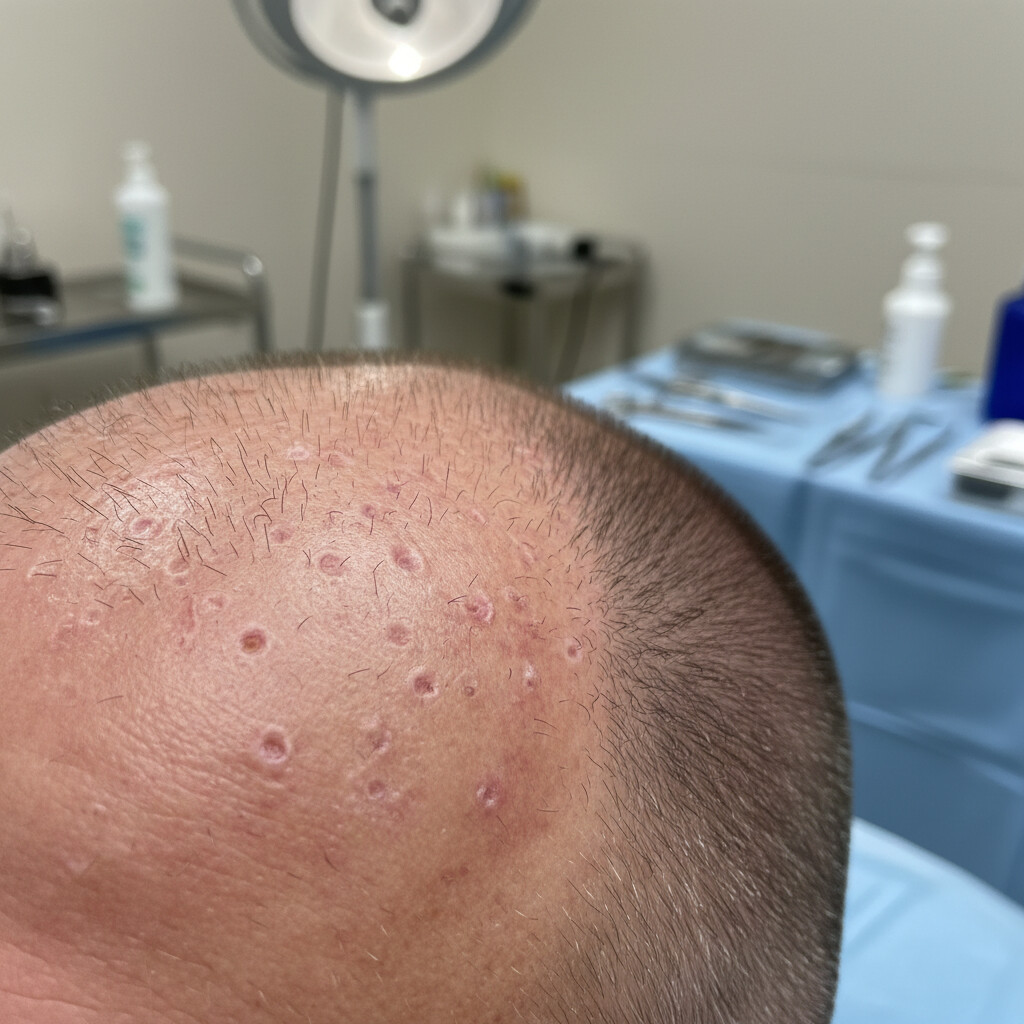
- No linear scar. The scars are small dots spread across the donor area. With good technique they are usually hard to see with most short haircuts.
- Easier donor recovery. Most patients find the donor area less painful and less tight than after strip surgery. Most people return to desk work within about a week.
- Flexibility. Grafts can be selected one by one, and in suitable cases beard or body hair can be used as an extra source. Body hair is less predictable, as explained in Can Beard or Body Hair Be Used for a Hair Transplant?
Disadvantages of FUE:
- Overharvesting risk. Because grafts are taken across a wide area, taking too many or taking them too close together can leave the donor area visibly thin or patchy.
- Transection. Grafts are cut “blind” beneath the skin surface, so some follicles can be damaged during extraction. The rate depends heavily on the surgeon and team.
- Shaving. The donor area is usually shaved short. Unshaven or partly shaven FUE is possible in some cases but is slower and suits smaller sessions.
- Dot scars are still scars. They can show as small white spots with a very close shave, especially in people with darker hair and lighter skin.
Why FUE is the more common choice today
Several factors explain the shift towards FUE:
- Hairstyle freedom. Many men want to keep the option of short hair. FUT scars usually need some length on top of them; FUE scars generally do not.
- Donor recovery. No stitches, less tightness and less pain in the donor area appeal to most patients.
- Market and training. Many clinics, especially in popular destinations for medical travel, now offer only FUE. This is partly patient demand and partly because FUE fits a high-volume model. It is not proof that FUE gives better growth.
- Better tools. Improved punches and motors have made FUE more efficient. Variations such as sapphire blades for the recipient sites affect the implantation side, not the extraction method.
What FUE does not do is create more donor hair. Both methods draw from the same limited supply. How many grafts you can safely take over a lifetime depends on your donor density and scalp, not on the letters in the name of the procedure. Over-aggressive FUE can use up and thin the donor area as surely as repeated strips.
FUE vs. FUT at a glance
| FUE | FUT | |
|---|---|---|
| Harvesting | Individual grafts with a small punch | Strip of scalp, divided under microscope |
| Donor scar | Many small dot scars | One linear scar |
| Short haircuts | Usually possible | Scar may show with very short hair |
| Donor recovery | Usually quicker, no stitches | More tightness, stitches or staples |
| Donor shaving | Usually required | Not required |
| Main risk in donor area | Overharvesting, visible thinning | Wide or stretched scar |
Who might still consider FUT?
FUT is less common but still has a place. Some surgeons may suggest it if you:
- Always wear your hair at a medium length or longer and do not mind a hidden line.
- Have good scalp laxity (a loose scalp), which helps the wound close with less tension.
- Expect to need several sessions over your lifetime. Some surgeons combine FUT first and FUE later to get the most out of the donor area.
- Have had a previous FUT scar that can be removed as part of a new strip.
Patients who already have an FUT scar can often have further grafts taken by FUE, and FUE grafts can sometimes be placed into the scar itself to make it less visible.
Questions to ask at your consultation
- Which method do you recommend for me, and why?
- How many grafts do you plan to take now, and how many would remain for the future?
- Who performs the extractions or the strip removal?
- How will my donor area look with the haircut I usually wear?
If a clinic only offers one method, that is not necessarily a problem, but it is worth asking whether their recommendation fits your case or their business.
Common questions
Is FUE scarless?
No. Every extraction leaves a tiny scar. With good technique and a sensible number of grafts, they are usually hard to notice, but they are there. Read more in our guide to hair transplant scars.
Does FUE give better growth than FUT?
Not reliably. Growth depends mainly on surgeon skill, graft handling and planning. Both methods can produce excellent or poor results.
Is recovery for the recipient area different?
Not much. Scabs, redness and the normal shedding of transplanted hairs (roughly weeks 2-8) happen after both methods.
Discussion
Have you had FUE, FUT or both? Share how your donor area healed and what haircut you can wear now. If you chose FUT recently, tell us what made you decide on it.
Sources
- Comparison Between Strip Harvesting and Follicular Unit Extraction: A Fair and Balanced View, ISHRS
- Controversies in Hair Transplantation, Journal of Cutaneous and Aesthetic Surgery, 2017
- FUE Vs. FUT and Maximizing the Hair Graft Harvest, ISHRS (a single surgeon’s view)
- Is FUE Scarless?, ISHRS
Related guides
- What Is an FUE Hair Transplant? How the FUE Method Works
- Manual vs Motorized FUE: What Is the Difference?
- Sapphire FUE Hair Transplant: What It Is and Is It Better?
- Donor Area Overharvesting: Signs, Risks and How to Avoid It
- Hair Transplant Scars: Understanding FUE and Natural Results
- FUE Hair Transplant
- FUT Method
About this guide: ForumHairTransplant.com is an independent patient community. We are not affiliated with any clinic or surgeon, and we don’t accept payment for rankings, reviews or recommendations. This article is general information, not medical advice. Talk to a qualified doctor about your own situation.