By ForumHairTransplant Editorial Team · Prepared with AI assistance · Sources checked: 19 October 2026
Hair transplants can work for women, but fewer women are good candidates than men. Female hair loss is usually diffuse thinning across the top of the scalp, and the donor area at the back can be affected too, so there is often less stable hair to move. A transplant works best for women with a clear diagnosis, a strong donor area and a defined area to treat, such as a high hairline, traction alopecia or a scar. For many others, medical treatment is the better first step.
Key takeaways
- Get a proper diagnosis first. Shedding from low iron, thyroid problems, stress or hormonal changes needs treatment, not surgery.
- Female pattern hair loss usually thins the top and parting while keeping the frontal hairline. This makes transplants less predictable than in men.
- The donor area must be checked closely. If it is thinning as well, moving hair from it may not help and can make it look thin.
- The clearest cases for surgery are hairline lowering, traction alopecia, stable scars and some stable, well-defined pattern loss.
- Medical treatment is often continued after surgery to protect the native hair around the grafts.
How female hair loss differs from male hair loss
In men, pattern baldness usually follows a predictable path: the hairline recedes and the crown thins, while a stable band of hair remains at the back and sides. In women, the pattern is different:
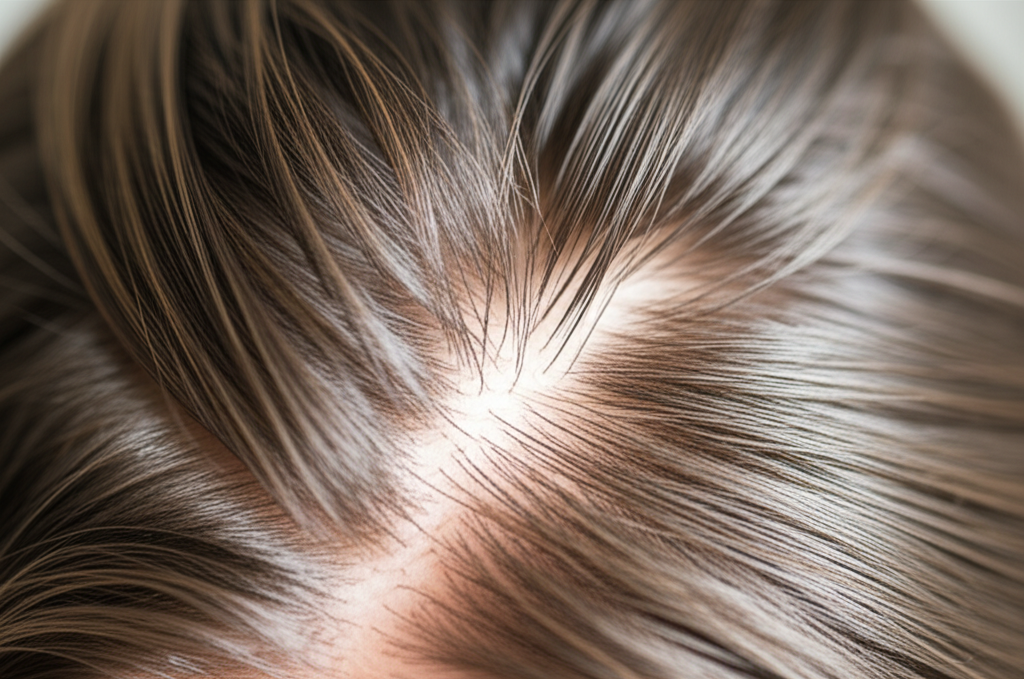
- Diffuse thinning over the top and crown. The parting gets wider and more scalp shows through, but the frontal hairline usually stays in place. This is often graded on the Ludwig scale.
- Miniaturisation spread across the scalp. Hairs become finer rather than disappearing completely in one area.
- A less reliable donor zone. In some women, the back and sides also thin. This is sometimes called diffuse unpatterned hair loss, and it makes transplantation a poor option.

Common causes of hair loss in women
Several causes can look similar, and more than one can be present at the same time:
- Female pattern hair loss (FPHL). The most common cause. It is genetic and influenced by hormones, and often becomes more noticeable around menopause.
- Telogen effluvium. A temporary, diffuse shedding that often starts a few months after a trigger such as childbirth, illness, surgery, crash dieting or major stress. It usually recovers once the trigger is dealt with. See our guide on telogen effluvium.
- Hormonal and medical conditions. Thyroid disease, polycystic ovary syndrome (PCOS) and other causes of raised androgens can contribute.
- Nutritional deficiencies. Low iron stores are a common, treatable factor. Low vitamin D is also often checked.
- Traction alopecia. Loss along the hairline and temples from years of tight braids, weaves, extensions or ponytails.
- Alopecia areata. An autoimmune condition causing patchy loss. Transplants are generally not used while it is active.
- Scarring alopecias. Conditions such as frontal fibrosing alopecia and lichen planopilaris permanently destroy follicles. Transplants are only considered, if at all, after the condition has been inactive for a long time, and results are less predictable.
- Medications. Some drugs can trigger shedding as a side effect.
Why diagnosis comes first
A dermatologist or hair specialist will usually:
- Take a history: when the loss started, family history, pregnancies, menstrual changes, diet, illness, medications and hairstyling habits.
- Examine the scalp, often with a magnifying device (trichoscopy), to look at hair calibre and signs of inflammation or scarring.
- Order blood tests where appropriate, commonly iron stores (ferritin), thyroid function and vitamin D, with hormone tests if there are signs such as irregular periods, acne or excess facial hair.
- Occasionally take a small scalp biopsy if the diagnosis is unclear.
If a treatable cause is found, correcting it can slow or stop the shedding, and some hair may recover. Surgery during active shedding is usually a mistake, because you cannot yet see what is permanent.
Non-surgical treatments
For most women with pattern hair loss, medical treatment is the starting point. Options your doctor may discuss include:
- Topical minoxidil. The most widely used treatment for FPHL. It takes several months to show an effect and needs to be continued to keep the benefit. A temporary increase in shedding in the first weeks is common.
- Low-dose oral minoxidil. Prescribed off-label by some doctors. It needs medical supervision because of possible effects on blood pressure and unwanted facial or body hair.
- Anti-androgen medicines. Spironolactone is sometimes prescribed off-label, particularly where androgens play a role. Finasteride is generally reserved for women who cannot become pregnant. These medicines must not be used during pregnancy and usually require reliable contraception.
- Treating deficiencies. Iron or vitamin D supplements help if a deficiency is confirmed. Taking them without a deficiency is unlikely to help.
- PRP and low-level laser devices. Some women use them alongside standard treatment. The evidence is more limited and results vary.

Many surgeons prefer that a woman with FPHL has tried medical treatment first. It shows how the hair responds, and it helps protect the native hair after surgery.
When a hair transplant can work for women
A transplant tends to give the most predictable results when there is a stable donor area and a clearly defined area to treat:
- Hairline lowering or a naturally high forehead. Some women transplant grafts to bring the hairline forward. In some cases this is done surgically by moving the scalp forward instead.
- Traction alopecia. Once the pulling has stopped and the loss has been stable for some time, lost hair along the hairline and temples can often be restored.
- Scars. Stable scars from facelifts, brow lifts, injuries or burns can be treated, although scar tissue may need more than one session.
- Stable, well-defined pattern loss. Women with thinning at the front or top, a dense donor area and loss that is under control with treatment may benefit from added density.
- Eyebrows. Eyebrow transplants are a separate procedure with their own planning.
It is usually not suitable for women with diffuse thinning that includes the donor area, active shedding, active alopecia areata or an active scarring alopecia.
How the procedure differs for women

- Donor assessment is stricter. The surgeon checks density and hair calibre across the back and sides, and whether that area is also miniaturising. Taking too much can leave the donor zone visibly thin. See Understanding Overharvesting in Hair Restoration.
- Harvesting method. FUE leaves small dot scars. Many women prefer to avoid a full shave, so some clinics offer partial-shave or unshaven FUE, which usually takes longer and may limit the number of grafts. FUT leaves a linear scar that is often well hidden under longer hair and does not require shaving. Both are used; the right choice depends on your hair and donor area. See FUE vs. FUT.
- Grafts go between existing hairs. The aim is usually to add density rather than build a new hairline. The surgeon has to make recipient sites without damaging the native hairs around them.
- Graft numbers are often modest. Covering thinning areas needs careful distribution, not the largest possible session.
Recovery and what to expect
Recovery is broadly similar to men’s, with a few points women often ask about:
- Normal shedding of transplanted hairs. Most transplanted hairs fall out between weeks 2 and 8. This is expected; the follicles remain and regrow.
- Shock loss. Because grafts are placed among existing hair, some women notice temporary shedding of native hairs near the operated area. It usually grows back over a few months, but it can make the scalp look thinner for a while before it improves. Our guide on shock loss vs. normal shedding explains the difference.
- Growth timeline. New hair usually appears around months 3-4, with the final result at about 12-18 months.
- Ongoing treatment. Surgery does not stop FPHL. Many surgeons recommend continuing medical treatment to keep the native hair, and a later session may be needed.
- Hair colouring and styling. Chemical treatments are usually postponed for several weeks. Ask your surgeon for a specific timeline.
When to contact your surgeon or doctor
- Before surgery: if you notice sudden, heavy shedding, patchy loss, or a scalp that is itchy, burning or inflamed, see a doctor first. These can signal a condition that needs diagnosis.
- After surgery: contact your surgeon if you have increasing pain, spreading redness, pus, fever, or bleeding that does not stop with gentle pressure.
- Months later: if shedding of native hair continues beyond a few months or keeps getting worse, ask for a review. It may be telogen effluvium or progressing pattern loss that needs treatment.
Common questions
Can every woman with thinning hair have a transplant?
No. Women with diffuse thinning that also affects the donor area, or with active shedding or scarring conditions, are usually not good candidates.
Do women need to shave their head?
Not always. Unshaven or partial-shave FUE and FUT are options, but they have trade-offs in time and graft numbers. Ask what is realistic for your case.
Will I still need medication after a transplant?
Often, yes. Transplanted hair is generally stable, but FPHL can keep thinning the hair around it.
Discussion
Women on the forum: what did your diagnosis involve, and did medical treatment change your decision about surgery? If you had a transplant, how did you handle the shaving question and the months of shedding?
Sources
- A Guide to Hair Transplant for Women, ISHRS
- Female Hair Loss: Causes, Diagnosis, Treatment, and Tips, ISHRS
- Hair Replacement Surgery, Cleveland Clinic
- Clinical Features of Patients Treated With Hair Transplants in Female Pattern Hair Loss, Annals of Dermatology, 2024
Related guides
- What Is the Ludwig Scale? Female Hair Loss and Diffuse Thinning
- What Causes Hair Loss? Genetics, DHT, Stress and Medical Causes
- Unshaven Hair Transplant: Who Is a Good Candidate?
- Eyebrow Transplant: How It Works, Recovery and Results
- Who is a Good Candidate for a Hair Transplant?
- Who Are Suitable Candidates for Hair Transplantation?
- Women Hair Transplant in Turkey
About this guide: ForumHairTransplant.com is an independent patient community. We are not affiliated with any clinic or surgeon, and we don’t accept payment for rankings, reviews or recommendations. This article is general information, not medical advice. Talk to a qualified doctor about your own situation.