
Most hair loss in adults comes from androgenetic alopecia, better known as male or female pattern hair loss. An inherited sensitivity to the hormone DHT slowly shrinks hair follicles. It is not the only cause, though. Stress and illness can trigger temporary shedding. The immune system can attack follicles. Thyroid problems and low iron can thin hair, and a few rarer conditions destroy follicles for good. The right treatment depends entirely on the cause, so a proper diagnosis has to come before any decision about medication or a hair transplant.
By ForumHairTransplant Editorial Team · Prepared with AI assistance · Sources checked: 19 October 2026
Key takeaways
- Pattern hair loss (androgenetic alopecia) is the most common cause in both men and women. It is driven by genetics and DHT, and it usually keeps progressing over time.
- Sudden shedding all over the scalp is often telogen effluvium, a delayed reaction to illness, stress, childbirth or rapid weight loss. It usually settles within months.
- Patchy loss, an itchy, burning or red scalp, or loss in an unusual pattern should be checked by a doctor, ideally a dermatologist.
- Thyroid disease, iron deficiency and some medications can cause or worsen thinning. Simple blood tests usually check for these.
- A hair transplant only makes sense for stable, permanent loss with a healthy donor area. It is not a treatment for shedding or for active inflammatory scalp conditions.
How normal hair growth works
Each scalp hair grows in a cycle. The growth phase (anagen) lasts several years. A short transition phase (catagen) follows, then a resting phase (telogen) of about three months. At the end of the resting phase the old hair falls out and a new one starts growing from the same follicle.
Because follicles cycle independently, losing some hair every day is normal. Figures of around 50-100 hairs a day are often quoted. Different causes of hair loss disrupt this cycle in different ways:
- Pattern hair loss shortens the growth phase and gradually shrinks the follicle.
- Telogen effluvium pushes many follicles into the resting phase at the same time, so they shed together a few months later.
- Scarring conditions destroy the follicle completely, so nothing grows back.
Androgenetic alopecia: genetics and DHT
What DHT does
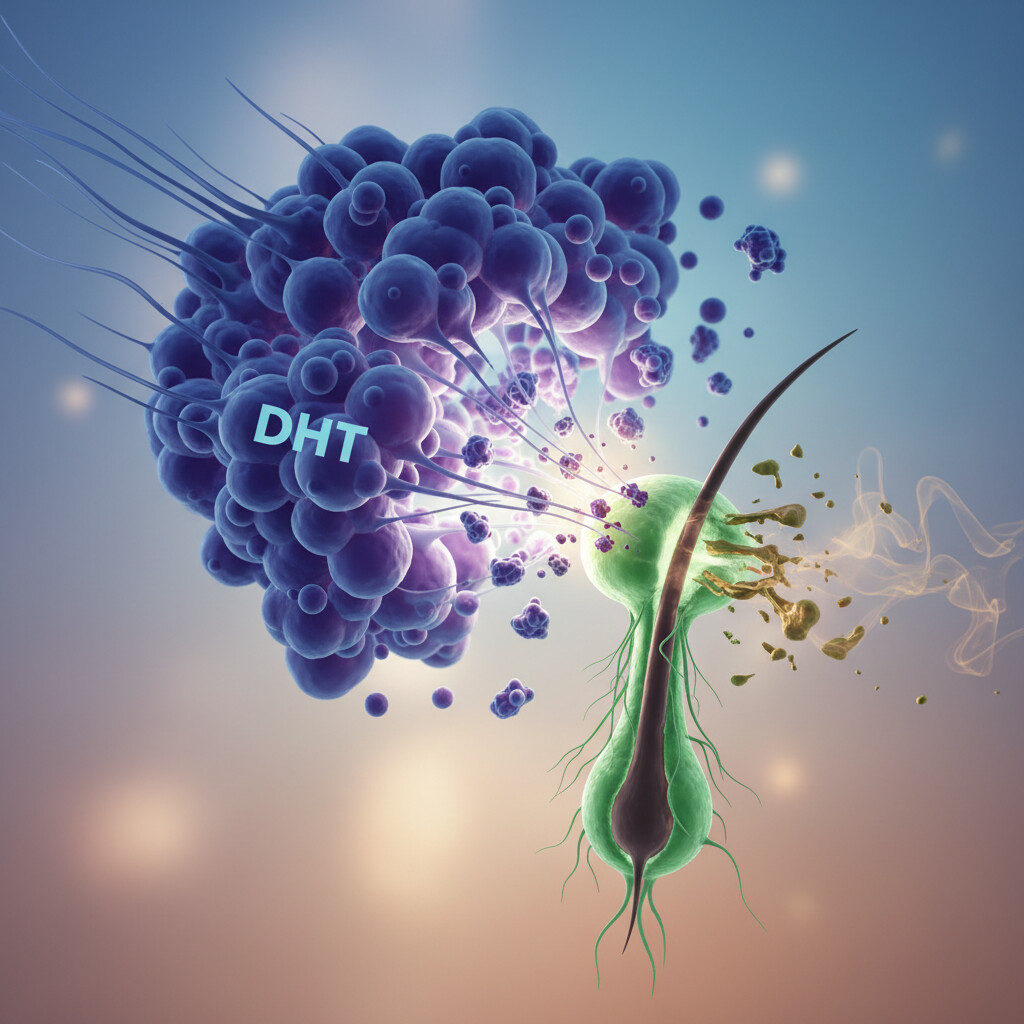
Dihydrotestosterone (DHT) is made from testosterone by an enzyme called 5-alpha reductase. It plays a normal role in male development. In people with a genetic sensitivity, DHT acts on scalp follicles and causes miniaturization. With each cycle the growth phase gets shorter and the follicle produces a finer, shorter and lighter hair. Eventually the hairs are so fine that the area looks bald.
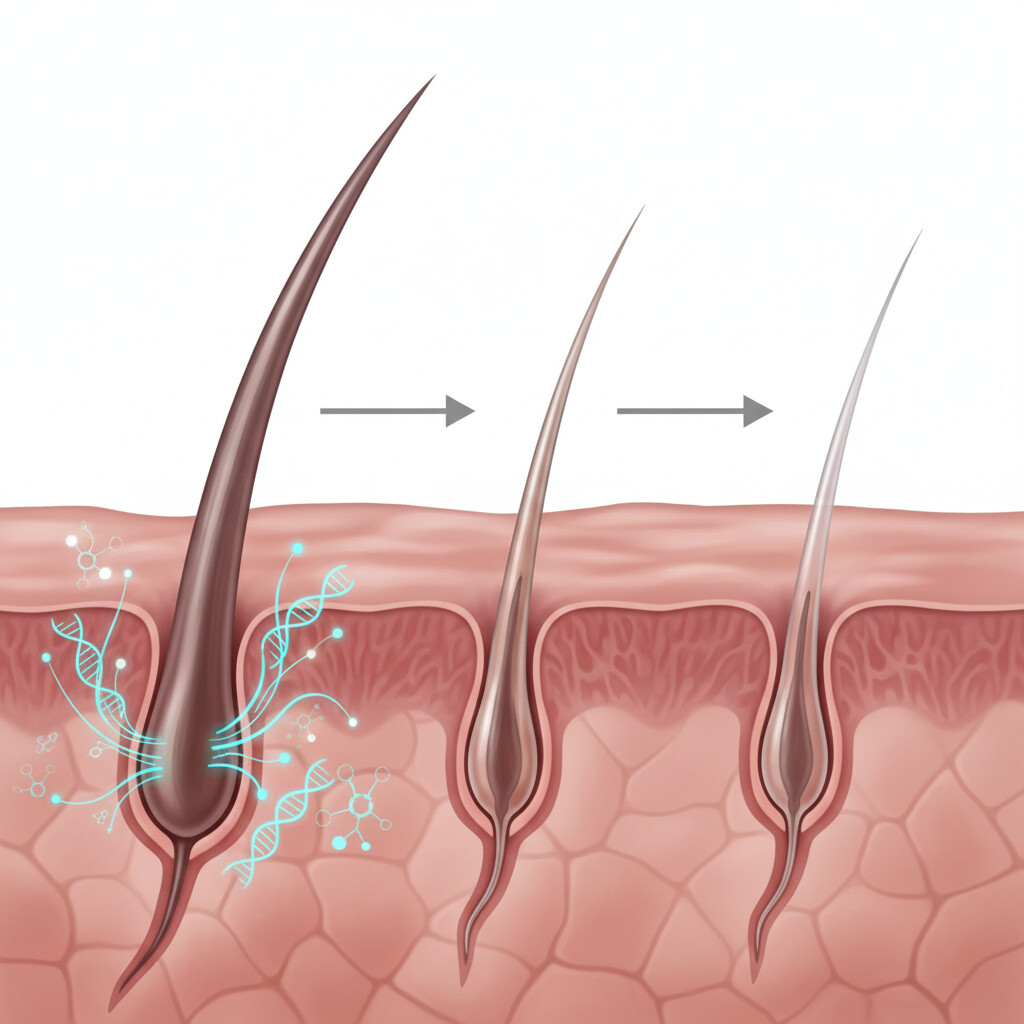
The problem is usually the follicles’ sensitivity, not “too much testosterone”. Women, who have much lower androgen levels, can develop pattern thinning too.
Follicles on the back and sides of the scalp are generally much less sensitive to DHT. That is why many men keep a horseshoe of hair for life, and why this area is used as the donor area in a hair transplant.
The role of genetics
Pattern hair loss is inherited through many genes, from both sides of the family. The popular idea that it “comes from your mother’s side” is an oversimplification. A family history of hair loss makes it more likely, and the pattern your relatives had can hint at yours, but it cannot predict exactly how far or how fast your own loss will go.
How it looks in men
In men it usually starts with recession at the temples, thinning at the crown, or both. It can begin in the late teens or much later, and the speed varies a lot. Doctors describe the stages with the Norwood scale, explained in our guide to the Norwood scale.
How it looks in women
Women usually notice diffuse thinning over the top of the scalp and a widening parting, while the frontal hairline tends to stay in place. This is described with the Ludwig scale; see female hair loss and the Ludwig scale. In women, a doctor may also look for hormonal causes such as polycystic ovary syndrome, especially if there are irregular periods, acne or increased body hair.
Telogen effluvium: shedding after stress or illness
Telogen effluvium is diffuse shedding that happens when a shock to the body pushes many follicles into the resting phase at once. Common triggers include:
- a high fever or significant illness,
- surgery or a major injury,
- childbirth,
- crash dieting or rapid weight loss,
- severe emotional stress,
- starting or stopping certain medications.
The shedding typically starts about two to three months after the trigger, which is why people often don’t connect the two. Hair comes out all over the scalp rather than in patches, and more hair than usual appears in the shower or on the pillow. In most cases shedding settles within about six months once the trigger has passed. Regrowth then takes time to show, because hair grows only around a centimetre a month.
Two points matter here. First, telogen effluvium can last longer in some people (chronic telogen effluvium), and that deserves a medical check. Second, a bout of shedding can “unmask” pattern hair loss that was already developing. Read more in our guide to stress-related hair loss. If you are planning surgery, how stress relates to hair transplant success is covered separately.
After a hair transplant, the transplanted hairs usually shed between weeks 2 and 8. This is expected and is not the same as telogen effluvium.
Alopecia areata
Alopecia areata is an autoimmune condition in which the immune system attacks hair follicles. It typically causes smooth, round bald patches on the scalp, and it can also affect the beard, eyebrows or body hair. Hair often regrows on its own, but new patches can appear later. In a small number of people it spreads to the whole scalp or body.
Alopecia areata is diagnosed and treated by a dermatologist. A hair transplant is generally not recommended while the condition is active, because transplanted follicles can be attacked too. See hair transplants and alopecia areata for when it may or may not be considered.
Thyroid, nutrition and other medical causes
- Thyroid disorders. Both an underactive and an overactive thyroid can cause diffuse thinning. Hair usually improves once the thyroid condition is treated, although it can take months.
- Iron deficiency. Low iron stores are a common, treatable contributor, particularly in women with heavy periods and in people on restricted diets. Get tested before taking iron, because too much iron is harmful.
- Other nutritional gaps. Very low protein intake, severe calorie restriction and some vitamin or mineral deficiencies can affect hair. If you are not deficient, supplements are unlikely to help. High-dose biotin can also interfere with some blood tests, so tell your doctor if you take it.
- Medications and medical treatments. Chemotherapy often causes rapid hair loss that usually regrows afterwards. Some other medicines list hair loss as a side effect. Never stop a prescribed medicine on your own; ask the prescribing doctor.
- Hormonal changes. Hair often sheds after childbirth, and thinning can become more noticeable around menopause.
- Scalp infections. Fungal infection of the scalp (tinea capitis) causes scaly patches with broken hairs. It needs medical treatment, usually with tablets.
- Traction alopecia. Years of tight ponytails, braids or extensions pull on the follicles. Caught early it can recover; long-standing traction loss can become permanent.
Scarring alopecias: the causes not to miss
Scarring (cicatricial) alopecias are a group of less common conditions in which inflammation destroys hair follicles permanently. Examples include lichen planopilaris, frontal fibrosing alopecia, central centrifugal cicatricial alopecia and discoid lupus.
Warning signs include itching, burning or tenderness of the scalp, redness or scaling around the hair follicles, and smooth, shiny areas where the follicle openings have disappeared. Frontal fibrosing alopecia often shows up as a slowly receding hairline, sometimes with eyebrow loss. It can easily be mistaken for ordinary pattern loss.
Early diagnosis matters because treatment aims to stop the inflammation. Hair that is already lost does not come back. A transplant may only be considered once a specialist confirms the condition has been inactive for a long time, and results are less predictable than in pattern hair loss.
Getting a diagnosis
A doctor, ideally a dermatologist, usually starts with your history: when the loss began, how fast it is progressing, the pattern, family history, recent illness, diet, medications and, for women, periods and pregnancies. They then examine the scalp. This often includes a gentle pull test and a close look with a magnifying device (dermoscopy or trichoscopy).
Depending on the picture, blood tests may check thyroid function, iron stores and a full blood count, and sometimes vitamin D or hormone levels. If a scarring condition is suspected, a small scalp biopsy may be needed.
It helps to bring photos of your hair from the past few years, a list of your medications and supplements, and notes on any illness, stress or weight change before the loss started.
See a doctor promptly if hair loss is sudden or rapid, comes in patches, affects your eyebrows, beard or body hair, or comes with scalp pain, burning, redness or scaling. The same applies if it comes with other symptoms such as tiredness, weight change or irregular periods.
What the cause means for treatment
- Pattern hair loss is usually progressive. Medical treatments can slow it, and in some people partly reverse it. A doctor can discuss options such as minoxidil or finasteride, including their possible side effects and whether they suit you. A transplant can restore areas where hair has been lost, if the donor area is strong enough and the future pattern can be reasonably predicted. See who is a good candidate for a hair transplant.
- Telogen effluvium usually recovers once the trigger has passed. Surgery is not a solution for it.
- Alopecia areata is managed medically. Transplants are generally avoided while it is active.
- Thyroid, iron and other medical causes improve when the underlying problem is corrected.
- Scarring alopecias need the inflammation controlled first. Surgery is only an option in selected, long-stable cases.
A responsible hair transplant surgeon will want to know what is causing your loss before recommending surgery. Be cautious if a clinic offers a graft number from photos without asking about your history, or without suggesting a medical check when the pattern looks unusual.
Common questions
Can stress cause permanent hair loss?
Usually not on its own. Stress-related shedding (telogen effluvium) is typically temporary. It can, however, make existing pattern hair loss more noticeable, and that underlying loss will continue unless it is treated.
Is hair loss inherited from the mother’s side?
Not only. Pattern hair loss is influenced by many genes from both parents. Family history on either side is a useful hint, not a prediction.
Will vitamins or special shampoos stop my hair loss?
Only if a proven deficiency is part of the cause. For pattern hair loss, supplements and shampoos have not been shown to replace medical treatment. Ask a doctor before spending money on them.
Discussion
What turned out to be the cause of your hair loss, and how was it diagnosed? If you had shedding after illness or stress, how long did it take to settle, and did it reveal pattern loss underneath? Your experience can help someone who is still trying to work out what is going on.
Sources
- Androgenetic Alopecia (StatPearls), NCBI Bookshelf, NIH, 2024
- Androgenetic alopecia (MedlinePlus Genetics), MedlinePlus, NIH, 2023
- Male pattern hair loss (androgenetic alopecia, balding), DermNet
- Telogen effluvium (hair shedding), DermNet
Related guides
- Norwood Scale: The 7 Stages of Male Pattern Baldness Explained
- What Is the Ludwig Scale? Female Hair Loss and Diffuse Thinning
- What Is Telogen Effluvium? Stress Hair Loss Symptoms and Recovery
- Can You Get a Hair Transplant for Alopecia Areata?
- Hair Transplant for Women: Who Is a Candidate and What Works
About this guide: ForumHairTransplant.com is an independent patient community. We are not affiliated with any clinic or surgeon, and we don’t accept payment for rankings, reviews or recommendations. This article is general information, not medical advice. Talk to a qualified doctor about your own situation.