By ForumHairTransplant Editorial Team · Prepared with AI assistance · Sources checked: 19 October 2026
The Norwood scale (also called the Hamilton-Norwood scale) is the standard way to describe how far male pattern baldness has progressed. It sorts hair loss into seven main stages, from no recession (stage 1) to a narrow horseshoe of hair around the sides and back (stage 7). For a hair transplant it gives you and your surgeon a shared language, but it is only a starting point: donor quality, age and likely future loss matter just as much as the stage number.
Key takeaways
- The scale has seven main stages plus variants such as “vertex” (crown-first) and “Type A” (front-to-back) loss.
- It describes the pattern of loss. It does not measure hair density, hair calibre or how much donor hair you have.
- Your stage today is less important for planning than where your hair loss is likely to be in 10-20 years.
- The same stage can mean very different plans for a 25-year-old and a 50-year-old.
- The Norwood scale applies to men. Women usually have a different pattern, classified with the Ludwig scale.
Where the scale comes from
Male pattern baldness (androgenetic alopecia) follows a fairly predictable pattern in most men: the temples recede, the crown thins, and eventually the two areas meet. The hormone DHT and genetics drive this, as explained in our guide to what causes hair loss.
In the 1950s James Hamilton published a classification of these patterns. In the 1970s O’Tar Norwood revised and expanded it, and his version is the one most clinics and forums use today. It is a visual scale: you compare your scalp with a set of drawings and pick the closest match.
The seven stages
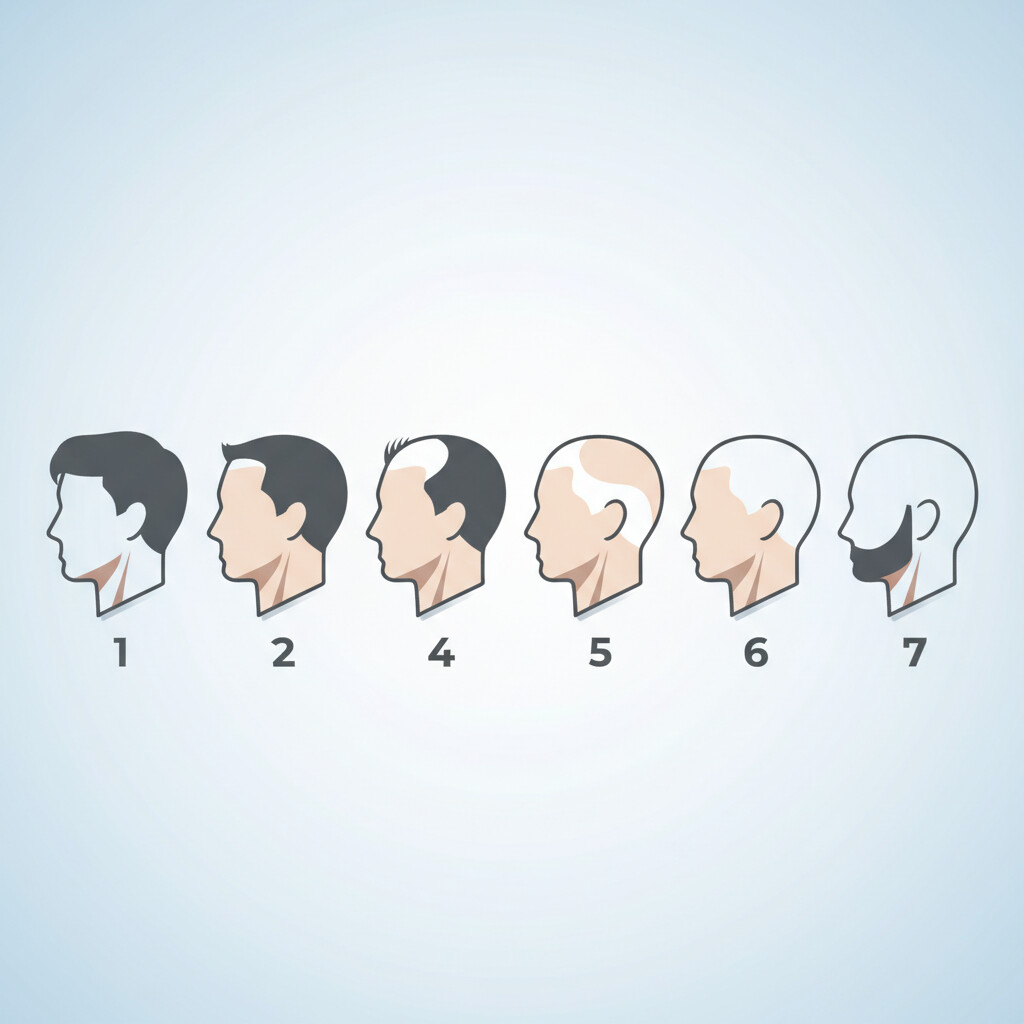
- Stage 1: no significant recession. The hairline sits low and fairly straight. Some men have slight rounding at the temples even here.
- Stage 2: slight, usually symmetrical recession at the temples. Many adult men settle into this kind of “mature hairline” without ever going further. Stage 2 on its own is not always a sign of progressive baldness.
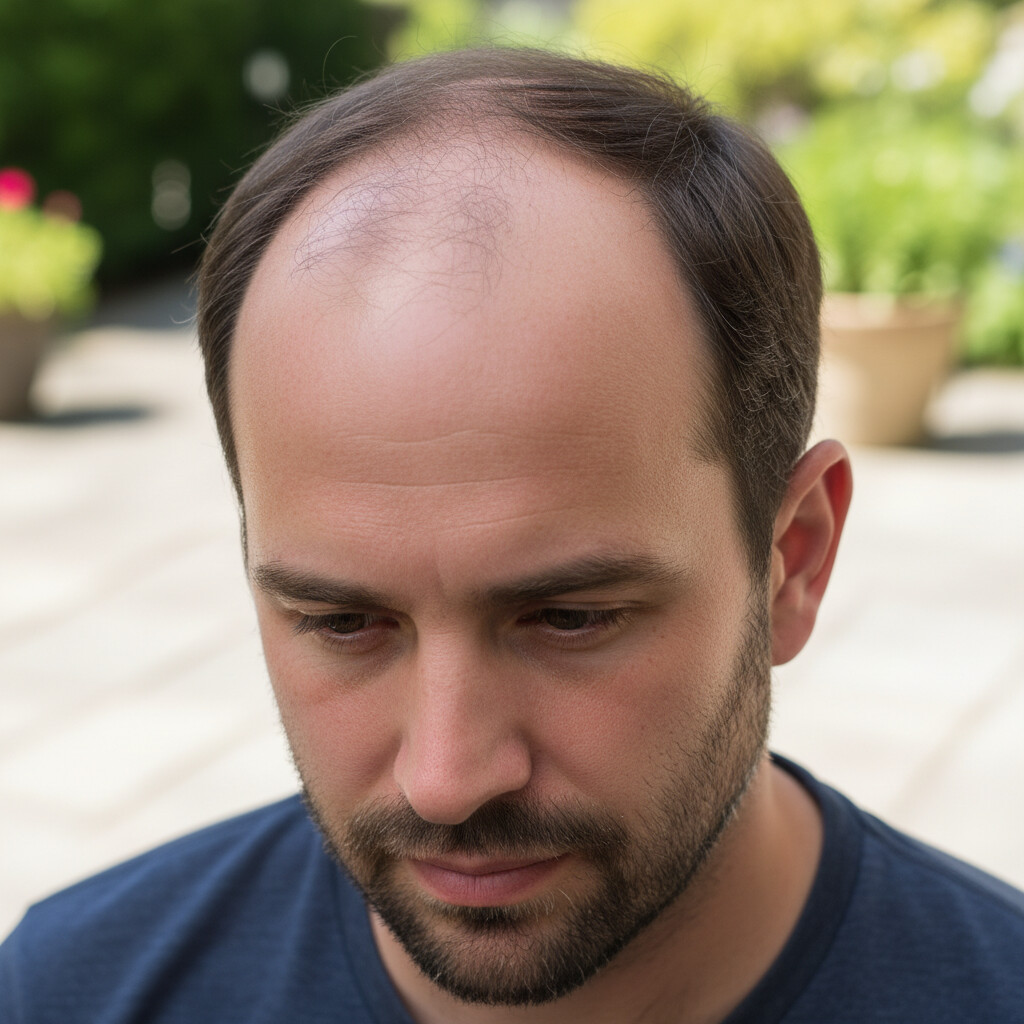
- Stage 3: the first stage usually counted as balding. The temples recede deeper, creating a clear M, U or V shape. In stage 3 vertex, the hairline is still fairly intact but the crown has started to thin.

- Stage 4: deeper frontal recession plus a clearly visible bald or thin area on the crown. A band of hair across the top still separates the two areas.
- Stage 5: the front and crown areas are larger, and the band between them is narrower and thinner.
- Stage 6: the band across the top has gone. The front and crown have merged into one large bald area.
- Stage 7: only a horseshoe of hair remains around the sides and back, and this band is often narrower and finer than in earlier stages.
The Type A variant
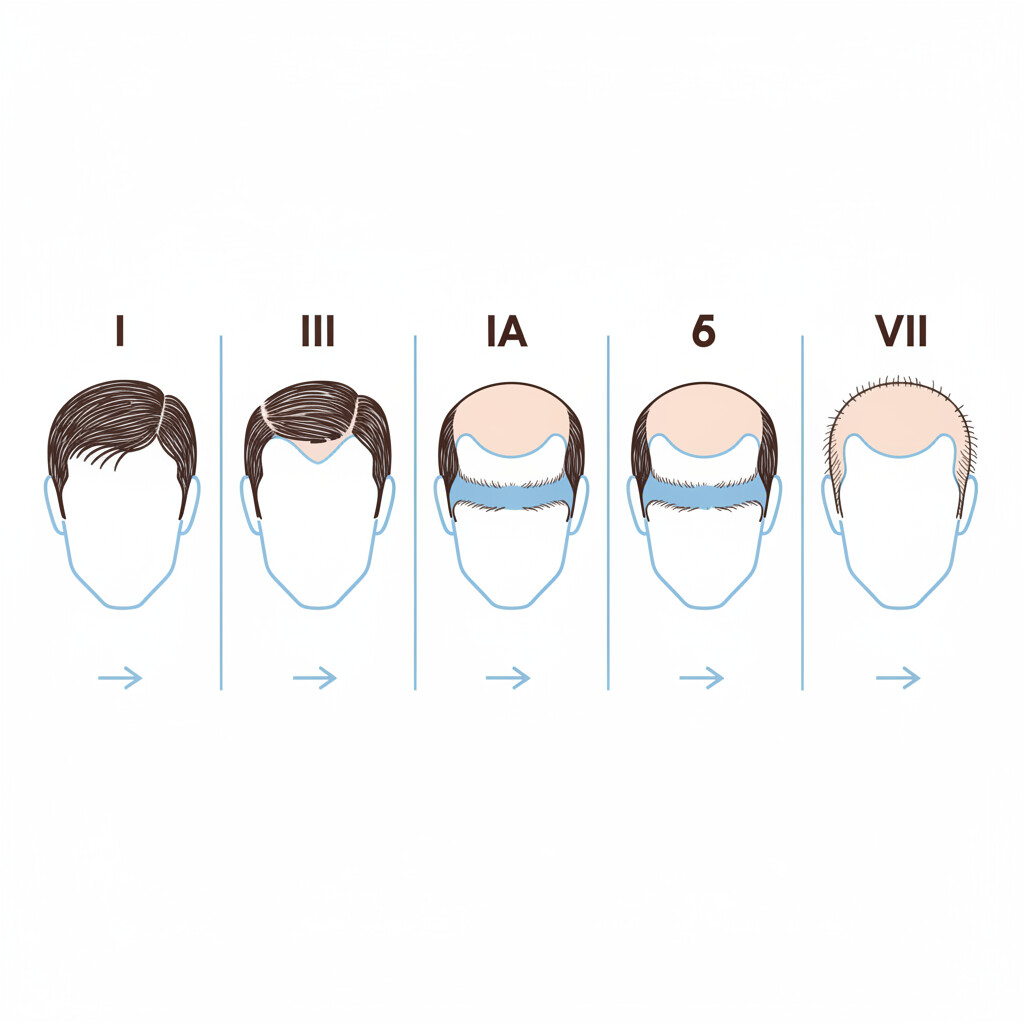
A minority of men lose hair from the front backwards without a separate crown bald spot. Norwood described this as the “A” variant (stages 2A to 5A). The hairline moves steadily back across the top of the head.
What the scale does not tell you
The Norwood scale is useful but limited. It does not describe:
- Density. Two men at stage 3 can have very different amounts of hair in the thinning areas.
- Diffuse thinning. Some men thin evenly across the top, and in some cases also in the donor area, rather than following the classic pattern. This does not fit neatly on the scale and needs careful assessment before any surgery.
- Donor quality. The number of hairs per graft, hair thickness and donor density decide how much can be moved. The scale says nothing about this.
- Other causes of hair loss. Sudden or patchy shedding can come from other conditions. Telogen effluvium, for example, causes diffuse shedding after illness, stress or other triggers and usually recovers on its own. It is not pattern baldness and should be ruled out before planning surgery.
- Women’s hair loss. Women usually keep their hairline and thin across the top, which is classified with the Ludwig scale.
How your stage affects transplant planning
In very general terms:
- Stages 2-3: usually a smaller procedure focused on the hairline and temples. The main risk here is not the surgery but the future: younger men at these stages may still progress a long way.
- Stages 4-5: larger procedures, often split between front, mid-scalp and crown. Many surgeons prioritise the front and mid-scalp because that is what frames the face, and leave the crown for later if donor supply allows.
- Stages 6-7: the area to cover is large compared with the donor supply. Full density everywhere is usually not realistic. The aim is often good coverage of the front and top, with lower density or no work on the crown.
Each clinic has its own approach, and the right plan depends on your scalp. Our guide on who is a good candidate for a hair transplant covers the other factors surgeons look at.
Why future progression matters more than today’s stage
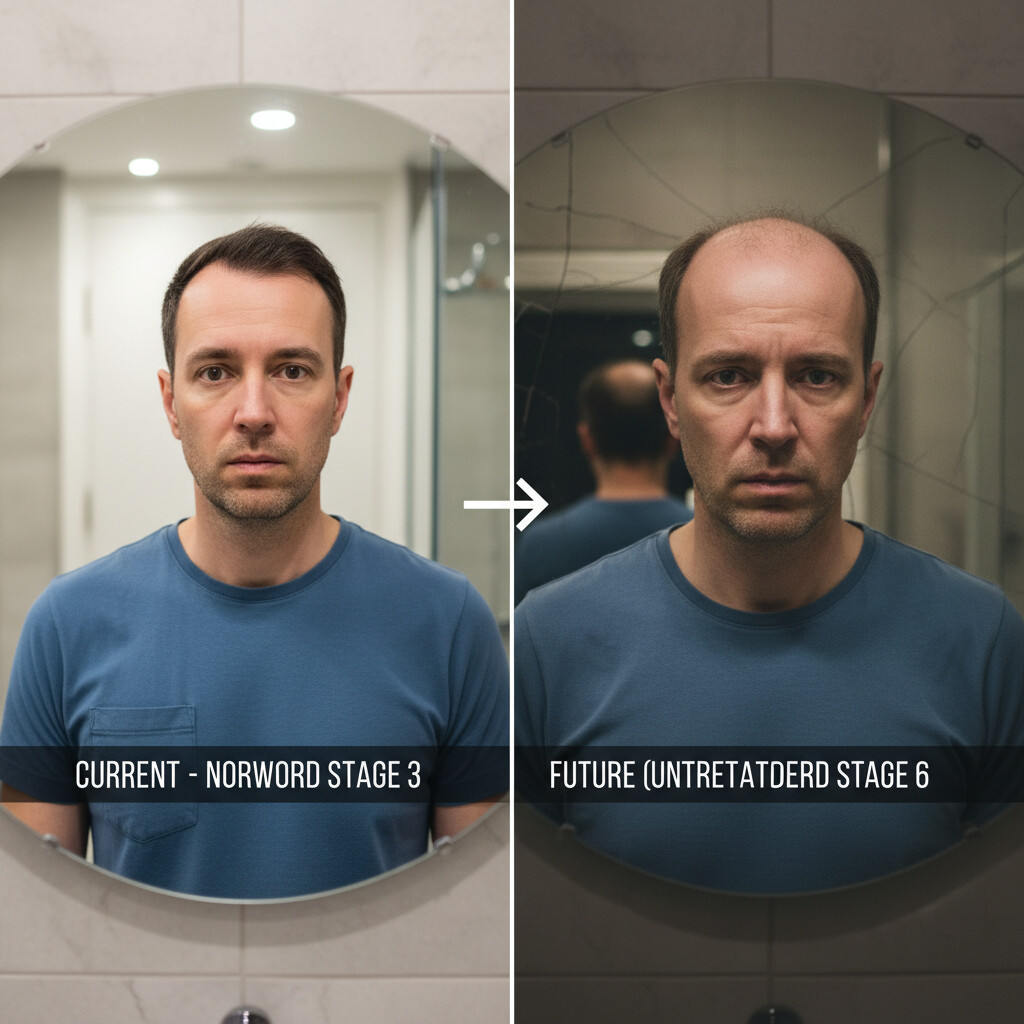
Pattern baldness usually keeps progressing, although the speed varies a lot between people. A transplant moves hair; it does not stop loss in the native hair around it. If a young man at stage 3 gets a low, dense hairline and later reaches stage 5 or 6, he can be left with an isolated strip of transplanted hair and not enough donor hair to fill the gap behind it.
To reduce this risk, a careful surgeon will usually:
- Look at age and family history. Your father’s, grandfathers’ and brothers’ hair can give a rough idea of where you may end up.
- Place the hairline conservatively. A hairline that suits your age now and will still look natural at 50 or 60. See how a natural hairline is designed.
- Keep donor hair in reserve. Not using the whole donor supply in the first procedure leaves room for a second session if loss continues.
- Discuss medical treatment. Treatments such as finasteride or minoxidil can slow loss in native hair in many men. They have possible side effects and are not suitable for everyone, so this is a conversation to have with a doctor. Long-term maintenance after a transplant explains how this fits in.
Using the scale in a consultation
Self-assessment from photos is imprecise, because lighting and camera angle can make you look a stage better or worse, so a surgeon will usually examine the scalp directly. Knowing your approximate stage still helps you ask better questions. When you get a plan or quote, ask:
- Which Norwood stage do you think I am now, and where do you expect me to be in 10-15 years?
- How does this plan still look if my loss progresses?
- How many grafts does my donor area safely allow over my lifetime, and how many does this plan use?
- Do I have diffuse thinning or another type of hair loss that changes the plan?
Common questions
Is Norwood 2 the same as a receding hairline?
Not necessarily. Many men develop a slightly higher, mature hairline in their late teens or twenties and stay there. It is only a sign of progressive balding if the recession keeps deepening or the crown starts thinning.
Can I skip stages?
Loss does not always follow the drawings step by step. Some men thin at the crown first, others lose the front first (Type A), and the speed varies widely.
Am I too advanced for a transplant at stage 6 or 7?
Not automatically. It depends on donor quality and your expectations. Many men at these stages get a useful improvement, but usually not full density across the whole scalp.
Discussion
Which Norwood stage were you when you first considered a transplant, and did clinics agree on your stage? If you had surgery, share how your plan accounted for future loss.
Sources
- Male Pattern Baldness: Classification and Incidence (Norwood), Southern Medical Journal, 1975
- Classifications of Patterned Hair Loss: A Review (Gupta and Mysore), Journal of Cutaneous and Aesthetic Surgery, 2016
- Androgenetic Alopecia, ISHRS
- Male Pattern Baldness (Androgenic Alopecia): Stages, Treatment, Cleveland Clinic
Related guides
- What Causes Hair Loss? Genetics, DHT, Stress and Medical Causes
- What Is the Ludwig Scale? Female Hair Loss and Diffuse Thinning
- Who is a Good Candidate for a Hair Transplant?
- How Is a Natural Hairline Designed for a Hair Transplant?
- What Is Telogen Effluvium? Stress Hair Loss Symptoms and Recovery
- Hair Loss in Men
About this guide: ForumHairTransplant.com is an independent patient community. We are not affiliated with any clinic or surgeon, and we don’t accept payment for rankings, reviews or recommendations. This article is general information, not medical advice. Talk to a qualified doctor about your own situation.