
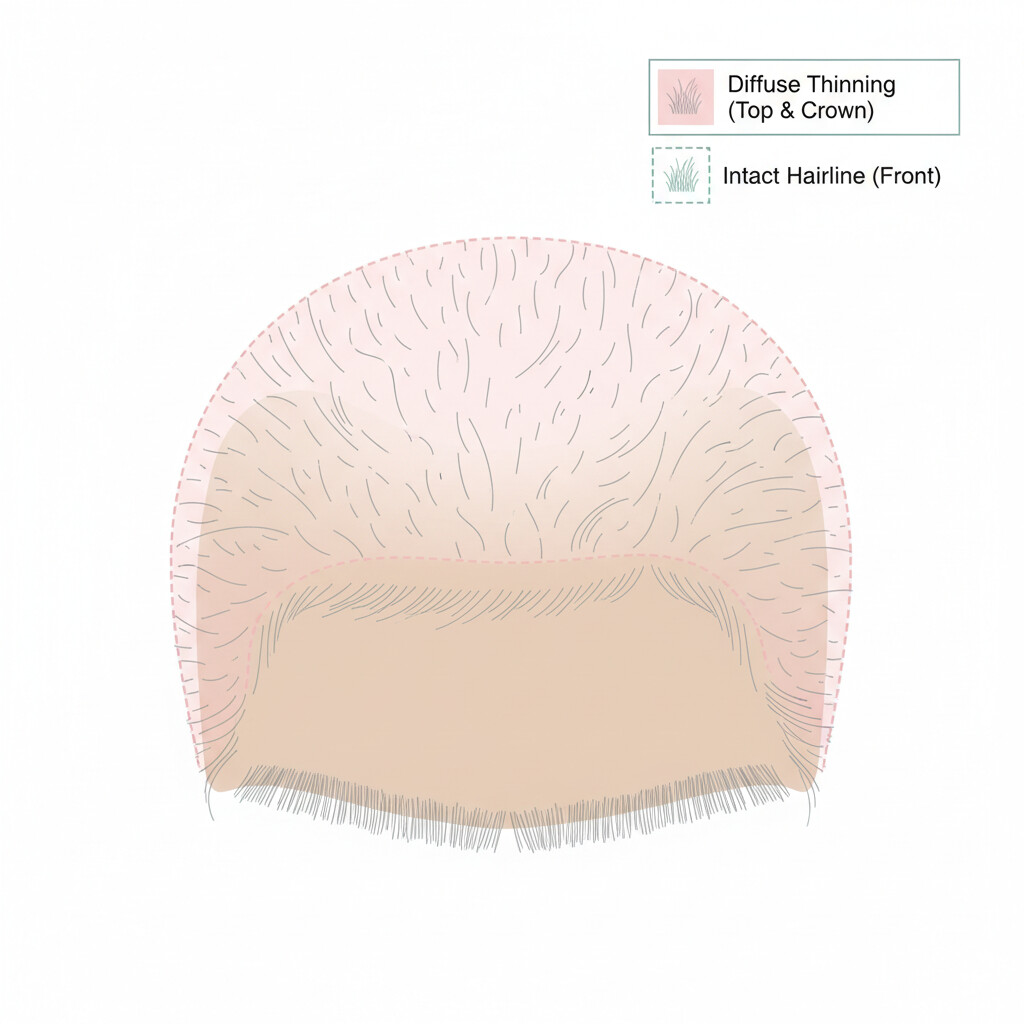
The Ludwig scale is a three-stage system doctors use to describe how far female pattern hair loss has progressed. Most women do not develop a receding hairline or bald patches. Instead, hair thins gradually over the top of the scalp while the front hairline stays in place, and the Ludwig scale grades that diffuse thinning from mild (stage I) to severe (stage III). Your stage helps track change over time, but it does not tell you the cause. That needs a medical assessment.
Key takeaways
- Female pattern hair loss usually shows as a widening part and thinning over the top and crown, with the frontal hairline preserved.
- The Ludwig scale has three stages: mild, moderate and severe thinning of the central scalp.
- Diffuse thinning has several possible causes, including genetics, hormonal changes, thyroid problems, low iron and telogen effluvium. More than one can be present.
- Medical treatment is the first step for most women. A hair transplant suits only some, mainly those with stable, well-defined thinning and a strong donor area.
How female hair loss differs from male pattern baldness
In men, genetic hair loss follows a fairly predictable pattern: the temples recede, the crown thins, and the top may eventually become bald. The Norwood scale describes those stages.
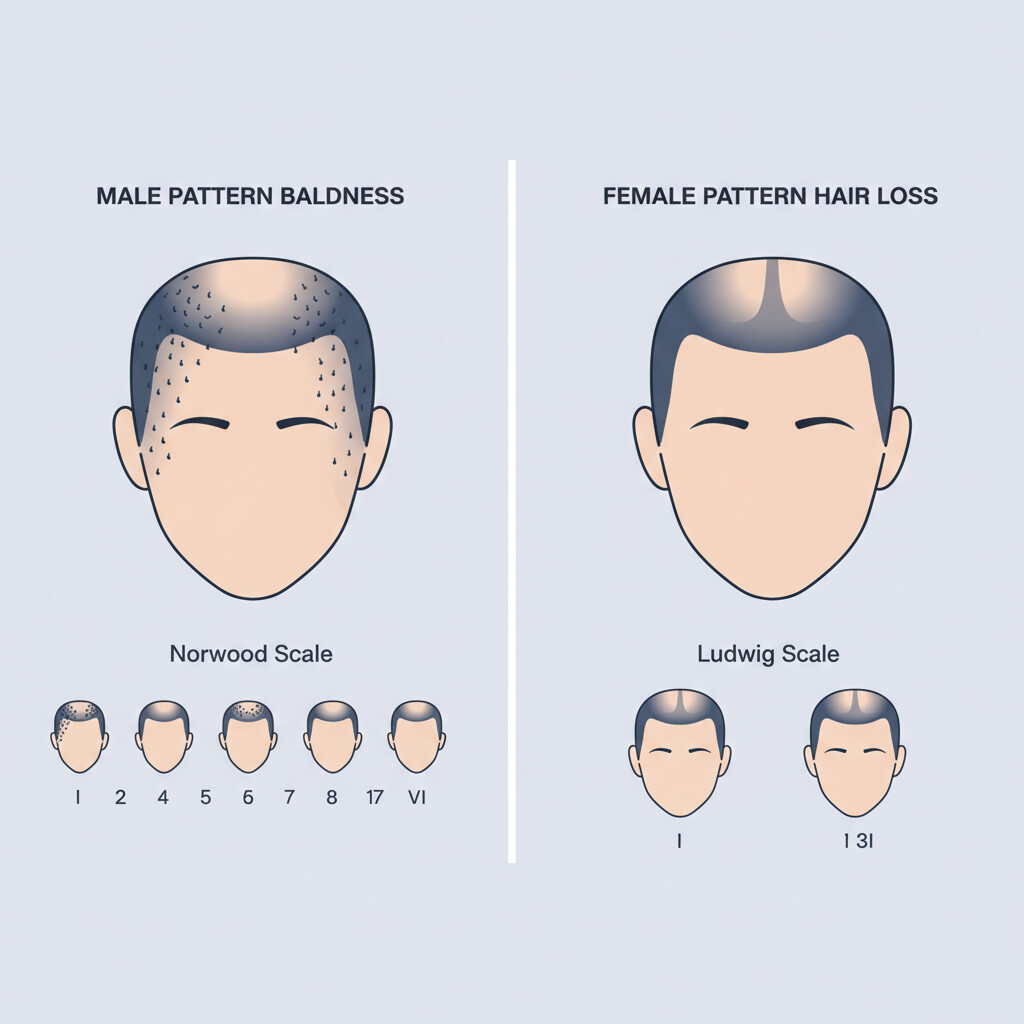
Female pattern hair loss (FPHL) is the female form of androgenetic alopecia, but it looks different:
- The frontal hairline is usually kept. A true receding hairline is less common.
- Thinning is spread out over the top and crown rather than complete loss in one area.
- The part widens. Many women first notice more scalp along their parting, or a smaller ponytail.
- Complete baldness is rare. Even in advanced stages, some hair usually remains.
The Ludwig scale: three stages
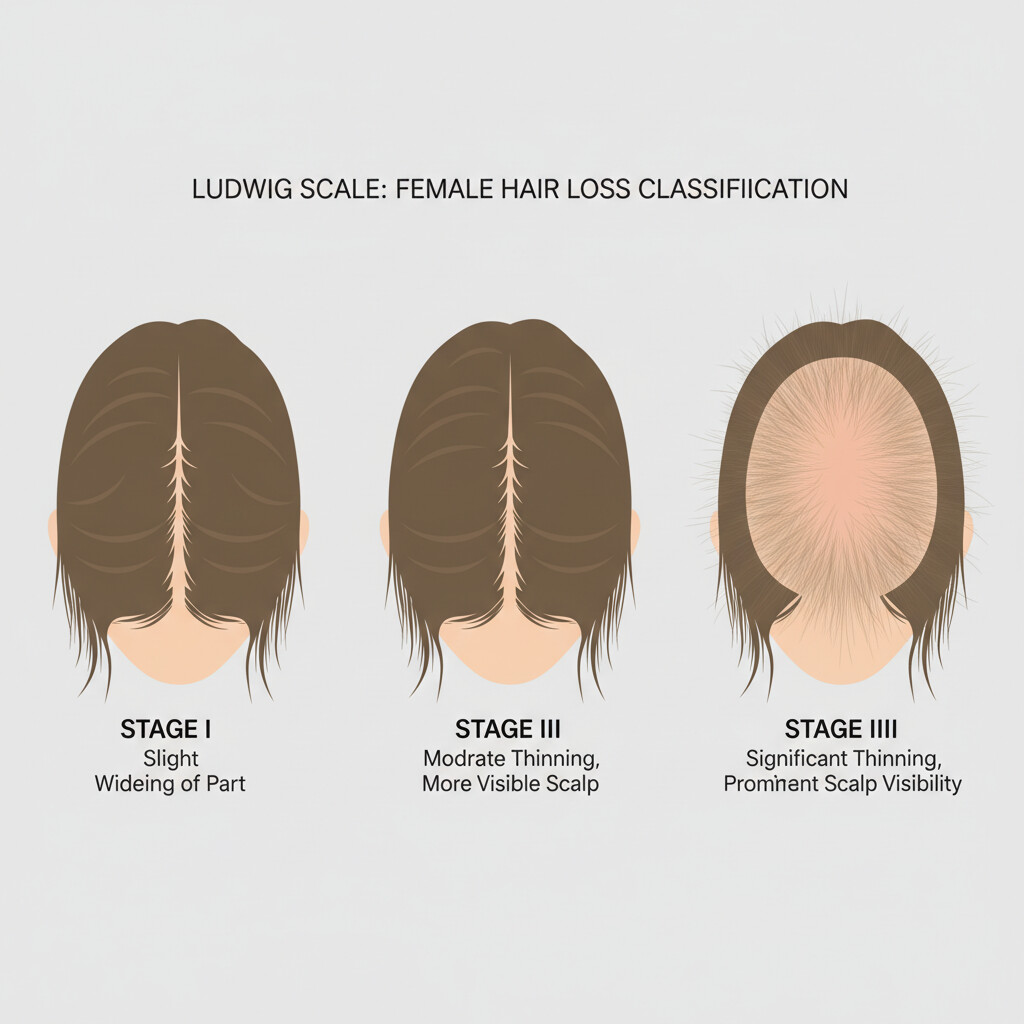
The Ludwig scale was described in 1977 and is still widely used. It focuses on the central scalp:
- Stage I (mild): Thinning on top that may be hard to see when hair is styled. The part is slightly wider and the frontal hairline is intact.
- Stage II (moderate): Clearly reduced density over the top and crown. The scalp shows more, especially under bright light or when hair is wet.
- Stage III (severe): Extensive thinning over the top, with the scalp clearly visible. A band of hair usually remains at the front.
Some doctors use other scales, such as the Savin or Sinclair scales, which add more steps or grade the width of the part. They all measure the same thing. Photos of your part line in the same light every few months are a simple way to track change.
What diffuse thinning means
“Diffuse” means spread out rather than patchy. In pattern hair loss, affected follicles gradually miniaturise: each cycle they produce finer, shorter and lighter hairs. You lose volume without obvious bald spots. But several other conditions can look similar and need different treatment, which is why a scale alone cannot give a diagnosis.
Common causes of diffuse thinning in women
Hair loss often has more than one cause. Our guide on what causes hair loss covers them in detail. For women, the main ones are:
- Genetics (androgenetic alopecia). Follicles on top of the scalp are sensitive to androgens, often with normal hormone levels. This is the most common cause of long-term thinning.
- Hormonal changes. Shedding after childbirth is common and usually recovers. Thinning can become more noticeable around menopause. Conditions with raised androgens, such as polycystic ovary syndrome (PCOS), can contribute.
- Telogen effluvium. Illness, surgery, childbirth, crash dieting or severe stress can push many hairs into the resting phase at once. Heavy shedding follows about two to three months later and often settles once the trigger is gone. See What Is Telogen Effluvium?
- Thyroid disorders. Both an underactive and an overactive thyroid can cause diffuse shedding.
- Low iron and other deficiencies. Low iron stores are a common finding in women with shedding. Only supplement what a blood test shows you actually lack.
- Medications. Some drugs list hair loss as a side effect. Don’t stop a prescribed medicine without talking to your doctor.
- Other scalp conditions. Alopecia areata usually causes patches, and scarring alopecias need early treatment, so both should be ruled out.
Shedding vs thinning: telogen effluvium mainly causes more hairs falling out. Pattern hair loss mainly causes thinner hairs and a wider part, sometimes without dramatic shedding. The two often overlap, and a dermatologist can tell them apart.
Treatment options
Treatment depends on the cause, so diagnosis comes first. Typical approaches include:
- Topical minoxidil. The most established treatment for female pattern hair loss, approved for women in many countries. It takes several months to work, and a temporary increase in shedding in the first weeks is common.
- Prescription options. A doctor may discuss anti-androgens such as spironolactone, or low-dose oral minoxidil. These are often used off-label, need supervision, and some are not safe in pregnancy.
- Treating the underlying cause, such as a thyroid problem, low iron or PCOS.
- Supporting treatments. Low-level laser devices and PRP are used by some women, but the evidence is more limited. Treat them as add-ons, not replacements.
- Gentle hair care. Avoiding tight hairstyles, harsh chemicals and excess heat reduces breakage, though it does not reverse pattern loss.
Most treatments only work while you keep using them. Give a new treatment at least six months and judge it with photos, not day-to-day impressions.
When a hair transplant can help women
A hair transplant moves follicles from the back and sides of the scalp to thinning areas. Fewer women are suitable than men, mainly because the donor area must be stable and dense. See hair transplants for women for more detail.
Women are more likely to be good candidates if they have:
- stable, well-defined thinning, such as a widened part or thinning behind the hairline,
- a strong donor area that is not thinning itself,
- a clear diagnosis, with thyroid problems, low iron or active telogen effluvium ruled out or treated,
- realistic expectations: a transplant adds density to selected areas, not the whole scalp.
A transplant is usually not advised when thinning affects the whole scalp including the donor area, or when the cause of shedding is unknown. Many surgeons want a period of stable medical treatment first, because native hair around the transplant can keep thinning.
Two practical points matter. FUT (strip) harvesting is often used for women because it avoids shaving, and unshaven FUE is another option. Women can also be prone to shock loss, a temporary loss of native hairs around the operated area, which usually grows back over the following months.
For women who are not surgical candidates, scalp micropigmentation can reduce the contrast between hair and scalp. It adds the look of density, not hair, and it fades over time.
When to see a doctor
See a GP or dermatologist promptly if you notice:
- sudden, heavy or quickly worsening hair loss,
- patches of loss, or redness, scaling, pain or burning on the scalp,
- a receding hairline or loss of eyebrow hair,
- irregular periods, acne, extra facial hair or unexplained weight change,
- hair loss after starting or stopping a medication.
Stress can also affect shedding and recovery, as explained in Can Stress Reduce Hair Transplant Success?
Common questions
Can the Ludwig scale tell me what is causing my hair loss?
No. It describes the pattern and severity, not the cause. Two women at the same stage can have very different underlying reasons.
Is hair loss after pregnancy the same as the Ludwig pattern?
Usually not. Shedding a few months after childbirth is typically telogen effluvium and tends to recover. If thinning persists beyond a year, it may reveal underlying pattern hair loss, so get it checked.
Discussion
Which Ludwig stage were you at when you first noticed thinning, and what helped you get a clear diagnosis? If you have tried medical treatment or had a transplant as a woman, share what worked and what didn’t.
Related guides
- Hair Transplant for Women: Who Is a Candidate and What Works
- What Causes Hair Loss? Genetics, DHT, Stress and Medical Causes
- What Is Telogen Effluvium? Stress Hair Loss Symptoms and Recovery
- Norwood Scale: The 7 Stages of Male Pattern Baldness Explained
- Can Stress Reduce Hair Transplant Success?
About this guide: ForumHairTransplant.com is an independent patient community. We are not affiliated with any clinic or surgeon, and we don’t accept payment for rankings, reviews or recommendations. This article is general information, not medical advice. Talk to a qualified doctor about your own situation.