
By ForumHairTransplant Editorial Team · Prepared with AI assistance · Sources checked: 19 October 2026
Overharvesting means taking too many grafts from the donor area, or taking them from the wrong places, so that the back and sides of the head look visibly thin, patchy or scarred. It is one of the hardest hair transplant problems to fix, because extracted follicles do not grow back. The best protection is a conservative plan that treats the donor area as a limited, lifetime supply.
Key takeaways
- The donor area is finite. Every graft removed leaves a small gap and a small scar, and those follicles do not regrow.
- Overharvesting can happen through too many grafts overall, extractions clustered too closely, or harvesting outside the safe donor zone.
- Signs include a see-through or “moth-eaten” look at the back, visible white dots with short hair, and thinning where hair used to look even.
- Some donor thinning in the first months can be temporary. Judge the donor area at about 9-12 months.
- Damage can be improved with camouflage or repair procedures, but rarely fully reversed. Prevention matters most.
Why the donor area is limited
The hair at the back and sides of the head is usually resistant to the hormone that causes pattern baldness. That is why it is used for transplants, as explained in our donor area guide.
But the supply is limited. The donor area can only lose a certain share of its follicles before it starts to look thin. How many grafts a person can safely give depends on donor density, the size of the safe zone, hair calibre, colour and curl, and scalp characteristics. Two men of the same age and Norwood stage can have very different lifetime capacities.
What counts as overharvesting?
There are three main ways it happens:
- Too many grafts overall. Taking more than the donor area can spare in one session, or across several sessions, reduces density everywhere.
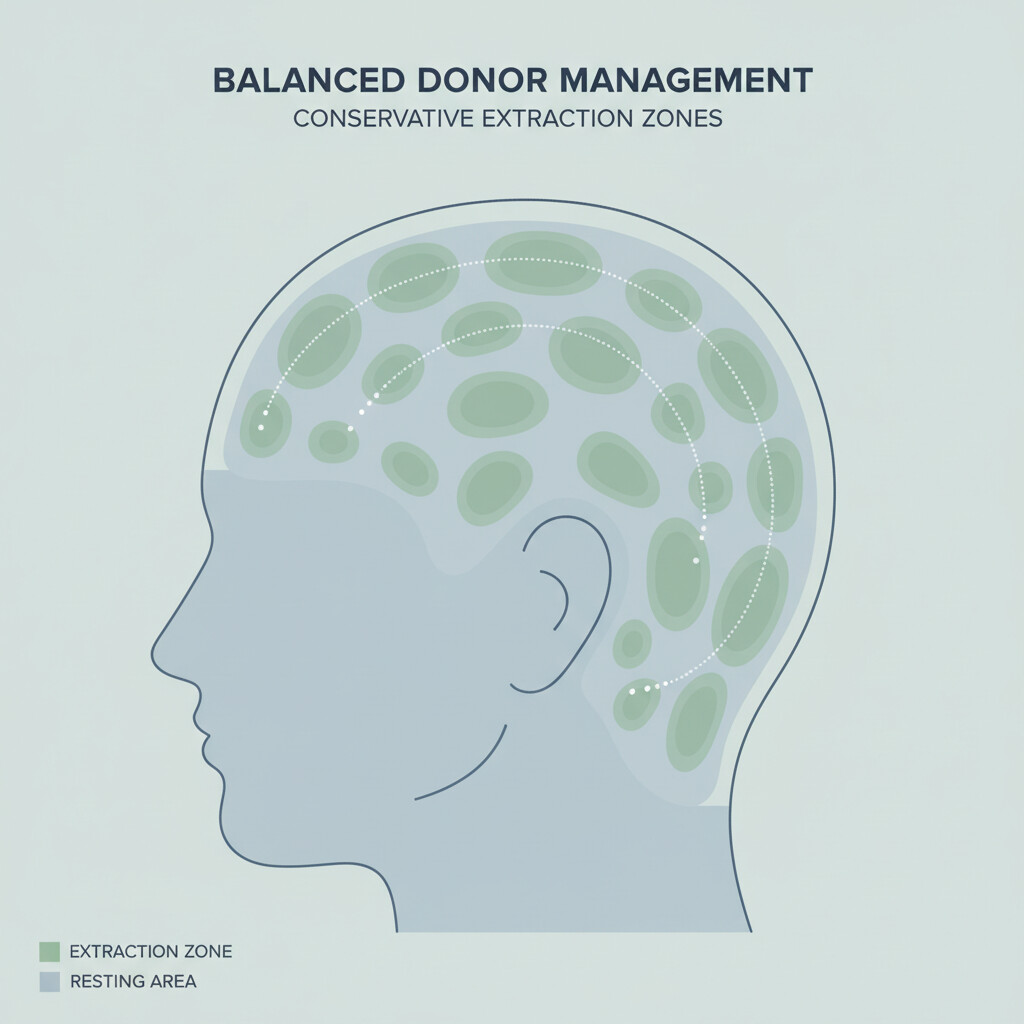
- Clustered extraction. Taking grafts too close together in one zone creates visible patches even if the total number is reasonable. Good technique spreads extraction evenly.
- Harvesting outside the safe zone. Follicles taken from too high on the crown edge or too low on the neck may not be permanently resistant to pattern loss. Hairs transplanted from these areas can thin later, and extraction scars can end up in areas that may later go bald.
Many surgeons work with rough guidelines about how much of any one area can be taken, but there is no single safe number that applies to everyone. It has to be judged from your own donor area.
Why it happens
Overharvesting is usually a planning problem rather than bad luck. Common causes include:
- Very large single sessions promoted as better value. Some patients can safely have a large session, but not everyone. Our guide on why mega sessions may not be right for you explains the trade-offs.
- Chasing maximum density in the recipient area, using more grafts than the donor area can supply without showing.
- Pricing per graft, which can create an incentive to take more.
- Limited assessment before surgery, without measuring donor density or considering future sessions.
- Inexperienced extraction, especially where much of the work is left to staff without close supervision.
The question of conservative vs aggressive planning is at the heart of this.
Signs of overharvesting
After the donor area has fully recovered, possible signs are:
- The back and sides look noticeably thinner than before surgery, or thinner than areas that were not harvested.
- Scalp is visible through the donor area in normal light, especially with the hair wet or short.
- An uneven, patchy or “moth-eaten” pattern.
- Many visible white dot scars with a short haircut.
- You can no longer wear the hair lengths you used to.
Don’t judge too early
In the first weeks and months, the donor area can look thinner than it really is. Swelling, short regrowing hair and temporary shedding of some existing hairs around the extraction sites (a form of shock loss) can all make it look sparse. This often improves as the hair recovers. Most surgeons suggest waiting about 9-12 months before judging the final appearance. If you are worried earlier, take clear photos in the same light each month and share them with your surgeon.
Consequences
- A visible donor area that limits hairstyles, particularly short cuts.
- Fewer options later. If pattern loss continues, there may not be enough donor hair left for a second procedure. Our guide on reusing donor hair in future sessions explains why the supply has to be planned from the start.
- Emotional impact. For some people, a thin donor area becomes a bigger worry than the original hair loss.
Can overharvesting be fixed?
Extracted follicles cannot be replaced, so the goal is to reduce how noticeable the problem is. Options a specialist may discuss include:
- Growing the hair longer to cover thin areas and scars, where the remaining density allows it.
- Scalp micropigmentation (SMP), which adds tiny pigment dots to reduce the contrast of scars and thin patches. It fades over time and needs touch-ups.
- Grafting into scars in selected cases, sometimes using beard or body hair if suitable, to break up visible white dots.
- Medical treatment to protect native hair in the recipient area. It does not restore extracted donor follicles.
Results of repair vary, and it is worth getting an opinion from a surgeon experienced in repair work before deciding.
How to protect your donor area
- Ask how many grafts your donor area can safely provide over your lifetime, and how many this procedure will use.
- Ask how they will spread the extraction across the donor zone, and where the safe zone boundaries are for you.
- Be cautious of very high graft numbers for a small area, or plans that promise full density everywhere in one session.
- Consider the long term. A slightly less dense result now can leave room for a second procedure later if loss continues.
- Look at donor area photos, not only recipient area results, when comparing clinics, ideally with short hair and at 12 months or more.
Some patients also ask whether donor quality can be improved before surgery. Our guide on improving donor area quality looks at what is realistic.
When to talk to a surgeon
- Your donor area still looks clearly thin or patchy 9-12 months after surgery.
- You notice thinning spreading in the donor area, rather than improving.
- You are planning another session and are unsure how much donor hair you have left.

Common questions
How many grafts is too many?
There is no single number. It depends on donor density, the size of the safe zone and your hair characteristics. What is safe for one person can be overharvesting for another.
Does FUT avoid overharvesting?
FUT removes a strip and leaves a linear scar, but the area between remains at normal density. FUE spreads extraction across a wider area, which makes careful spacing important. Both methods use up the same finite supply. See Does technique affect long-term density?
Will my donor area look the same as before?
It will usually be slightly less dense, because hair has been removed. After a well-planned procedure, most people find the difference hard to notice at normal hair lengths.
Discussion
How did your donor area look at 12 months compared with before surgery? If you had more than one session, share how your surgeon planned the donor supply between procedures.
Sources
- Androgenetic Alopecia: A Guide to Pattern Hair Loss, ISHRS
- Controversies in Hair Transplantation, Journal of Cutaneous and Aesthetic Surgery, 2017
- Assessment of Safe Donor Zone of Scalp and Beard for FUE in Indian Men: 580 Cases, Journal of Cutaneous and Aesthetic Surgery, 2018
Related guides
- Hair Transplant Density: How Dense Should It Be?
- Conservative vs Aggressive Hair Transplant Planning: Which Is Right?
- Hair Transplant Risks and Complications: What Can Go Wrong?
- Can You Improve Donor Area Quality Before Surgery?
- Hair Transplant Problems: Planning Mistakes vs. Healing Issues
- Donor Area Healing After FUE: Timeline and What Is Normal
About this guide: ForumHairTransplant.com is an independent patient community. We are not affiliated with any clinic or surgeon, and we don’t accept payment for rankings, reviews or recommendations. This article is general information, not medical advice. Talk to a qualified doctor about your own situation.