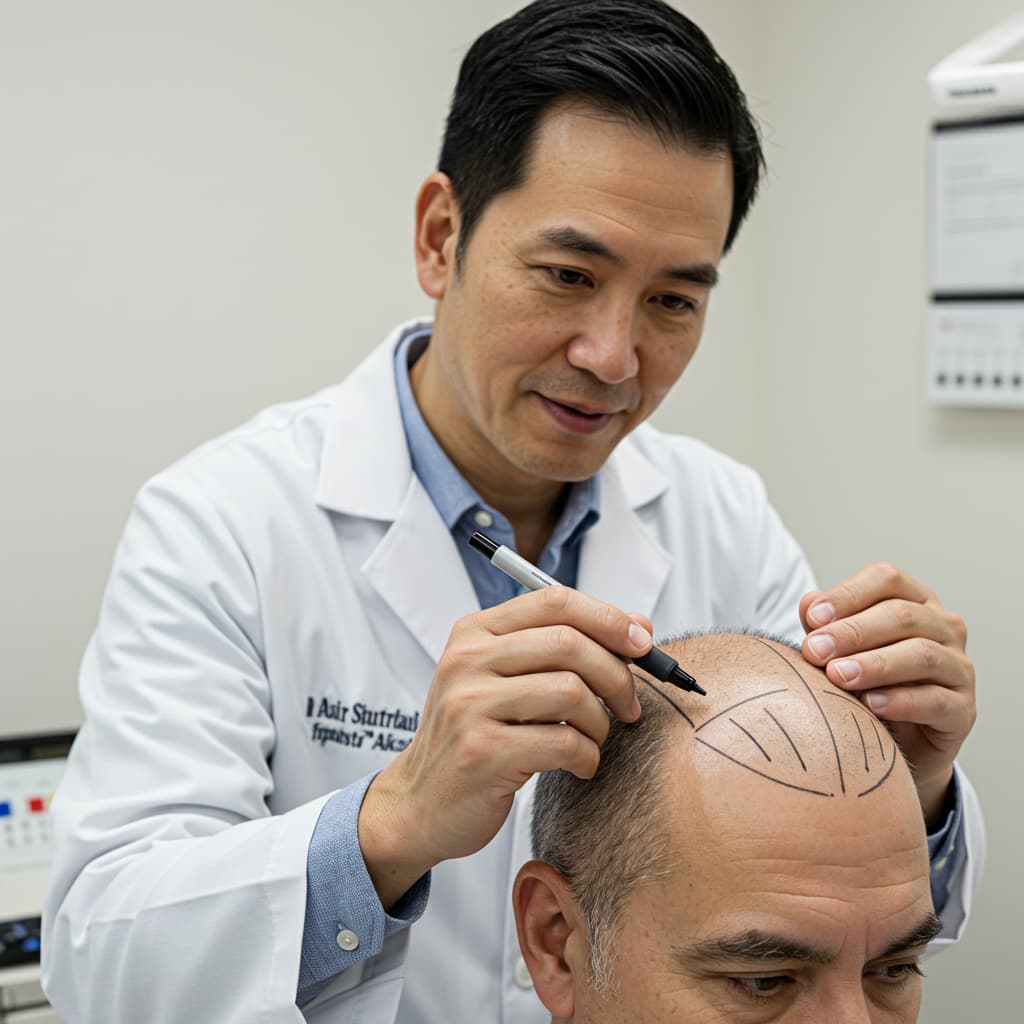
There is no single “right” density for a hair transplant. The aim is enough density to look full and natural in the areas that matter most, usually the front, without using up more donor hair than you can afford to lose. Because the eye needs only around half of a normal density to read hair as full, a well-planned transplant can look convincing without recreating the density you had at 18. How far you can go depends on your donor supply, hair characteristics and how much area needs covering.
Key takeaways
- Density is usually concentrated at the front and hairline zone, because that frames the face. The crown often gets lower density and is frequently a lower priority.
- The very edge of the hairline should be soft and irregular, made mainly of single-hair grafts, with density building up just behind it.
- Your donor area is a limited, lifetime supply. Every graft spent on extra density in one area is a graft not available elsewhere or later.
- Hair calibre, curl and the colour contrast between hair and scalp change how full a given density looks.
- Density can only be judged at 12-18 months. Thin-looking results at 4-6 months are normal.
Density in grafts versus hairs
Density is measured per square centimetre, and it helps to know which unit is being used.
- A graft (follicular unit) is a natural group of one to four hairs.
- Hair density is the number of individual hairs per cm².
A clinic quoting “50 per cm²” may mean grafts or hairs, and the difference is large. Ask which one. As a rough guide, many surgeons place somewhere around 30-50 grafts per cm² in the front, and less further back. Practice varies, and a higher number is not automatically better. Our guide to grafts, follicle count and density explains how grafts and hairs relate.
Where density goes: front, mid-scalp and crown
A transplant rarely spreads grafts evenly. Most plans follow a front-to-back logic.
The hairline zone
The front is what people see first and what frames your face, so it usually gets the highest density in the plan. But the very first few millimetres are kept deliberately soft:
- The leading edge uses mainly single-hair grafts placed in a slightly irregular pattern, so there is no hard line.
- Density builds up quickly just behind this “transition zone”, often with two- and three-hair grafts.
- Height and shape are planned for your age, so the hairline still suits you in 20 years.
A hairline that is dense right to the edge, perfectly straight or too low is one of the most common reasons a result looks artificial. See the consultation process for designing a hairline.
The mid-scalp
Behind the hairline, moderate density with larger grafts builds bulk and supports the front when hair is styled forward or to the side.
The crown
The crown usually gets lower density, for three reasons:
- Hair grows in a whorl, which makes it harder to cover and easier to see through.
- The crown can keep expanding as hair loss progresses, so it can absorb a very large number of grafts.
- It matters less for how the face is framed.
Many surgeons treat the front first and leave the crown for later, if at all, especially in younger patients. Crown vs. hairline prioritisation explains this decision in detail.
What affects how dense a result looks
Two people with the same graft count can end up with very different-looking results.
- Hair calibre: thick hairs cover far more scalp than fine hairs. Coarse hair can look full at a lower density.
- Curl and wave: curly or wavy hair covers more scalp and hides gaps better than straight hair.
- Hair and skin colour contrast: dark hair on pale skin shows the scalp easily, so it needs more density to look full. Low contrast, such as light hair on light skin or dark hair on darker skin, hides the scalp better.
- Hairs per graft: a donor area with many two- and three-hair grafts gives more coverage per graft.
- Native hair in the area: transplanting between existing hairs adds to what is there, but thinning native hair can later reduce the overall look.
- Styling and length: longer hair styled over the area gives more coverage than very short hair.
The limit: your donor supply
Your donor area on the back and sides of the head sets the ceiling. Take too much and the donor area itself looks thin or patchy, a problem called overharvesting, which is hard to repair. See understanding overharvesting.
The total number of grafts you can safely take in one session, and over a lifetime, depends on your donor density and the size of the safe zone. Very large sessions are sometimes advertised, but they are not suitable for everyone. How many grafts can be transplanted in one session covers what decides this.
This also means that if you are still losing hair, a good plan keeps grafts in reserve for areas that may thin later, rather than using them all to make one area as dense as possible now.
Can grafts be packed too densely?
Placing grafts very close together can look attractive on paper, but most surgeons are careful about it. Very dense packing in a single session may reduce blood supply to the grafts and lower growth, and it uses more donor hair. How dense is “too dense” depends on the surgeon’s technique, the size of the incisions and your scalp. Views differ, so ask the surgeon what density they plan in each zone and why.
The way grafts are placed matters as much as how many. Correct angle and direction make hair lie flat and overlap, which increases coverage. See the artistry of recipient site creation.

When you can judge density
Density cannot be judged in the first year.
- Weeks 2-8: most transplanted hairs shed. This is normal. Some people also have shock loss, temporary shedding of their existing native hair near the operated areas, which usually recovers within a few months.
- Months 3-6: new hairs start to grow, often fine and uneven. Many people feel disappointed with density at this stage.
- Months 8-12: hairs thicken and the result fills in.
- 12-18 months: the final density becomes clear. The crown often takes longest.
If you are still unhappy after 12-18 months, a second session to add density is sometimes possible, depending on your donor area.
Realistic expectations
A transplant redistributes your hair. It does not create new hair. For most people with significant hair loss, the realistic goal is:
- A natural, age-appropriate hairline with good density at the front.
- Enough coverage behind it to look full when styled.
- A donor area that still looks normal.
- Grafts left for the future if hair loss continues.
It is not the density of a teenager across the whole scalp. Medical treatment to protect your native hair is often discussed alongside surgery, because keeping existing hair is one of the most effective ways to keep a result looking dense.
Questions to ask about density
- What density will you place in the hairline, mid-scalp and crown, in grafts or hairs per cm²?
- How many grafts does my donor area allow over my lifetime, and how many will this plan use?
- How does the plan account for hair I am likely to lose in the next 10-15 years?
- Why this density for my hair type and colour?
- What would a second session look like if I want more density later?
Common questions
Why is the hairline not the least dense part of the transplant?
Only the very front edge is kept light, using single hairs in an irregular pattern. Just behind that, the front zone usually gets the most density because it frames the face. Leaving the whole front sparse tends to look thin, not natural.
Should the crown be as dense as the front?
Usually not. The crown is harder to cover, can keep expanding with ongoing hair loss, and uses a lot of grafts. Most plans give it lower density or leave it for later.
Is a higher graft number always better?
No. More grafts can mean more coverage, but only if your donor area can spare them and the plan makes sense for your future hair loss.
Can I get the density I had before hair loss?
Rarely. Because hair looks full at around half its original density, most people don’t need to, and the donor supply usually would not allow it.
Discussion
How dense did your surgeon plan your hairline and crown, and how did it look at 12 months? If you have fine or light-coloured hair, or very dark hair on pale skin, how did that affect your result? Sharing your numbers and photos helps others understand what to expect.
Related guides
- Hair Grafts Explained: Hairs per Graft, Count and Density
- Does Hair Transplant Technique Affect Long-Term Density?
- What Is a Hair Transplant Mega Session, and Is It Right for You?
- Hair Transplant Growth Timeline: Month-by-Month Progress
- Do I Need More Than One Hair Transplant Session?
About this guide: ForumHairTransplant.com is an independent patient community. We are not affiliated with any clinic or surgeon, and we don’t accept payment for rankings, reviews or recommendations. This article is general information, not medical advice. Talk to a qualified doctor about your own situation.