By ForumHairTransplant Editorial Team · Prepared with AI assistance · Sources checked: 19 October 2026
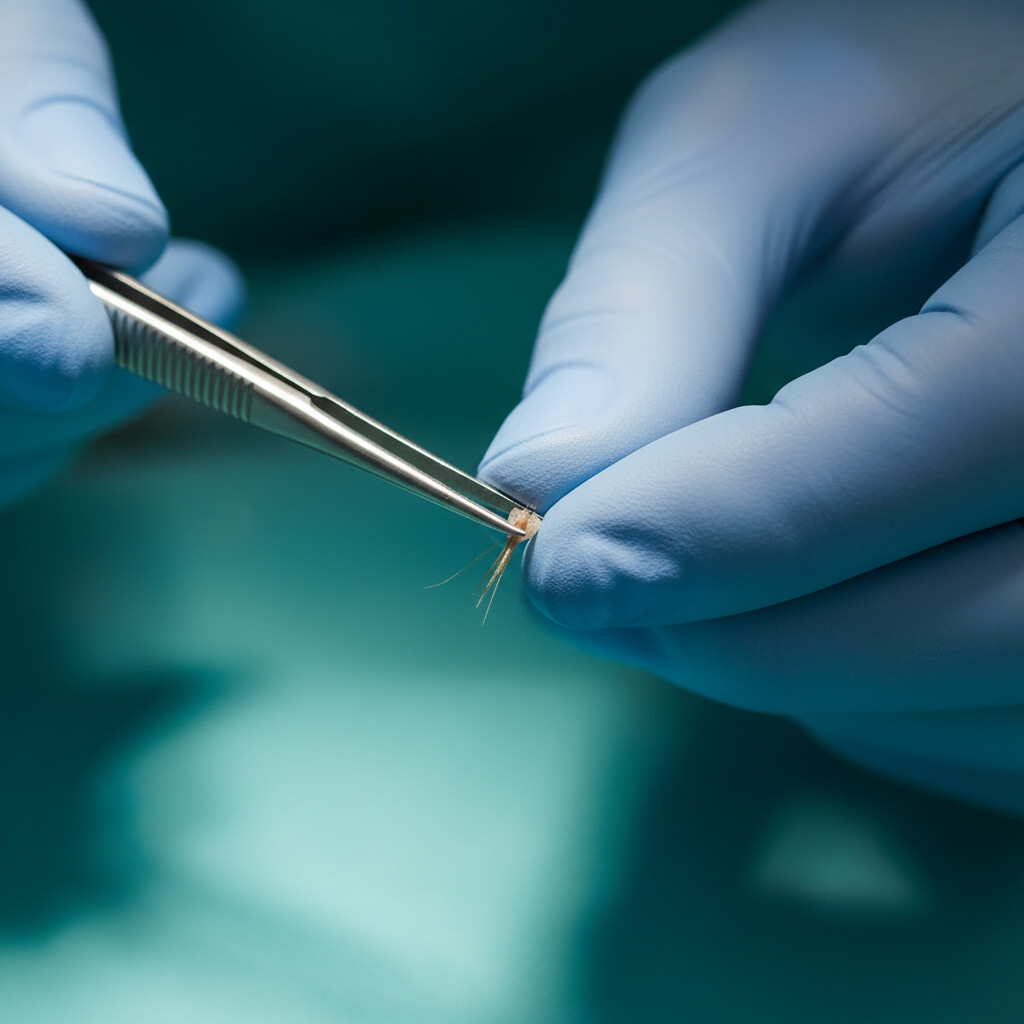
A hair transplant graft is one follicular unit: a natural group of one to four hairs, moved with a tiny amount of surrounding tissue from the donor area to a thinning area. Most grafts contain two or three hairs, so the number of hairs transplanted is usually around two to two and a half times the graft count, although this varies from person to person. How full the result looks depends not only on the number of grafts, but on how densely they are placed, the size of the area and the character of your hair.
Key takeaways
- One graft is one follicular unit with 1-4 hairs. “2,000 grafts” and “2,000 hairs” are very different things.
- Single-hair grafts are used for a soft hairline; two- and three-hair grafts add fullness behind it.
- A transplant can look full at a lower density than your original hair, but it rarely recreates youthful density over a large area.
- Your donor area is limited. The best plan balances coverage now with grafts kept in reserve for later.
- More grafts is not automatically better. Graft quality, handling and placement matter as much as the number.
What is a hair graft?
On the scalp, hair grows in small natural groups called follicular units. Each unit has one to four hairs, plus the tiny oil glands, nerves and blood vessels around them. In modern hair transplantation, these units are harvested whole and each one is called a graft.
There are two main ways to harvest grafts:
- FUE (follicular unit excision or extraction): each graft is removed individually with a small punch, typically under 1 mm wide. It leaves many tiny dot scars spread across the donor area, which are usually hard to see once hair grows back but are not invisible if the head is shaved very short.
- FUT (strip method): a thin strip of scalp is removed from the back of the head and dissected into individual grafts under magnification. It leaves a linear scar that is normally hidden by surrounding hair.
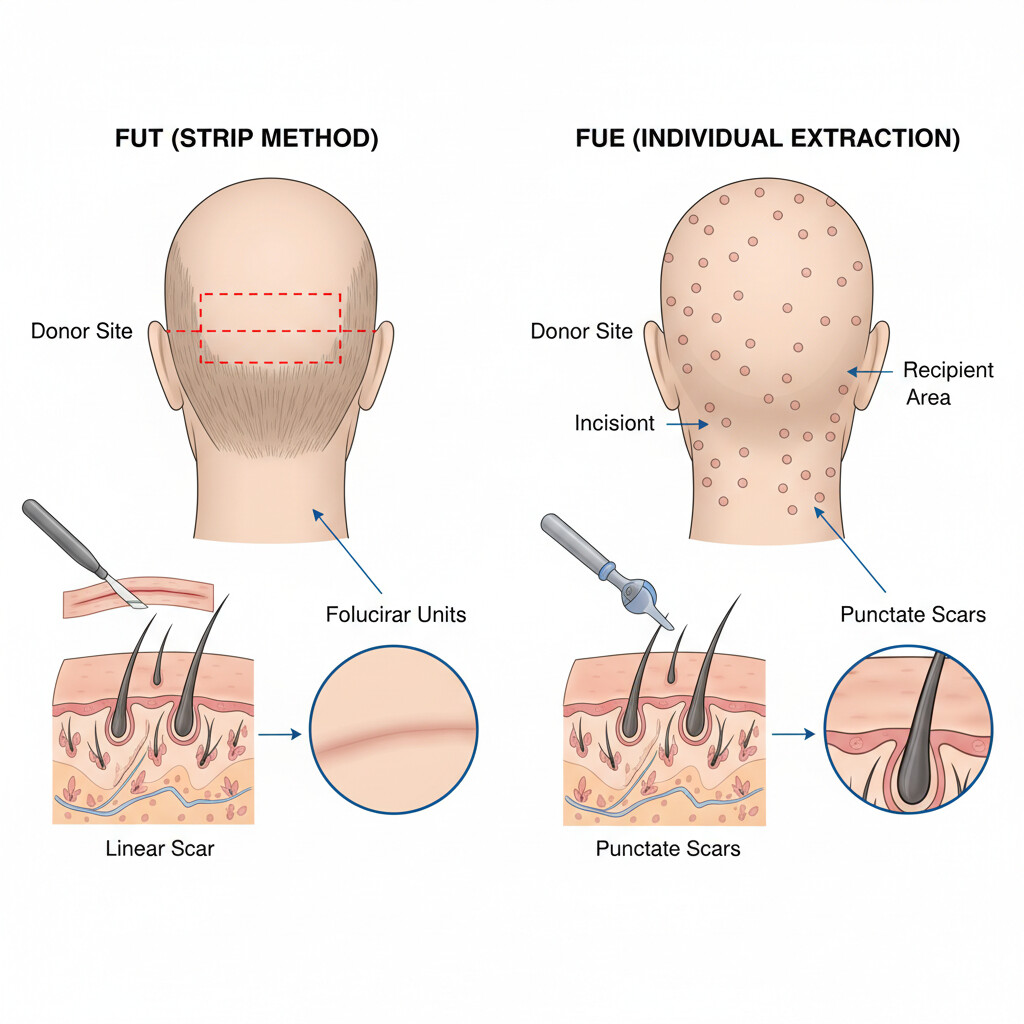
Both methods move the same basic unit. The graft is what counts, not the brand name of the technique. Our guide on whether technique affects long-term density explains why skill and handling usually matter more than the method’s label.
How many hairs are in one graft?
It varies between people and even between parts of the same donor area. As a general pattern:
- Two-hair grafts are usually the most common.
- Single-hair and three-hair grafts are less common, in proportions that differ from person to person.
- Four-hair grafts are relatively rare.
The average is often quoted at around 2 to 2.5 hairs per graft. Some people have mostly single- and two-hair units, which means fewer hairs per graft. Others have many three-hair units, which gives more coverage per graft. A surgeon can estimate your mix by examining the donor area under magnification.
Grafts vs. hairs: why the difference matters
When you compare quotes, check whether a clinic is counting grafts or hairs. A procedure of 2,000 grafts will usually move somewhere around 4,000-5,000 hairs. A quote for “4,000 hairs” may therefore be a much smaller procedure than a quote for 4,000 grafts.
Ask each clinic:
- How many grafts do you plan to transplant, and roughly how many hairs is that for me?
- How will single-, two- and three-hair grafts be distributed?
- How many grafts can my donor area safely provide in total, not just in this session?
Some clinics count grafts in front of the patient or provide a written breakdown after surgery. It is reasonable to ask how the final count will be recorded.
How grafts are placed for a natural look
A good surgeon uses different grafts for different zones:
- The front edge of the hairline is built mostly from single-hair grafts, placed irregularly so the line looks soft rather than straight or “pluggy.”
- Behind the hairline, two- and three-hair grafts are used to build fullness.
- The crown has a whorl, where hair grows in a spiral. Grafts must follow this direction, and the area usually needs many grafts to look covered.
The angle and direction of each graft are as important as the number. Grafts placed at the wrong angle can look unnatural even when density is good.
Density: what “full” really means
Density is usually described as the number of grafts (or hairs) per square centimetre. Two facts help set expectations:
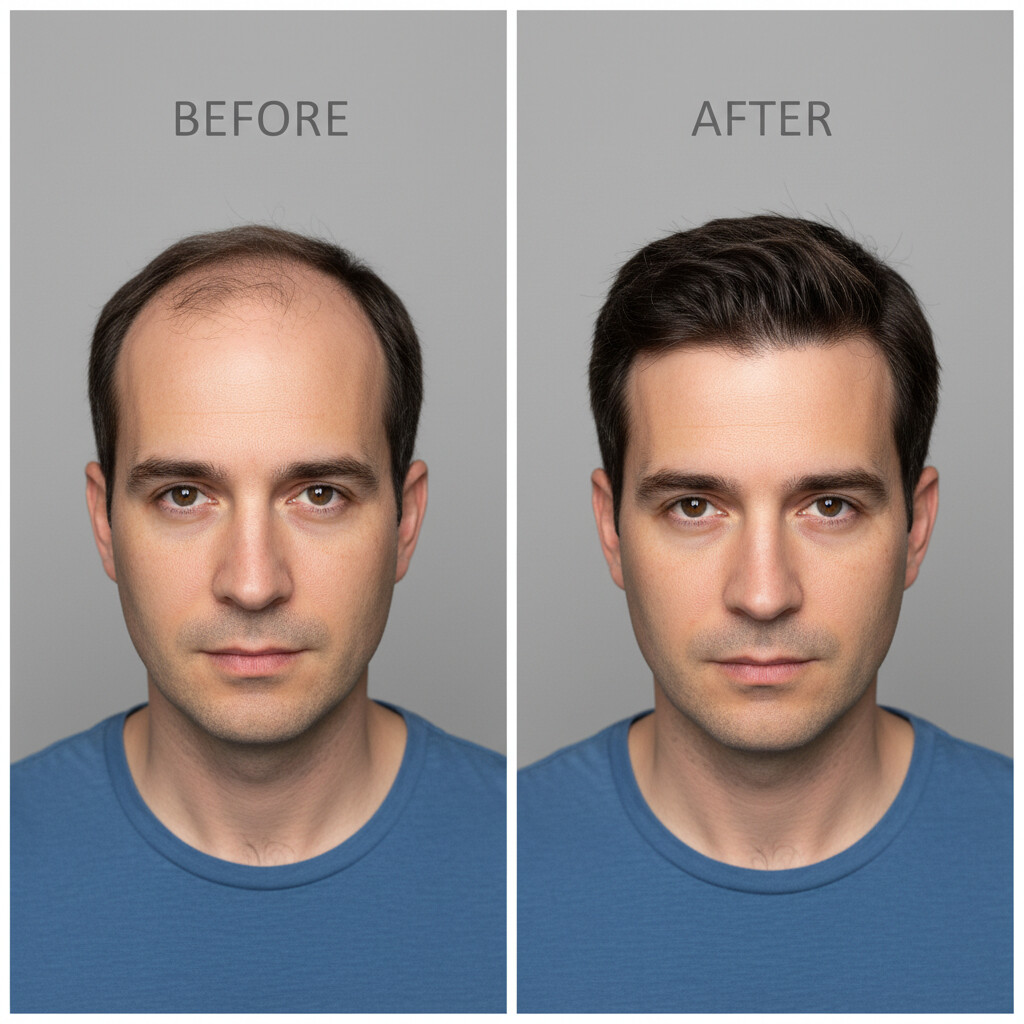
- Hair loss often isn’t obvious until a large share of the original hair has gone. In the same way, a transplant does not need to restore your original density to look full in most lighting.
- Transplanted density is lower than native density. Surgeons commonly place somewhere around 30-50 grafts per square centimetre in one session, depending on the area, the patient and the plan. Packing grafts much more tightly can reduce blood supply and survival, and it uses donor hair faster.
How full the result looks also depends on:
- Hair calibre: thick hair covers more scalp than fine hair.
- Curl or wave: curly hair gives more coverage per graft.
- Colour contrast: dark hair on pale skin shows gaps more; salt-and-pepper or light hair on light skin looks fuller.
- Hairs per graft: a donor area rich in multi-hair units gives more fullness per graft.
For a closer look at hairline and crown density choices, see our guide on how dense a hair transplant should be.
How many grafts will you need?
There is no universal number. It depends on the size of the area, the density you want, your hair characteristics and, above all, how many grafts your donor area can safely give. A hairline-only procedure may need a relatively modest number. Covering the front, top and crown of an advanced case can need several thousand grafts, often over more than one session.
Very large single sessions are sometimes offered. They can suit some patients with an excellent donor area, but they mean longer surgery, more time grafts spend outside the body, and a greater risk of overharvesting. Read how many grafts can be transplanted in one session and why mega sessions may not be right for everyone.
The donor limit
Your donor supply is finite. Each graft removed does not grow back in the donor area, and taking too many from one zone leaves visible thinning. A careful surgeon spreads extraction evenly and thinks about your whole life, not just this procedure. If your hair loss is likely to progress, keeping grafts in reserve for a future crown or repair session can matter more than maximising density today.
Graft survival: why handling matters
A graft only becomes hair if it survives. Between extraction and implantation, grafts are kept moist and cool, usually in a storage solution, and handled gently to avoid crushing or drying. Long surgeries increase the time grafts spend outside the body, which is one reason very large sessions need an experienced team.
After surgery, most transplanted hairs shed in weeks 2-8. This is normal shedding of the transplanted hair shafts, not graft failure; the follicle stays in the skin. Some people also notice temporary shock loss of native hairs near the operated areas. New growth usually starts around months 3-4, and the final result is typically visible at 12-18 months.

Common questions
Is 3,000 grafts the same as 3,000 hairs?
No. 3,000 grafts usually means somewhere around 6,000-7,500 hairs, depending on how many hairs your grafts contain. Always check which unit a clinic is using.
Do more grafts always give a better result?
No. Beyond a certain point, extra grafts add little visible density but use up donor hair. Placement, angle and survival matter as much as the number.
Will every graft grow?
Most grafts in a well-performed procedure grow, but not every single one. Survival depends on surgical handling, your health and aftercare. No honest clinic can promise complete growth.
Can I check how many grafts I actually received?
Ask before surgery how grafts are counted and whether you will get a written record. Some clinics show patients the counted grafts on the day.
Discussion
How many grafts did you have, and did your clinic tell you the hair count and the mix of single-, two- and three-hair grafts? Looking back, did the number match the density you got? Share your numbers and photos to help others compare.
Sources
- Logic of Hair Transplantation, Journal of Cutaneous and Aesthetic Surgery, 2017
- Controversies in Hair Transplantation, Journal of Cutaneous and Aesthetic Surgery, 2017
- Approach to Hair Transplantation in Advanced Grade Baldness by FUE: Retrospective Analysis of 820 Cases, Journal of Cutaneous and Aesthetic Surgery, 2018
- 7 Innovative Techniques in Hair Transplantation, ISHRS
Related guides
- How Many Grafts Can Be Transplanted in One Session?
- Hair Transplant Density: How Dense Should It Be?
- Does Hair Transplant Technique Affect Long-Term Density?
- What Is a Hair Transplant Mega Session, and Is It Right for You?
- Hair Transplant Donor Area: Why Back-of-Head Hair Resists DHT
About this guide: ForumHairTransplant.com is an independent patient community. We are not affiliated with any clinic or surgeon, and we don’t accept payment for rankings, reviews or recommendations. This article is general information, not medical advice. Talk to a qualified doctor about your own situation.