By ForumHairTransplant Editorial Team · Prepared with AI assistance · Sources checked: 19 October 2026
In a hair transplant, grafts are taken from the “safe donor zone”: a horseshoe-shaped band at the back and sides of the head. Hair in this zone is much less sensitive to DHT, the hormone behind pattern hair loss, and it usually keeps that resistance after it is moved to the top of the head. This is why transplanted hair can last. But the donor zone is resistant, not immune, and it is limited in size. The very lowest hairs on the nape are not always the most reliable. This guide explains how the donor area is chosen, assessed and protected.
Key takeaways
- The best donor hair usually comes from the middle of the back of the head and the sides, not the very bottom of the nape or the upper edge of the fringe.
- Donor follicles keep their DHT resistance after transplantation, a principle known as donor dominance.
- “Resistant” does not mean “immune.” In some people the donor area thins with age or with a diffuse pattern of hair loss.
- The donor supply is finite. Overharvesting leaves visible thinning and limits future sessions.
- A careful surgeon checks donor density and quality under magnification before promising any graft number.
What is the donor area?
The donor area is the part of the scalp where hair is expected to stay for life, even in people with advanced pattern baldness. It usually runs from above one ear, around the back of the head, to above the other ear.
The exact boundaries differ from person to person. In someone whose hair loss is likely to become very advanced, the permanent band is narrower, and harvesting too close to its upper or lower edge risks taking hairs that may later thin. Surgeons estimate the safe zone from your current pattern, your age, your family history and a close look at the hair itself.
Why donor hair resists DHT
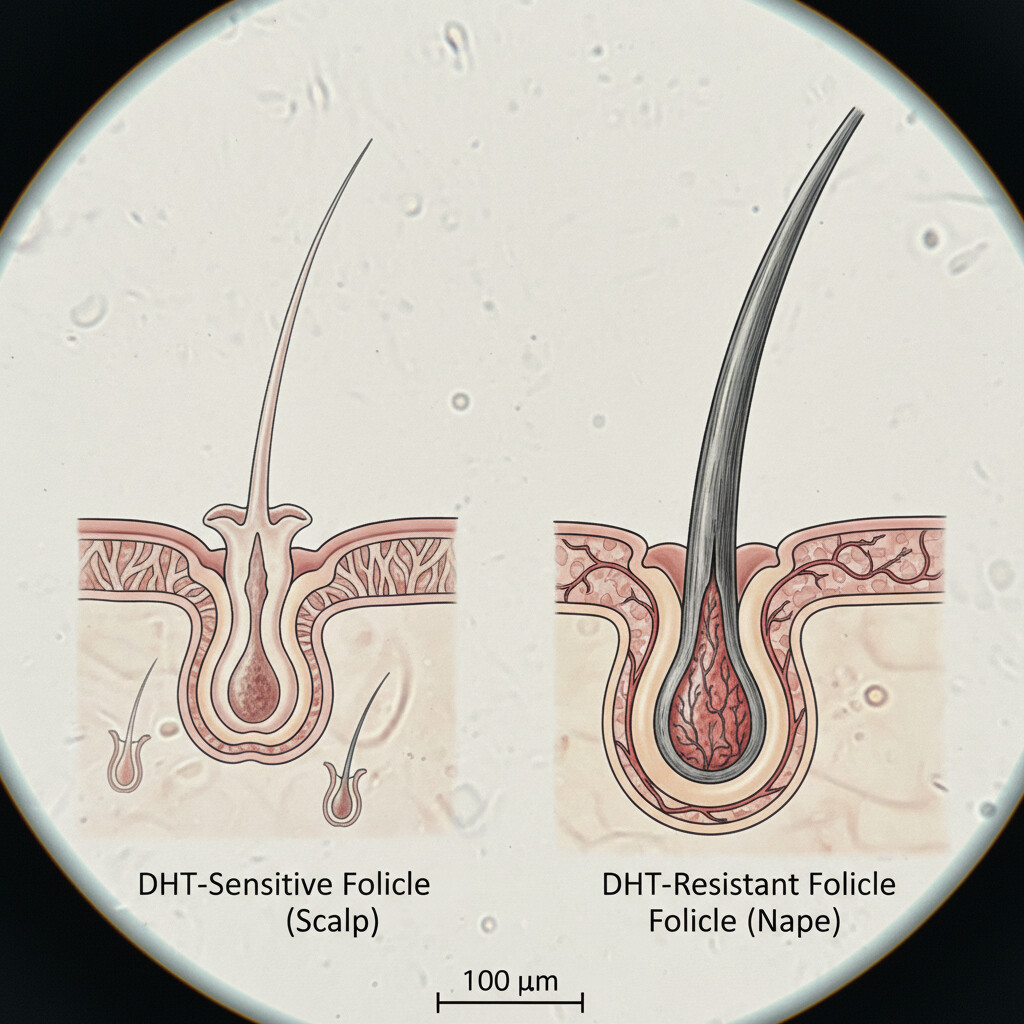
In androgenetic alopecia, testosterone is converted into DHT (dihydrotestosterone). In genetically susceptible follicles on the top and front of the scalp, DHT gradually shrinks the follicle, a process called miniaturisation. Each hair cycle produces a thinner, shorter hair, until the follicle may stop producing visible hair.
Follicles at the back and sides of the head respond much less to DHT. The exact biology is not fully understood, but the difference appears to lie in the follicles themselves, such as how they respond to androgens. The key point for patients is well established: donor follicles generally keep their own behaviour when moved. A follicle taken from the back of the head continues to act like back-of-head hair after it is placed in the hairline. This principle is called donor dominance, and it is the basis of every hair transplant.
Is the nape really the best donor area?
The word “nape” is often used loosely to mean the back of the head, but the details matter:
- The middle of the back of the head (occipital area) and the sides above the ears usually give the most reliable, thickest donor hair.
- The lowest part of the nape, close to the neck, often has finer hair. In some people it thins over time, and it can grow at flatter angles. Extraction scars there can also be more visible with short haircuts.
- The upper edge of the donor band can be affected by future hair loss in people heading towards advanced baldness.
Finer hairs from lower areas are sometimes used on purpose, for example to create a soft front edge of the hairline, but they should not be the main supply. A surgeon who harvests evenly from the most stable part of the zone protects both your result and your donor appearance.
Resistant, not immune
Most people keep their donor hair for life, but there are exceptions:
- Age-related thinning: donor density often decreases slowly with age.
- Diffuse patterns of loss: some people have thinning that also affects the sides and back. This is sometimes called diffuse unpatterned alopecia, and it can make someone a poor candidate.
- Retrograde thinning: in some men, the lower and outer edges of the donor area thin over time.
Because of this, a good assessment includes looking for miniaturised hairs in the donor area with magnification (trichoscopy), not just a glance at the back of the head. Our article Can Donor Hair Thin Over Time? covers this in more detail.
How donor quality is assessed
Two people with the same bald area can have very different options, depending on their donor area. A surgeon looks at:
- Density: how many follicular units there are per square centimetre.
- Hairs per graft: donor areas rich in two- and three-hair units give more coverage per graft.
- Hair calibre and texture: thicker, wavier or curly hair covers more scalp.
- Colour contrast between hair and skin.
- Scalp laxity: important if FUT is being considered.
- Size of the safe zone and the likely future pattern of loss.
From this, they can estimate a lifetime donor capacity: roughly how many grafts can be taken over one or more sessions without visible thinning. If you are wondering whether anything helps before surgery, see Can You Improve Donor Area Quality Before Surgery?
Harvesting from the donor area: FUE vs. FUT
Both main methods use the same safe donor zone. They differ in how grafts are removed and what the donor area looks like afterwards.
FUE (follicular unit excision)
Grafts are removed one by one with a small punch, typically under 1 mm wide.
- Pros: no linear scar, usually quicker donor recovery, allows shorter haircuts, and can also harvest beard or body hair.
- Cons: leaves many small dot scars across a wider area. These are usually hard to see but can show on a very short shave. Poor technique can transect (cut) follicles or overharvest one zone. The donor area usually needs shaving.
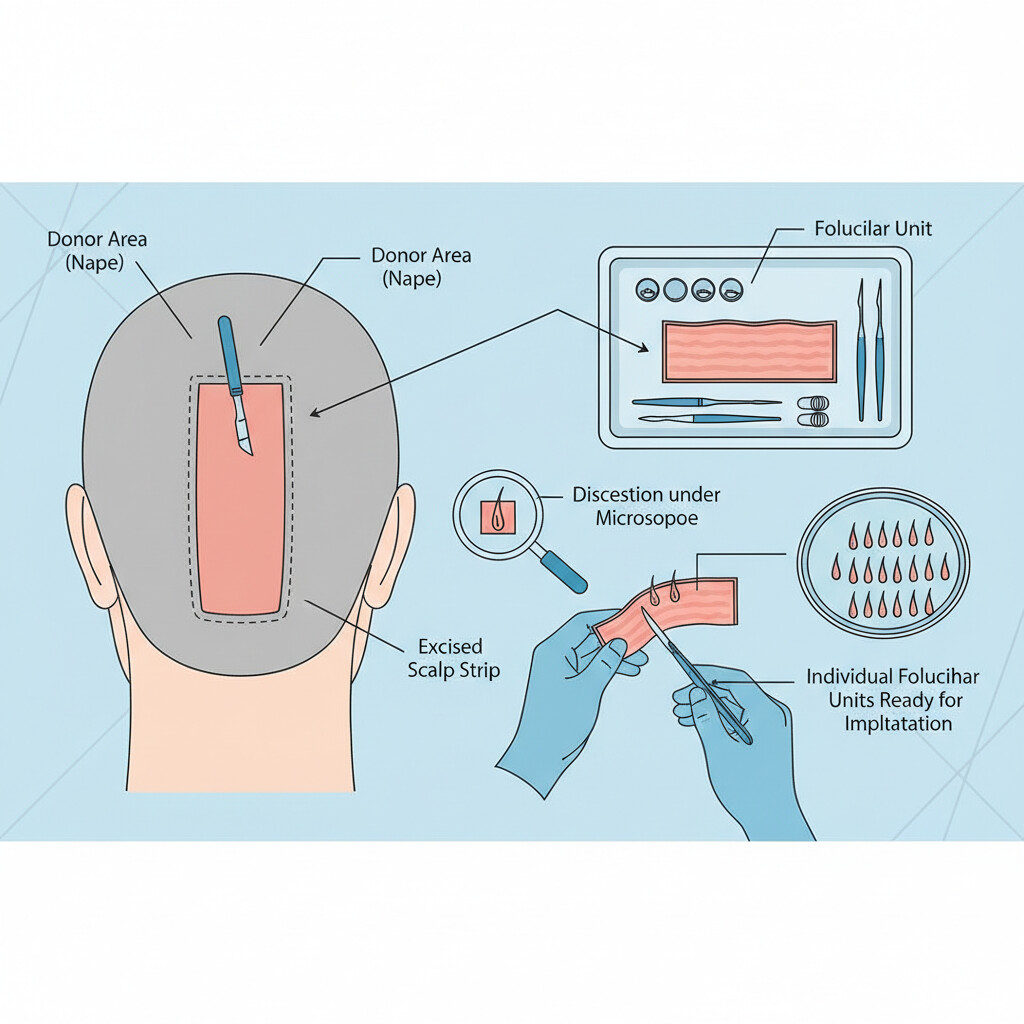
FUT (strip method)
A thin strip of scalp is removed, the wound is stitched closed, and the strip is divided into grafts under magnification.
- Pros: can yield a large number of grafts from the most stable central band, with little need to shave, and graft quality is often good.
- Cons: leaves a linear scar that can show with very short hair, causes more tightness and discomfort in the first weeks, and needs stitch removal or dissolving stitches. Scalp laxity limits repeat sessions.
Some surgeons combine the two methods to maximise lifetime donor supply. Neither method is scarless. Read more in Hair Transplant Scars: FUE and Natural Results.
Protecting the donor area from overharvesting
Every follicle removed is gone from the donor area for good. If too many grafts are taken, or taken unevenly, the back of the head can look thin, patchy or “moth-eaten.” This is difficult to repair, because the damaged area is also the source of grafts for any repair work. See Understanding Overharvesting in Hair Restoration.
Ask any clinic how many grafts they plan to take, how many they think your donor area can give over your lifetime, and how much they intend to keep in reserve for future sessions or crown work.
Alternative donor areas
If scalp donor supply is limited, beard hair (especially under the chin) and sometimes chest hair can be used as a supplement. These hairs differ in thickness, growth cycle and texture, so they are usually used to add density behind the hairline or in the crown rather than to build the hairline itself. See Alternative Donor Areas: Beard and Body Hair.
Healing and aftercare of the donor area
After FUE, the donor area is usually red with small scabs for about one to two weeks. After FUT, there is a stitched wound that can feel tight. Typical advice includes:
- Keep the area clean and wash exactly as your clinic instructs.
- Use any ointment, antibiotic or pain relief only as prescribed.
- Avoid heavy exercise and anything that stretches or bumps the donor area for the period your surgeon advises, especially after FUT.
- Protect healing skin from strong sun.
Temporary numbness, tingling or itching in the donor area is common and usually settles over weeks to months.
When to contact your surgeon
Contact your clinic or a local doctor if you notice:
- increasing pain, warmth, swelling or spreading redness after the first few days,
- pus, a bad smell, or a fever,
- bleeding that does not stop with gentle, steady pressure,
- an FUT wound that opens up,
- patchy thinning in the donor area that appears or worsens months after surgery.
Common questions
Will the donor area grow back after FUE?
The extracted follicles do not grow back, but the hair left in between hides the extraction sites once it grows. With careful, even harvesting, most people’s donor area looks normal at a moderate hair length.
Can transplanted donor hair fall out later?
Transplanted hair generally keeps the resistance of its donor site, so it tends to last. It can still thin with age, like the donor area itself. Native hair around the transplant can continue to be lost.
How many grafts can my donor area give?
It varies widely with density, the size of the safe zone and hair characteristics. Only an in-person assessment can give a realistic estimate. Be wary of large numbers promised from photos alone.
Can the donor area be used again?
Often, yes, if the first procedure was conservative. See Can Donor Hair Be Reused in Future Sessions?
Discussion
How did your clinic assess your donor area, and did they tell you your estimated lifetime graft supply? If you have had FUE or FUT, how does your donor area look now at your usual haircut length? Share your experience and photos below.
Sources
- Androgenetic Alopecia: A Guide to Pattern Hair Loss, ISHRS
- Controversies in Hair Transplantation, Journal of Cutaneous and Aesthetic Surgery, 2017
- Assessment of Safe Donor Zone of Scalp and Beard for FUE in Indian Men: 580 Cases, Journal of Cutaneous and Aesthetic Surgery, 2018
Related guides
- Do I Need More Than One Hair Transplant Session?
- Can You Improve Donor Area Quality Before Surgery?
- Hair Grafts Explained: Hairs per Graft, Count and Density
- Who is a Good Candidate for a Hair Transplant?
- The Fundamental Principles of Hair Transplantation: A Permanent Solution to Hair Loss
About this guide: ForumHairTransplant.com is an independent patient community. We are not affiliated with any clinic or surgeon, and we don’t accept payment for rankings, reviews or recommendations. This article is general information, not medical advice. Talk to a qualified doctor about your own situation.