
By ForumHairTransplant Editorial Team · Prepared with AI assistance · Sources checked: 19 October 2026
A hair transplant is a surgical procedure that moves hair follicles from the back and sides of the scalp (the donor area) to areas that are thinning or bald. The moved hair usually keeps growing for life, because donor follicles are naturally resistant to the hormone behind pattern baldness. But a transplant does not cure hair loss: your native hair can keep thinning, and the number of grafts you can move is limited by your donor supply. This guide explains how it works, the main techniques, who it suits, what recovery looks like, and how to plan it well.
Key takeaways
- A transplant redistributes your own hair. It does not create new hair, so your donor area sets the limit on coverage and density.
- Transplanted hair is generally permanent, but hair loss in untreated areas can continue. Long-term planning matters as much as the surgery.
- The main techniques are FUE and FUT; DHI is a way of implanting FUE grafts. The surgeon’s skill and planning matter more than the technique’s name.
- Transplanted hairs usually shed in the first weeks. Growth starts around months 3-4, and the final result takes about 12-18 months.
- It is a real operation with real risks. A careful diagnosis and a well-chosen clinic reduce most of them.
How a hair transplant works
In male pattern baldness (androgenetic alopecia), follicles on the top of the head gradually shrink under the influence of DHT, a hormone derived from testosterone. Follicles in a horseshoe around the back and sides are genetically less sensitive to DHT, which is why many men keep hair there for life.
A transplant takes follicles from this stable zone and places them where hair has been lost. The follicles keep their original characteristics after they are moved. This principle is called “donor dominance”, and it is the reason the results last.
Hair naturally grows in small groups of 1-4 hairs called follicular units. Modern transplants move these units one by one as “grafts”, which is why well-done results look natural rather than “pluggy” like some older methods.
The main techniques
FUE (Follicular Unit Extraction)
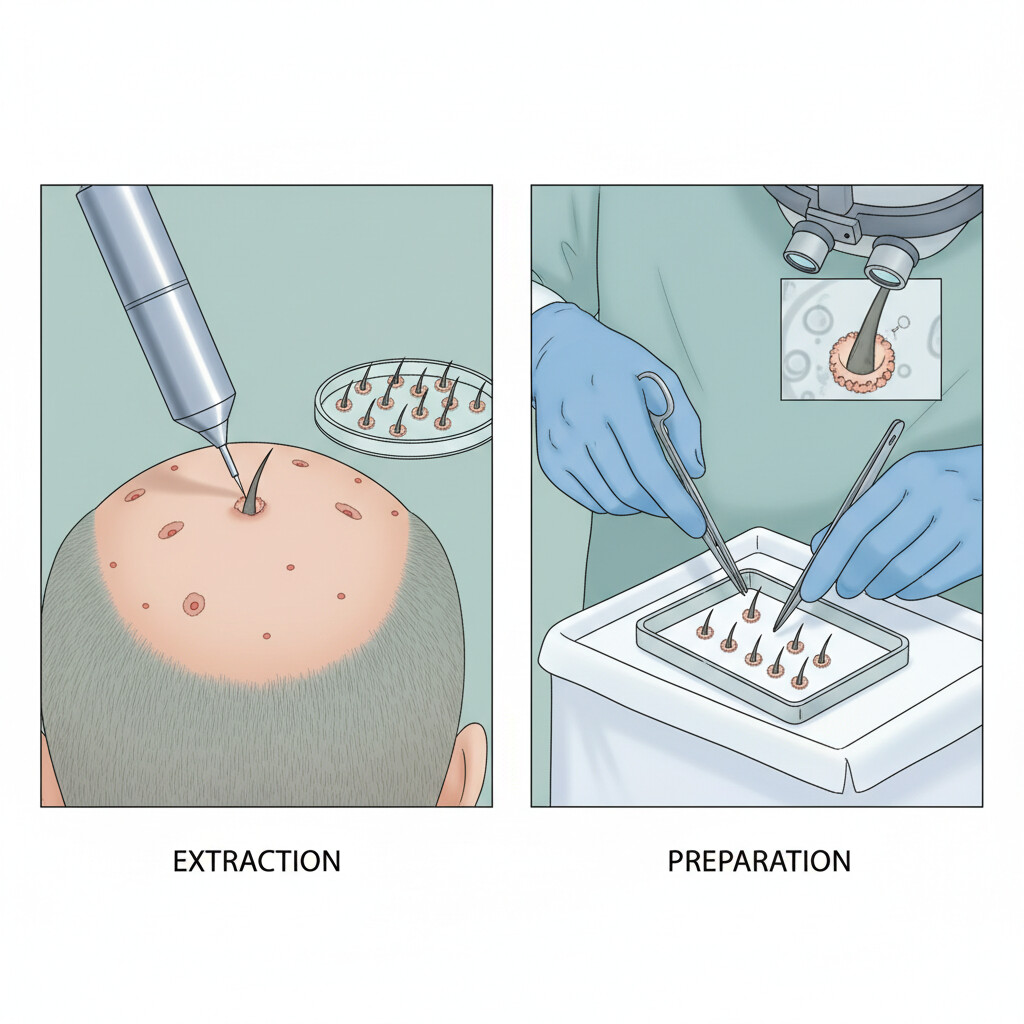
In FUE, individual follicular units are removed from the donor area with a small circular punch, typically under about 1 mm in diameter. Each extraction leaves a tiny round scar. These are usually hidden by surrounding hair, although they can show if the donor area is shaved very close or has been overharvested. FUE is the most common method today. Read more in our guide to the FUE method.
FUT (Follicular Unit Transplantation, “strip” method)
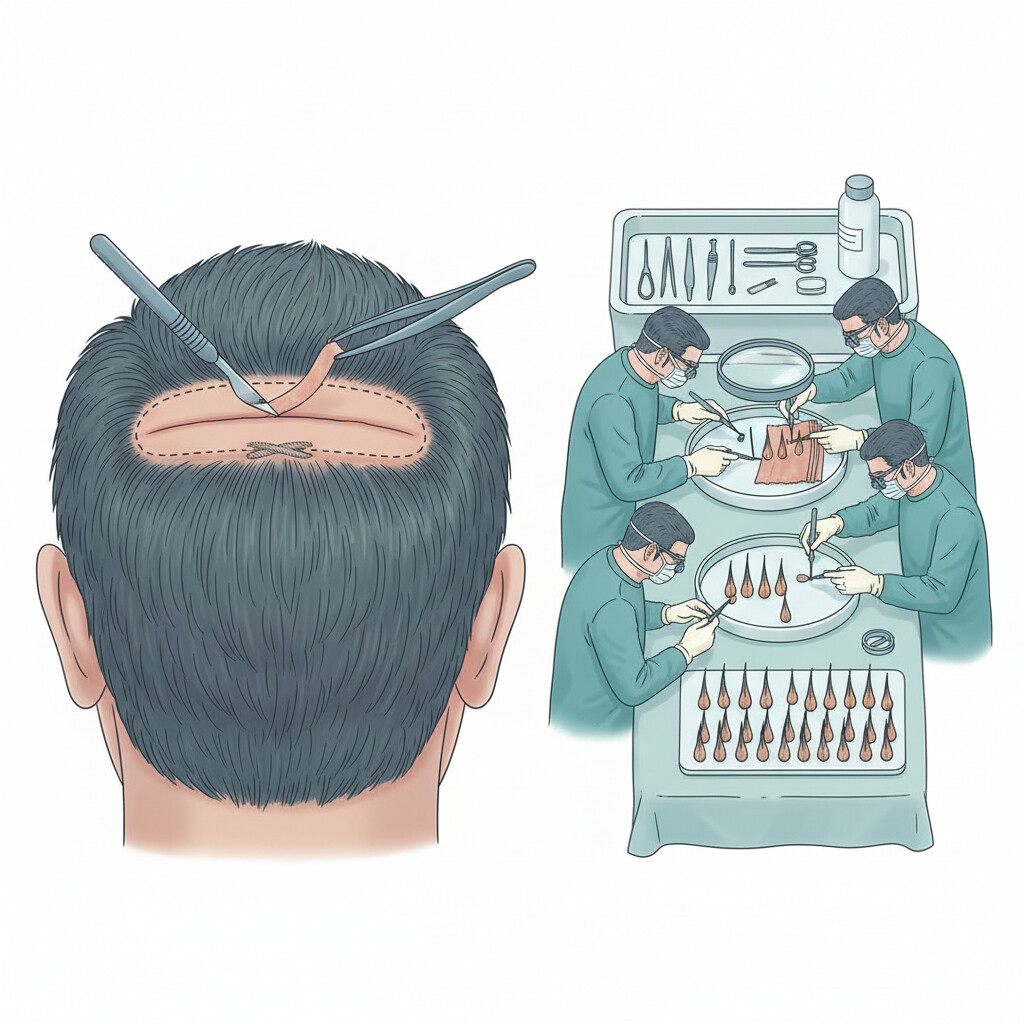
In FUT, the surgeon removes a thin strip of scalp from the donor area, closes the wound with stitches, and a team dissects the strip into individual grafts under microscopes. FUT leaves a single linear scar that is usually hidden under hair of moderate length but can show with very short haircuts. It is less common than FUE today, but some surgeons still prefer it for certain patients, for example when a large number of grafts is needed and the patient wears their hair longer.
DHI and other names
DHI (Direct Hair Implantation) is not a separate way of harvesting. Grafts are extracted by FUE, then loaded into a pen-like implanter that creates the opening and places the graft in one motion. Some clinics like it for dense packing between existing hairs; others prefer making incisions first and placing grafts with forceps. See DHI Hair Transplant Technique for the details.
You will also see names such as “Sapphire FUE” or other branded techniques. These usually describe the tool used for one step of the procedure. They can be useful, but they are no substitute for an experienced surgeon and a sensible plan.
| FUE | FUT (strip) | |
|---|---|---|
| Harvesting | Individual units with a small punch | A strip of scalp, then dissected |
| Donor scar | Many small dot scars | One linear scar |
| Short haircuts | Usually possible | Scar may show |
| Early recovery | Donor area heals quickly | Stitches, more tightness at first |
| Typical use | Most patients today | Selected cases, often longer hair |
Who is a good candidate?
A transplant tends to work best for people who:
- Have a clear diagnosis of pattern hair loss, rather than a temporary or inflammatory type of shedding.
- Have a good donor area: enough density, reasonable hair thickness, and no signs that the donor zone itself is thinning.
- Are in good general health, or have conditions such as diabetes or high blood pressure that are well controlled.
- Have realistic expectations about density, and understand they may need medical treatment or a second session later.
Age matters too. In younger men, hair loss is often still progressing, and it is hard to predict the final pattern. Planning a low, dense hairline too early can use up donor hair and look out of place later. Women’s hair loss is usually more diffuse and needs a different assessment. Conditions that can cause shedding, such as thyroid problems, iron deficiency or telogen effluvium, should be ruled out or treated first.
What happens on the day
A typical FUE day follows these steps. The full sequence is described in Hair Transplant Stages: Before, During and After.
- Consultation and planning. The surgeon examines your hair loss and donor area, discusses goals, and marks the hairline and recipient areas. This should ideally involve the surgeon, not only a sales coordinator.
- Preparation. The donor area is usually trimmed short. Local anaesthetic is injected; this is the most uncomfortable part for most people.
- Harvesting. Grafts are extracted by FUE, or a strip is removed for FUT.
- Graft handling. Grafts are sorted and kept in a cooled storage solution until they are placed.
- Recipient sites. Small openings are made in the thinning area. Their angle, direction and spacing largely decide how natural the result looks.
- Implantation. Grafts are placed into the openings, with forceps or an implanter pen.

A procedure usually takes most of a day, depending on the number of grafts and the team. You are awake throughout and normally go home or to your hotel the same evening.
Recovery and results timeline
These are typical patterns; your surgeon’s instructions come first.
- Days 1-3: Tenderness, some swelling of the forehead, and small crusts. You avoid touching the grafts and follow your clinic’s washing routine.
- Days 7-14: Crusts come off with gentle washing. Many people return to desk work within a week; more physical jobs and training usually wait longer.
- Weeks 2-8: Most transplanted hairs shed. This is expected and not a sign of failure. The follicles stay in the scalp and regrow. Some people also get shock loss, a temporary shedding of native hairs near the operated areas.
- Months 3-4: New hairs start to appear, often fine at first.
- Months 6-9: Clear improvement in coverage and thickness.
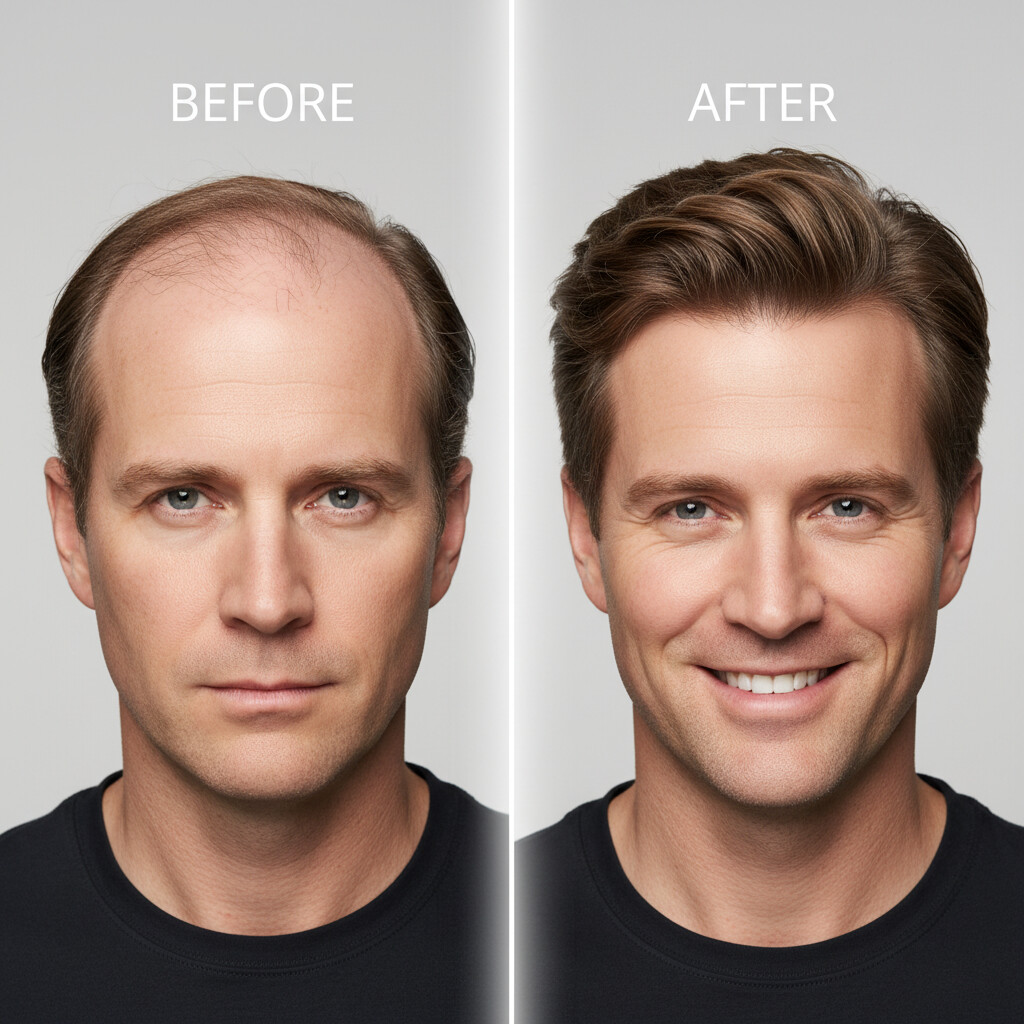
- Months 12-18: The final result, with the crown often taking longest.
The month-by-month growth timeline covers each stage in more detail.
Risks and limitations
A hair transplant is generally considered a low-risk procedure when it is done by a qualified team in a proper medical setting. Possible problems include:
- Swelling, redness and itching in the first days and weeks. These are common and usually settle on their own.
- Infection or folliculitis (inflamed hair follicles). Uncommon, but it needs prompt treatment.
- Numbness in the donor or recipient area. Usually temporary, lasting weeks to months.
- Poor growth from damaged grafts or poor handling.
- Unnatural design: a hairline that is too low, too straight or at the wrong angle.
- Overharvesting: a thinned or patchy-looking donor area from taking too many grafts.
- Ongoing native hair loss that leaves the transplanted area looking isolated over time.
The biggest limitation is supply. Your donor area can only give a limited number of grafts over a lifetime, so an honest plan balances today’s goals against future needs.
What does it cost?
Prices vary widely by country, clinic, surgeon involvement and number of grafts. Many clinics sell packages that include accommodation and transfers, while others charge per graft. When comparing quotes, check who performs each step, how many grafts are planned and why, and what follow-up is included. Our guide How Much Does a Hair Transplant Cost in 2026? explains what drives the price.
How to choose a clinic and surgeon
The team you choose has more influence on your result than the technique. Before deciding:
- Confirm who the surgeon is, what their qualifications are, and which steps they perform personally.
- Ask for many results from patients similar to you, including photos at 12 months or later and photos of the donor area.
- Be cautious of very large graft numbers promised without a proper donor assessment, and of pressure to book quickly.
- Check how aftercare and follow-up work, especially if you are travelling abroad.
- Read independent patient experiences, including the problems.
Our guide on how to choose a hair transplant clinic lists the questions to ask at consultations.

When to contact your surgeon
After surgery, contact your surgeon or a local doctor promptly if you notice:
- Pain that keeps getting worse instead of better after the first few days.
- Spreading redness, warmth, pus or a fever.
- Bleeding that does not stop with gentle pressure.
- Swelling that affects your vision or keeps increasing after the first few days.
Common questions
Is a hair transplant permanent?
The transplanted hair usually is, because donor follicles keep their resistance to DHT. Native hair around it can still thin, which is why many surgeons discuss medical treatment to protect it.
Does a hair transplant hurt?
The local anaesthetic injections sting. After that, most people feel pressure rather than pain during the procedure, and discomfort afterwards is usually manageable with simple painkillers.
Will I need more than one session?
Some people do, especially with advanced hair loss or if loss continues over the years. A good plan keeps some donor hair in reserve.
Can a transplant give me the density I had at 20?
Usually not. The aim is a natural, age-appropriate look with good coverage, not the full density of a teenager.
Discussion
Are you researching your first transplant, or have you already had one? Share what surprised you most about the process, and what you wish someone had told you before the consultation.
Sources
- Hair transplant, American Academy of Dermatology
- Hair replacement surgery, hair transplants, DermNet
- Hair transplant, NHS
- Hair transplant, MedlinePlus Medical Encyclopedia (NIH)
Related guides
- Who is a Good Candidate for a Hair Transplant?
- How Long Does a Hair Transplant Operation Take?
- Hair Transplant Aftercare: What to Do From Day 1 to Month 12
- Hair Transplant vs Hair Implant: What Is the Difference?
- Hair Transplant in Turkey: What to Expect Day by Day
- The Fundamental Principles of Hair Transplantation: A Permanent Solution to Hair Loss
About this guide: ForumHairTransplant.com is an independent patient community. We are not affiliated with any clinic or surgeon, and we don’t accept payment for rankings, reviews or recommendations. This article is general information, not medical advice. Talk to a qualified doctor about your own situation.