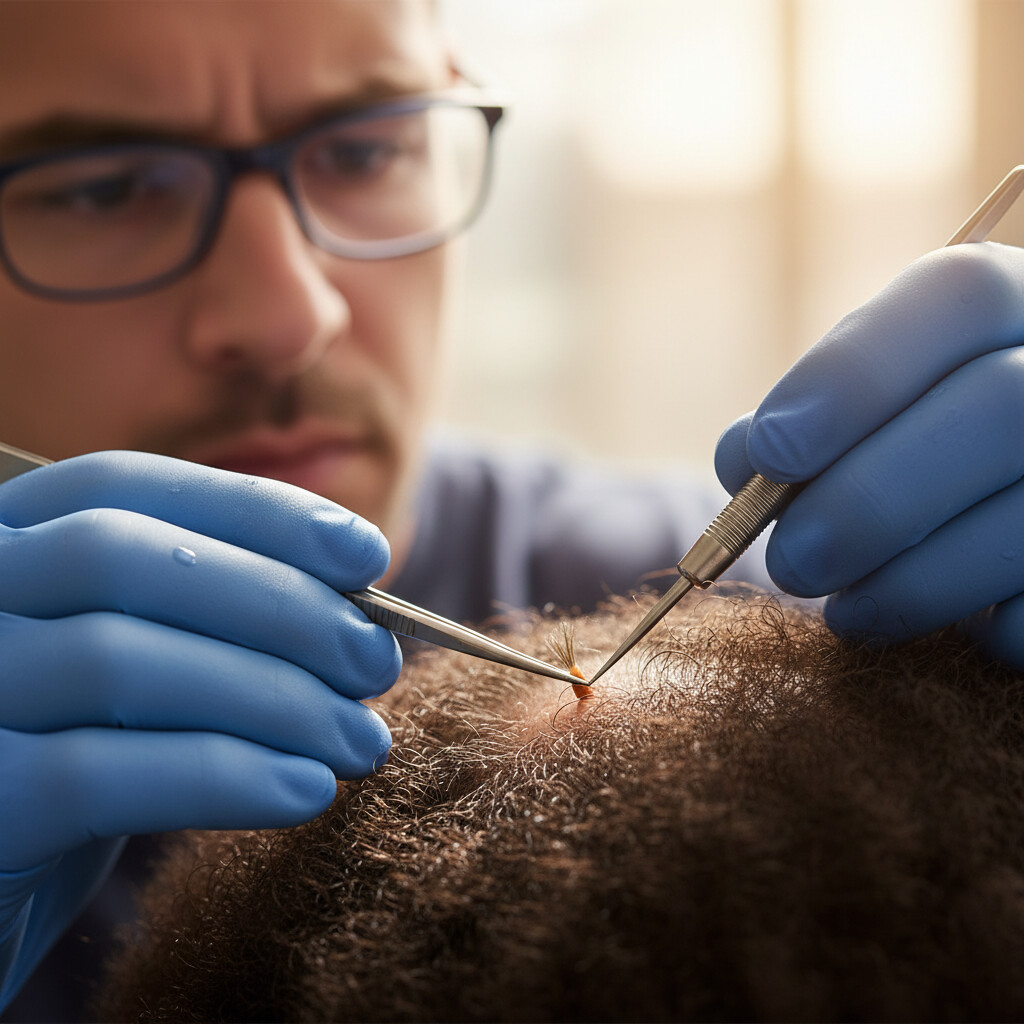
An Afro hair transplant uses the same basic methods as any other hair transplant, FUE or FUT, but adapted to the way Afro-textured hair grows. The key difference is under the skin: the follicles themselves are curved, which makes grafts easier to damage during extraction. “Afro technique” is a marketing label rather than one standard procedure, so what matters is whether the surgeon has real experience with curved follicles, keloid risk and Afro hairline design.
By ForumHairTransplant Editorial Team · Prepared with AI assistance · Sources checked: 19 October 2026
Key takeaways
- Afro-textured hair grows from curved follicles. Standard straight punches can cut through them, so surgeons often adjust punch size, type and depth, and may do a test extraction first.
- FUT (strip) is sometimes preferred for Afro hair because follicles are cut from the strip under direct vision, but it leaves a linear scar. FUE is also widely done with adapted technique.
- Afro hair usually has fewer hairs per square centimetre, but each curly hair covers a lot of scalp. A moderate number of grafts can give good visual coverage.
- People of African descent have a higher risk of keloid and thick scarring. Tell your surgeon about any keloids in you or your family.
- Some types of hair loss common in Afro hair, such as traction alopecia and scarring alopecias, need a diagnosis before anyone plans surgery.
What makes Afro-textured hair different?
Three features matter for surgery.
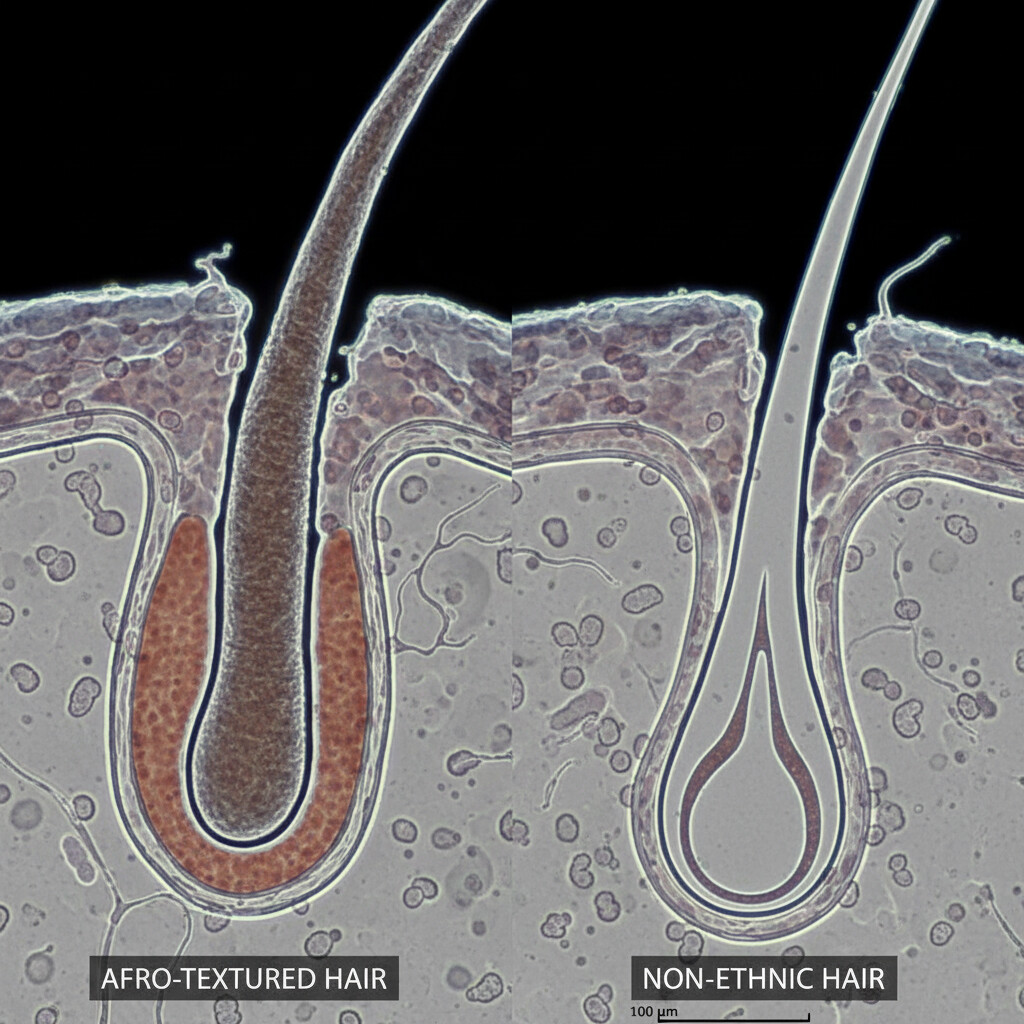
Curved follicles. In straight hair, the follicle runs in a fairly straight line beneath the skin. In Afro-textured hair the follicle itself curves, and the hair bulb can sit at a different angle than the visible hair suggests. When a straight punch follows the visible angle, it can cut across the lower part of the follicle. This is called transection, and a transected graft may grow poorly or not at all.
Hair shape and coverage. The hair shaft is flatter and more elliptical, which creates the tight curl. Afro hair often has a lower follicle density than straight hair, but each hair coils and spreads across the scalp. That means good coverage can often be achieved with fewer grafts than a similar area of straight hair would need. Our guide on graft numbers and density explains how grafts, hairs and coverage relate.
Skin healing. Keloids (raised scars that grow beyond the original wound) and hypertrophic scars are more common in people of African descent. Darker skin is also more prone to temporary light or dark marks after inflammation, so healed donor dots can look paler or darker than the surrounding skin.
Common causes of hair loss in Afro-textured hair
Before surgery, the cause of your hair loss must be clear. This is especially important because several conditions that look similar are treated very differently.
- Androgenetic alopecia (pattern hair loss). The same male or female pattern loss seen in other hair types. Usually suitable for a transplant if the donor area is good.
- Traction alopecia. Hair loss from long-term tension, for example tight braids, weaves, locs, extensions or cornrows. It usually affects the hairline and temples. If the follicles are permanently lost and the tension has stopped, a transplant can work well. If the hairstyle that caused it continues, the transplanted hair is at risk too.
- Scarring alopecias, such as central centrifugal cicatricial alopecia (CCCA), which mainly affects the crown. These destroy follicles and need treatment by a dermatologist. A transplant is only considered when the condition has been inactive for a long time, and results are less predictable.
If there is any doubt, ask for a dermatologist’s opinion and, if needed, a scalp biopsy before booking surgery.
FUE and FUT for Afro hair
Both methods can be used. The choice depends on your hair, your scarring risk, how short you like to wear your hair, and your surgeon’s experience. For a general comparison, see FUE vs. FUT.
FUE (follicular unit extraction)
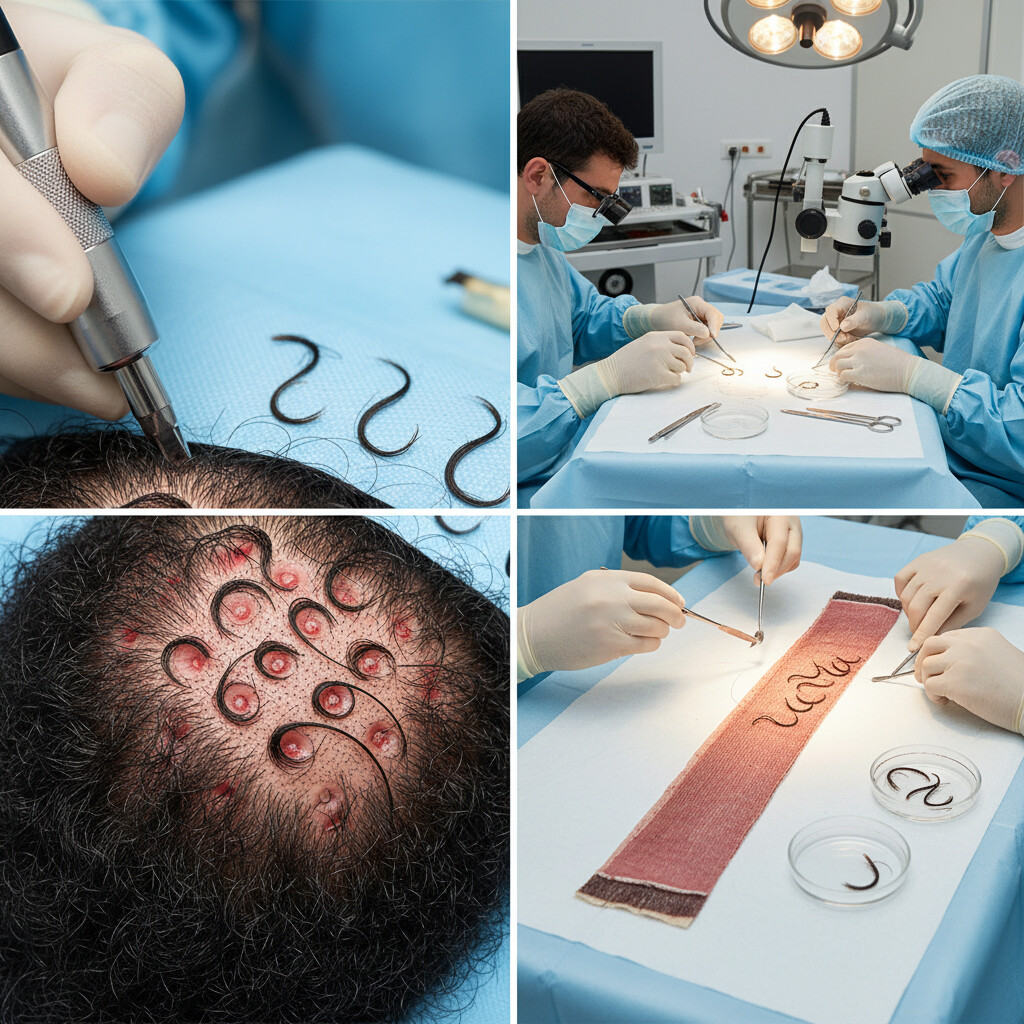
FUE removes grafts one by one with a small round punch. It avoids a linear scar and suits people who wear their hair very short. The challenge is the curved follicle. Surgeons experienced with Afro hair commonly:
- use punches that are slightly larger, or specially designed (for example curved or blunt) punches,
- make a shallow first cut and then free the graft gently rather than pushing the punch deep,
- do a small test extraction first to check the transection rate before committing to a large session,
- work more slowly, which can mean fewer grafts per day.
A larger punch removes slightly more skin per graft, so the donor dots may be a little bigger. With good planning they are still usually hidden by short hair.
FUT (strip surgery)
FUT removes a thin strip of skin from the back of the head. The follicular units are then dissected under a microscope, where the technician can see the curve of each follicle and avoid cutting it. For this reason, some surgeons prefer FUT for tightly curled hair.
The trade-off is a linear scar. Tight curls often camouflage it well at medium length, but it can be visible with very short hair. Because of the higher keloid risk, careful closure and a personal and family scar history are essential.
Keloid risk and how surgeons assess it
A keloid in the donor or recipient area is one of the most serious problems a transplant can cause, because keloids are hard to treat and can come back. Tell your surgeon if you have ever had:
- raised or growing scars after piercings, cuts, acne or surgery,
- keloids on the back of the neck or bumps after haircuts (common in men with Afro hair),
- a close family member with keloids.
Some surgeons do a small test session and wait a few months to see how the skin heals before doing a full procedure. People with active keloids are usually not suitable for a transplant. Our guide on chronic conditions including keloids goes into this in more detail.
Donor area management
The donor area is limited, and Afro hair often has fewer follicles per square centimetre to begin with. Taking too many grafts can leave the back of the head visibly thin, especially with short haircuts. A careful surgeon spreads extraction evenly and keeps some donor supply in reserve for the future. Read more about the risks of overharvesting.
FUE usually requires the donor area to be trimmed short. In selected cases, small trimmed strips can be hidden under longer hair. Whether that is realistic for you depends on your hair length and graft numbers.
Implantation and hairline design
Curved grafts can be harder to insert. Recipient sites may need to be slightly larger or deeper than for straight hair, and grafts are placed gently to avoid bending or crushing them. Both forceps implantation and implanter pens are used.
The hairline should respect natural Afro hairline patterns and your face, not copy a template designed for straight hair. The angle and direction of each graft decide how the curls lie. Recipient site creation explains why angle, direction and density matter so much.
Recovery and aftercare
Recovery is broadly the same as for other hair types:
- First days: redness, tenderness and some swelling. Follow your clinic’s washing routine exactly.
- Days 7-14: scabs loosen and come off with gentle washing.
- Weeks 2-8: most transplanted hairs shed. This is normal. It is different from shock loss, which is temporary loss of native hair near the operated areas.
- Months 3-4: new growth begins.
- Months 12-18: most people see their final result.
Points that matter more with Afro hair:
- Ingrown hairs and bumps. Curly regrowing hairs can curl back into the skin, causing small spots or folliculitis. Don’t pick at them; ask your clinic about treatment if they are frequent or painful.
- Styling. Avoid braids, weaves, extensions, tight styles, chemical relaxers and hair dye until your surgeon confirms the area has healed, often several weeks to months. In the long term, avoid styles that pull on the hairline, or traction loss can return.
- Moisture. Use only products your surgeon approves during healing. Heavy oils and gels should wait until the scabs are gone.
- Sun and pigmentation. Protect healing skin from strong sun to lower the risk of dark marks.
When to contact your surgeon
Contact your surgeon or a local doctor if you notice:
- a scar that becomes raised, hard, itchy or keeps growing after the first weeks,
- spreading redness, warmth, pus or fever,
- painful lumps or many inflamed bumps in the donor or recipient area,
- pain that gets worse rather than better.
Early treatment of a developing keloid or infection is much easier than later treatment.
Choosing a surgeon for Afro hair
Look for a surgeon who can show you real results on Afro-textured hair, ideally in people with a hair type and loss pattern like yours. Useful questions:
- How many Afro hair procedures do you do, and can I see results at 12 months or more?
- Do you recommend FUE or FUT for me, and why?
- What punch type and size do you use for curved follicles? Will you do a test extraction?
- How do you assess my keloid risk?
- How many grafts can my donor area safely provide over my lifetime?
Be careful with clinics that promise a special “Afro technique” but cannot explain what they actually do differently. Our guide Are New Hair Transplant Techniques Truly Better or Just Marketing? can help you judge those claims.
Cost
Prices vary widely by country and clinic. Afro hair procedures can cost more because extraction is slower and may need specialised instruments, but fewer grafts may be needed for the same visual coverage. Compare total graft numbers, who does the surgery and what aftercare is included, not just the headline price.
Common questions
Is an Afro hair transplant permanent?
Transplanted hair comes from the donor area, which is resistant to pattern baldness, so it usually keeps growing. It is not protected against traction, so tight styles can still damage it.
Can women with Afro hair have a transplant?
Yes, especially for traction alopecia at the hairline once the cause has stopped. Diffuse thinning and scarring alopecias need careful diagnosis first.
Will my donor scars be visible?
With FUE, small dot scars can be visible with a skin fade or shaved head, and may be lighter or darker than surrounding skin. With FUT there is a line. Discuss your usual haircut before choosing.
Discussion
If you have Afro-textured hair and have had a transplant, share which method was used, whether a test extraction was done, and how your donor area and scars healed. Your experience will help others in the same position.
Sources
- Hair Restoration in African-Americans (Yates), ISHRS, 2014
- Hair Transplantation (StatPearls), NCBI Bookshelf, NIH, 2025
The ISHRS page is from 2014.
Related guides
- SDHI, NEO FUE and Robotic FUE: What Is Actually Different?
- Sapphire FUE Hair Transplant: What It Is and Is It Better?
- Are New Hair Transplant Techniques Truly Better or Just Marketing?
- Hair Transplant With Psoriasis, Keloids or Antidepressants
- Hair Transplant Scars: Understanding FUE and Natural Results
About this guide: ForumHairTransplant.com is an independent patient community. We are not affiliated with any clinic or surgeon, and we don’t accept payment for rankings, reviews or recommendations. This article is general information, not medical advice. Talk to a qualified doctor about your own situation.