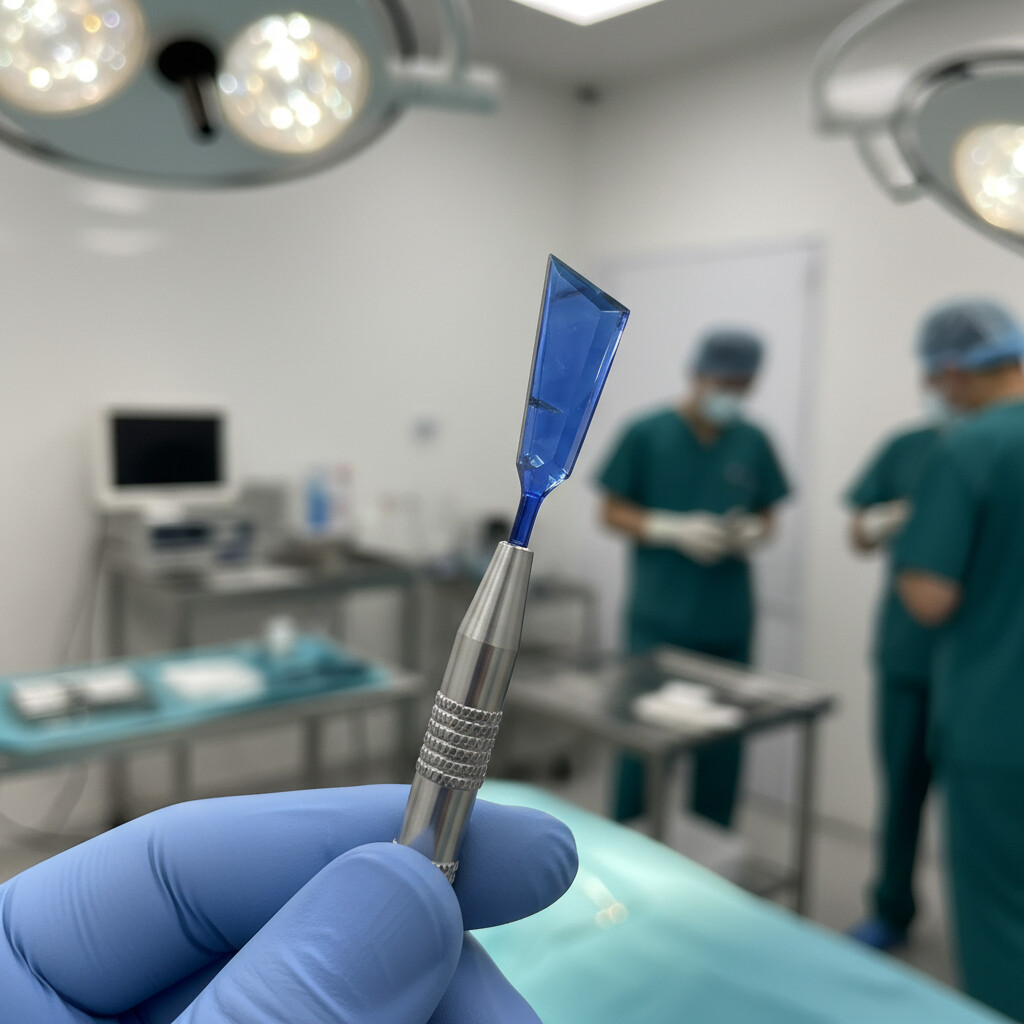
Sapphire FUE is a standard FUE hair transplant in which the small openings for the grafts (recipient sites or “channels”) are made with blades cut from synthetic sapphire instead of steel. Extraction is the same as in any FUE. Sapphire blades are sharp and smooth, and clinics often claim faster healing, less scarring and higher density. Those claims are not well proven, and the surgeon’s skill and planning affect your result far more than the blade material.
Key takeaways
- “Sapphire” refers only to the tool used to open recipient sites. Graft extraction and implantation are the same as in regular FUE.
- Sapphire blades are a legitimate tool, but there is little good comparative research showing they give better results than well-chosen steel blades or needles.
- Density, naturalness and graft survival depend mainly on planning, graft handling, site size and the team’s experience.
- Treat “Sapphire FUE” as a detail to ask about, not a reason to choose or pay more for one clinic over another.
How Sapphire FUE works
Every FUE procedure has three main steps. The surgeon removes individual follicular units from the donor area with a small punch, creates recipient sites in the thinning area, and then places the grafts into those sites. Our guide to how FUE works explains each step.
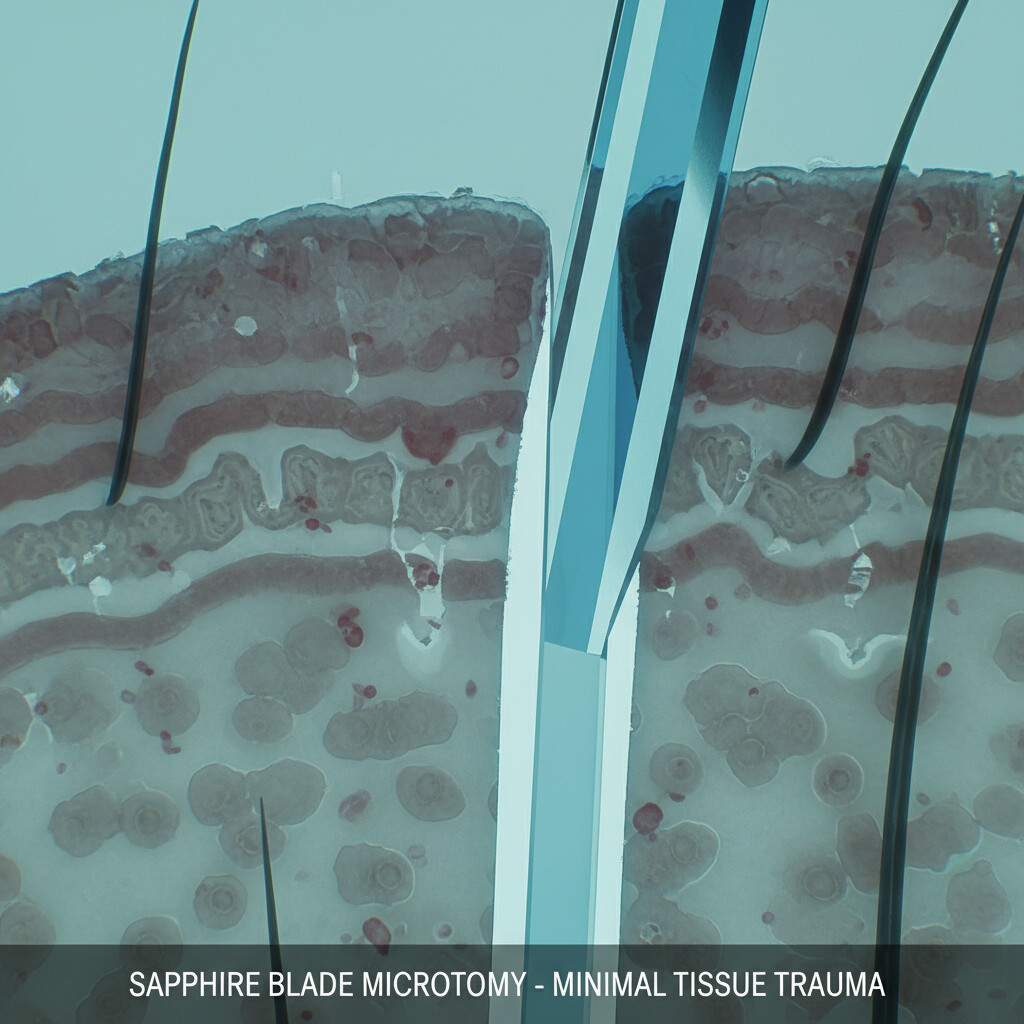
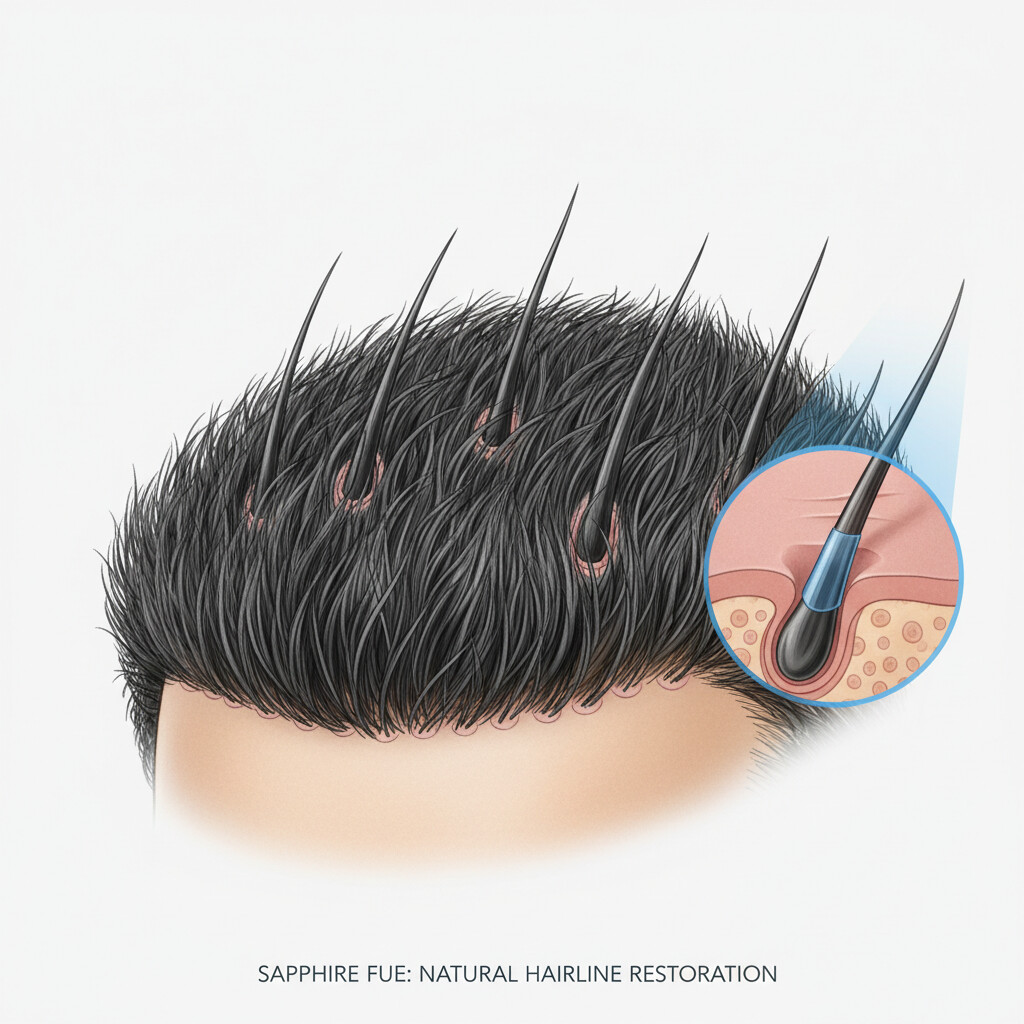
In Sapphire FUE, the middle step is done with a sapphire-tipped blade. The blade is usually chosen in a width that matches the graft size, and the surgeon uses it to make small slits at the planned angle, direction and depth. After that, grafts are placed with forceps or, in some clinics, with implanter pens.
So “Sapphire FUE” is not a separate operation. It is regular FUE with one specific tool choice. Other common tools for the same step include steel slit blades, custom-cut steel micro-blades and hypodermic needles. In DHI-style procedures, the implanter pen itself makes the opening as the graft is inserted.
What sapphire blades may offer
Sapphire is very hard and can be polished to a smooth, sharp edge that stays sharp through a procedure. Surgeons who like sapphire blades usually mention:
- A clean, consistent cut. A sharp, smooth blade may cause slightly less tearing of the surrounding tissue.
- Consistent sizing. Blades come in fixed widths, which makes it easy to match the site size to the graft size.
- Handling. Some surgeons simply prefer how the blade feels and cuts.
These are reasonable practical points. What they do not prove is that patients end up with better hair.
What is not well proven
Much of the marketing around Sapphire FUE presents benefits as established fact. In reality:
- Faster healing and less swelling. Some clinics report this, but there is little high-quality comparative research. Healing speed depends heavily on the number of sites, site size, depth, how the grafts are handled and your own skin. Most FUE patients heal the recipient area in one to two weeks regardless of the tool.
- Higher density. Density is limited by how many grafts your donor area can safely provide, how close sites can be placed without harming blood supply, and graft survival. A sharp blade does not change these limits. Very dense packing can actually increase the risk of poor growth if it is overdone.
- Less scarring. FUE donor scarring comes from the extraction punches, not from the recipient sites. The blade used on top of the head has no effect on the small dot scars in the donor area. The reason FUE usually leaves less visible scarring than a strip procedure is covered in FUE vs FUT.
- Better graft survival. Graft survival depends mainly on how long grafts are out of the body, how they are stored and handled, and how carefully they are placed. No tool can make up for rough handling or long out-of-body times.
A skilled surgeon with steel blades or needles can produce excellent, natural results. A less careful team with sapphire blades can produce poor ones.
Possible downsides
- Cost and marketing. In some markets, “Sapphire FUE” is a premium package name. You may pay more for a tool that makes little difference. In other clinics, sapphire blades are simply the default and not charged extra.
- Blade shape. Sapphire blades are generally used for slit-type incisions. Some surgeons prefer other site types, such as needle punctures or different incision orientations, depending on the area and the hair.
- Brittleness. Sapphire is hard but can chip. Blades are normally single-use.
- Distraction from what matters. Focusing on the tool name can take attention away from the questions that decide your result.
Where the real differences come from
What makes a transplant look natural and grow well is mostly out of sight of the brochure:
- Planning: a hairline and graft distribution that suit your age and likely future loss.
- Recipient site design: the angle, direction and density of the sites, which the surgeon controls whatever blade is used.
- Graft quality: careful extraction with low transection. The choice between manual and motorised FUE is another factor here, and again skill matters more than the device.
- Who does what: whether the surgeon personally makes the recipient sites, or whether technicians do most of the work with limited supervision.
Questions to ask a clinic
If a clinic promotes Sapphire FUE, these questions help you see past the label:
- Who will make the recipient sites, and who will do the extraction?
- Why do you choose sapphire blades for my case, and what size will you use?
- Is there a price difference between Sapphire FUE and your regular FUE? If so, what exactly changes?
- How many grafts do you plan, and at what density in each area?
- Can I see results from patients with hair loss similar to mine at 12 months or later?
The broader question of new names for similar techniques is covered in Are New Hair Transplant Techniques Truly Better or Just Marketing?
Recovery after Sapphire FUE
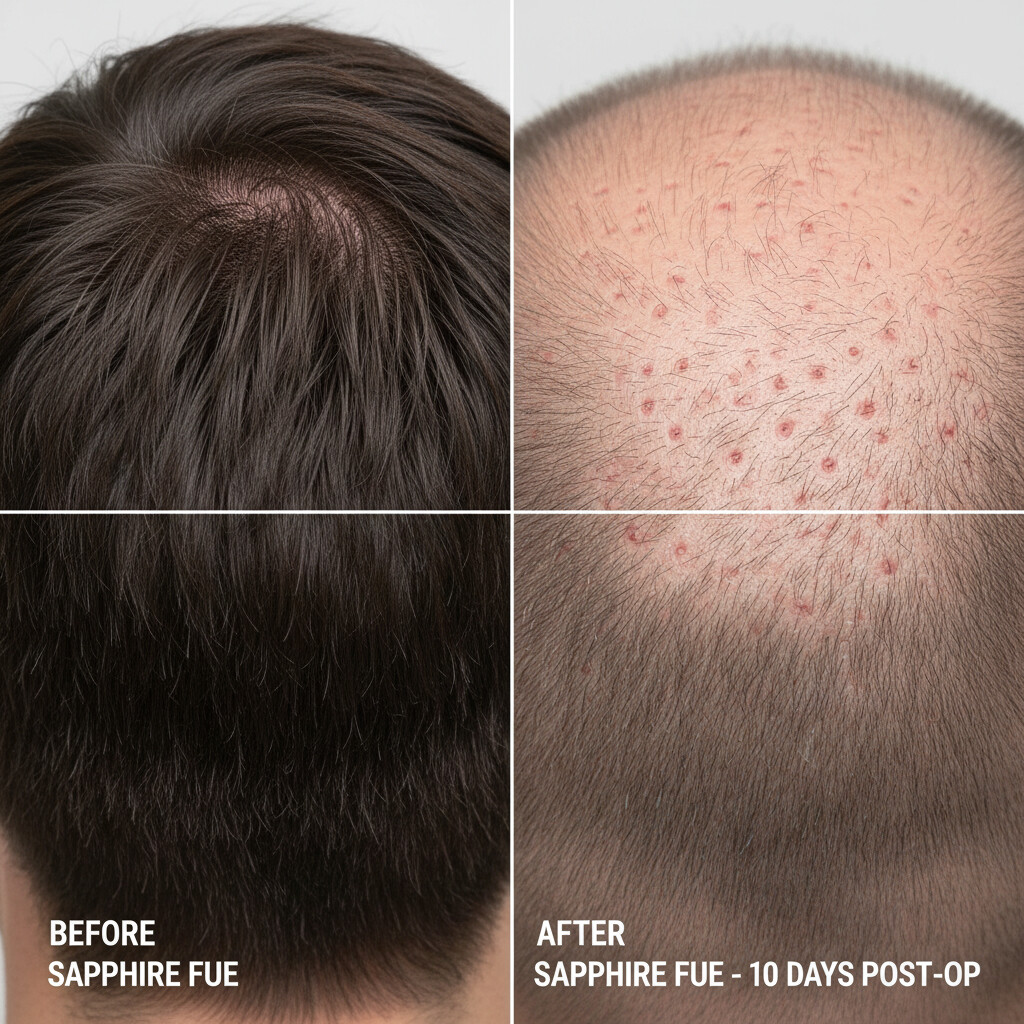
Recovery is the same as after any FUE. Expect some redness, small scabs and possible swelling in the first days. The scabs usually come off within one to two weeks with gentle washing. Most transplanted hairs then shed in roughly weeks 2-8. This normal shedding is expected and does not mean the grafts failed. New growth usually starts around months 3-4, and the final result is typically seen at 12-18 months.
Follow your own surgeon’s aftercare instructions, as protocols vary between clinics.
Common questions
Is Sapphire FUE better than regular FUE?
Not in any proven, general way. It is one tool option within FUE. A good surgeon’s result depends far more on planning and technique than on blade material.
Should I pay extra for sapphire blades?
Only if you understand what you are paying for. If the rest of the procedure, team and surgeon are the same, the extra cost buys a tool choice, not a guaranteed better outcome.
Can Sapphire FUE be done without shaving?
The blade does not decide this. Whether you can have an unshaven transplant depends on the size of the procedure, your hair and the clinic’s approach.
Discussion
Did your clinic use sapphire blades, and was it presented as an upgrade or just a standard tool? If you have compared quotes, share whether “Sapphire FUE” changed the price and what the clinic said it added.
Related guides
- What Is an FUE Hair Transplant? How the FUE Method Works
- SDHI, NEO FUE and Robotic FUE: What Is Actually Different?
- Choi Pen vs Sapphire FUE: What Is the Real Difference?
- Robotic Hair Transplant: How It Works, Pros, Cons and Limits
- Afro Hair Transplant: What Is Different for Afro-Textured Hair?
About this guide: ForumHairTransplant.com is an independent patient community. We are not affiliated with any clinic or surgeon, and we don’t accept payment for rankings, reviews or recommendations. This article is general information, not medical advice. Talk to a qualified doctor about your own situation.