By ForumHairTransplant Editorial Team · Prepared with AI assistance · Sources checked: 19 October 2026
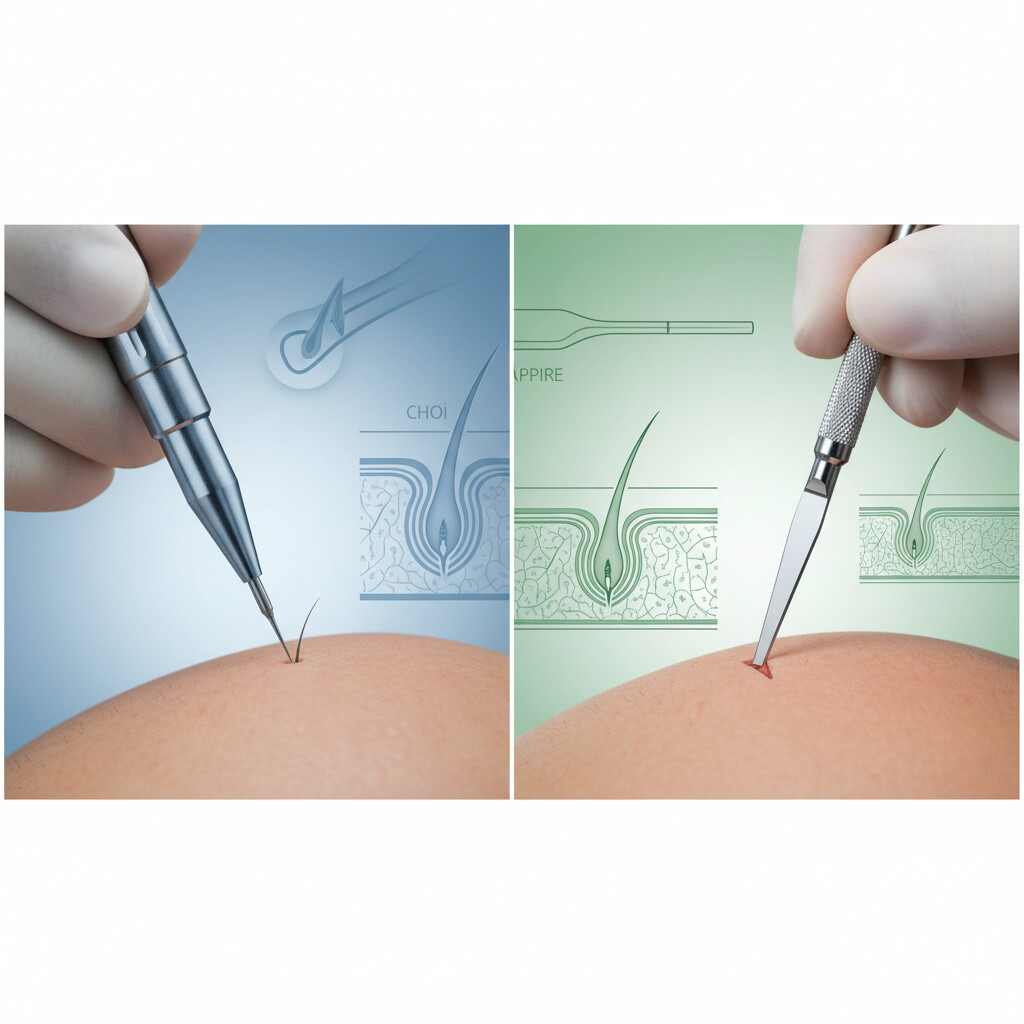
Choi pen (DHI) and sapphire FUE are not two different kinds of hair transplant. Both harvest grafts from the donor area in the same way, one follicular unit at a time. The difference is only in how the grafts are placed. With sapphire FUE, the surgeon first opens small channels with a sapphire-tipped blade and the grafts are then placed with forceps. With the Choi pen, each graft is loaded into a hollow needle and pushed into the scalp with the pen. Neither method has been shown to grow more hair in general. The skill and planning of the team matter far more than the tool.
Key takeaways
- Both methods use FUE extraction. The difference is the implantation step: pre-made channels plus forceps (sapphire) or implanter pens (Choi/DHI).
- Sapphire blades make fine, clean slits. Steel blades and needles can make very similar incisions in skilled hands.
- Implanter pens can be useful for placing grafts between existing hair and for close control of angle, but they need more trained staff and are often slower.
- There is no strong evidence that one method gives better growth for everyone. Marketing often exaggerates the differences.
- Choose a team for its results, planning and who does each step, not for the name of the technique.
What both methods have in common
In both cases, follicular units are removed one by one from the back and sides of the scalp with a small round punch. This is standard FUE extraction, explained in our guide on how FUE works. The same donor limits, the same risk of overharvesting and the same recovery timeline apply.
After surgery, both groups go through the same stages. Scabs clear in the first one to two weeks. Most transplanted hairs shed between about weeks 2 and 8, which is expected. New growth starts around months 3-4, and the final result takes around 12-18 months.
Sapphire FUE: pre-made channels
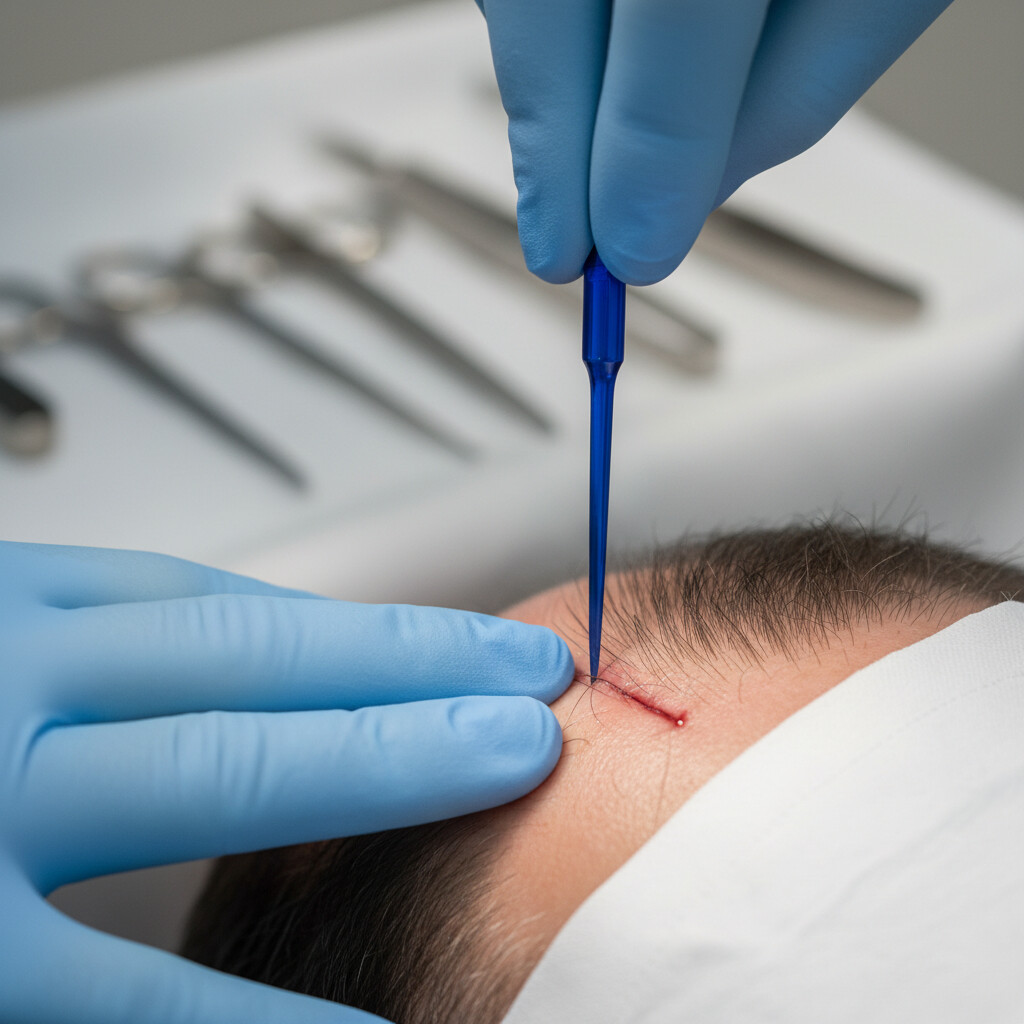
In sapphire FUE, the surgeon creates the recipient sites (small slits in the thinning area) with a blade made from synthetic sapphire. The grafts are then placed into these channels one by one, usually with fine forceps. More detail is in our guide to sapphire FUE.
Possible advantages:
- Sapphire blades are very sharp and stay sharp, so they make clean, small slits.
- Because all sites are made first, the surgeon can design the whole pattern of angle, direction and density before any graft goes in.
- Placement with forceps is fast in experienced hands and needs fewer tools than implanter pens.
Limits to keep in mind:
- Claims that sapphire blades lead to much less swelling, no scarring or clearly higher density are not well supported. Steel blades and needles can make incisions of a similar size.
- The quality of the result depends on how the sites are designed. That is covered in recipient site creation: angle, direction and density.
- Sites are usually made in shaved or short hair, which makes the procedure harder to hide.
Choi pen (DHI): implanter pens
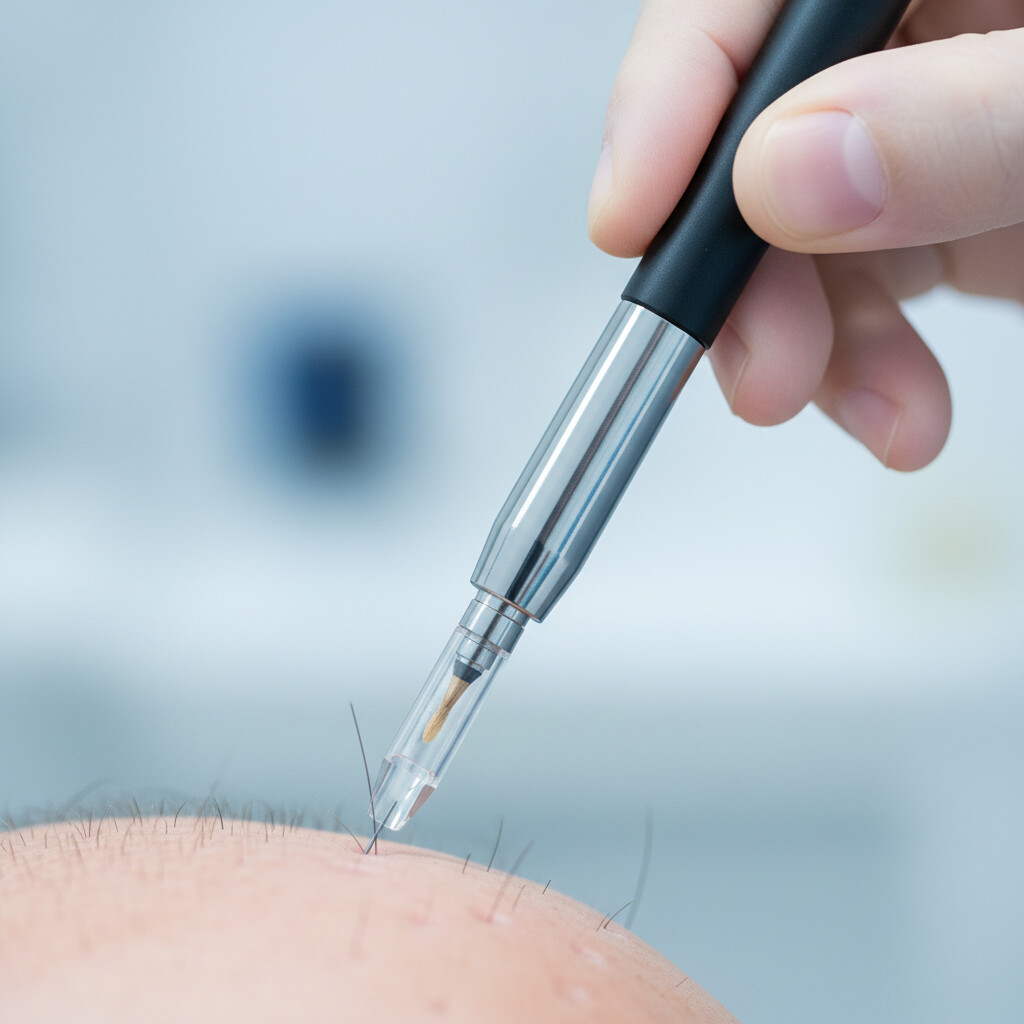
The Choi implanter pen is a pen-shaped tool with a hollow needle. A technician loads a graft into the needle. The surgeon or implanter then pushes the needle into the scalp and releases the graft, often creating the site and placing the graft in one movement. Clinics usually market this as DHI, covered in more detail in our DHI guide. Some teams use a hybrid: they open channels first and then use implanters to place the grafts.
Possible advantages:
- Angle and depth are set as each graft goes in, which gives close control.
- Grafts are handled less during placement, because they are pushed in through the needle rather than gripped with forceps.
- Useful for placing grafts between existing hairs, so it is often chosen for unshaven or partly shaven procedures and for adding density to thinning areas.
Limits to keep in mind:
- It needs several trained people to load pens continuously, and it is often slower. This usually makes it more expensive, or limits the number of grafts that can be placed in one day.
- The claim that grafts spend much less time outside the body is not automatically true. In many clinics most grafts are still harvested first and then wait to be loaded. Time outside the body depends on workflow and team size, not the tool itself.
- Needle size must match graft size. A poorly matched needle can damage grafts or make larger wounds than needed.
Side-by-side comparison
| Feature | Sapphire FUE | Choi pen (DHI) |
|---|---|---|
| Extraction | Standard FUE punch | Standard FUE punch |
| Recipient sites | Made in advance with a sapphire blade | Usually made by the pen needle as the graft is placed |
| Placement tool | Forceps | Implanter pen |
| Staff and time | Fewer tools, often faster | More staff needed, often slower |
| Working between existing hair | Possible, but harder | Often easier |
| Typical cost | Varies | Often higher |
| Evidence of better growth | Not clearly shown | Not clearly shown |
Which one should you choose?
For most patients, the technique name should be one of the last questions, not the first. Things that matter more include:
- Who does each step. Ask whether the surgeon designs the hairline and creates or oversees the recipient sites, or whether technicians do most of the work.
- The overall plan. A realistic graft number, a hairline that suits your age, and protection of your donor area for the future.
- Results in cases like yours. Ask for 12-month results with the same method, hair type and degree of hair loss as yours.
- Your situation. If you want to avoid shaving, or you are adding density between existing hair, implanters may suit you better. For large bald areas, pre-made channels are widely used and efficient.
Many experienced teams choose the method case by case, or combine both. If a clinic says one method is always far superior, or charges a lot more just for the name, ask what the practical difference will be for you. Our article on whether new techniques are truly better or just marketing looks at this more broadly.

Common questions
Is DHI better than sapphire FUE for density?
Not in general. Density depends mostly on your donor supply, the number of grafts that survive, and how closely the sites are placed. Both methods can achieve good density when done well.
Does recovery differ between the two?
Only slightly, if at all. Swelling, scabbing, shedding and regrowth follow a similar timeline. Follow the aftercare instructions your surgeon gives you, whichever method you have.
Can a clinic use both?
Yes. Some teams open channels with sapphire blades and then place grafts with implanter pens, or use pens only for the hairline.
Discussion
Did you have sapphire FUE, a Choi pen/DHI procedure or a combination? What made you choose it, and how did the result and recovery compare with what you were told? Please say whether you were shaved or unshaven, as it helps others compare like with like.
Sources
- Importance of the Recipient Area in Hair Transplantation, ISHRS
- Recipient Area, Journal of Cutaneous and Aesthetic Surgery, 2017
- Why FUE Is So Confusing, ISHRS
We could not find independent evidence on sapphire blades. These sources describe recipient-site creation and FUE terminology in general.
Related guides
- DHI Hair Transplant: How It Works, Pros, Cons and Recovery
- Choi Implanter Pen: How It Works in DHI, Pros and Cons
- Sapphire FUE Hair Transplant: What It Is and Is It Better?
- SDHI, NEO FUE and Robotic FUE: What Is Actually Different?
- Unshaven Hair Transplant: Who Is a Good Candidate?
About this guide: ForumHairTransplant.com is an independent patient community. We are not affiliated with any clinic or surgeon, and we don’t accept payment for rankings, reviews or recommendations. This article is general information, not medical advice. Talk to a qualified doctor about your own situation.