
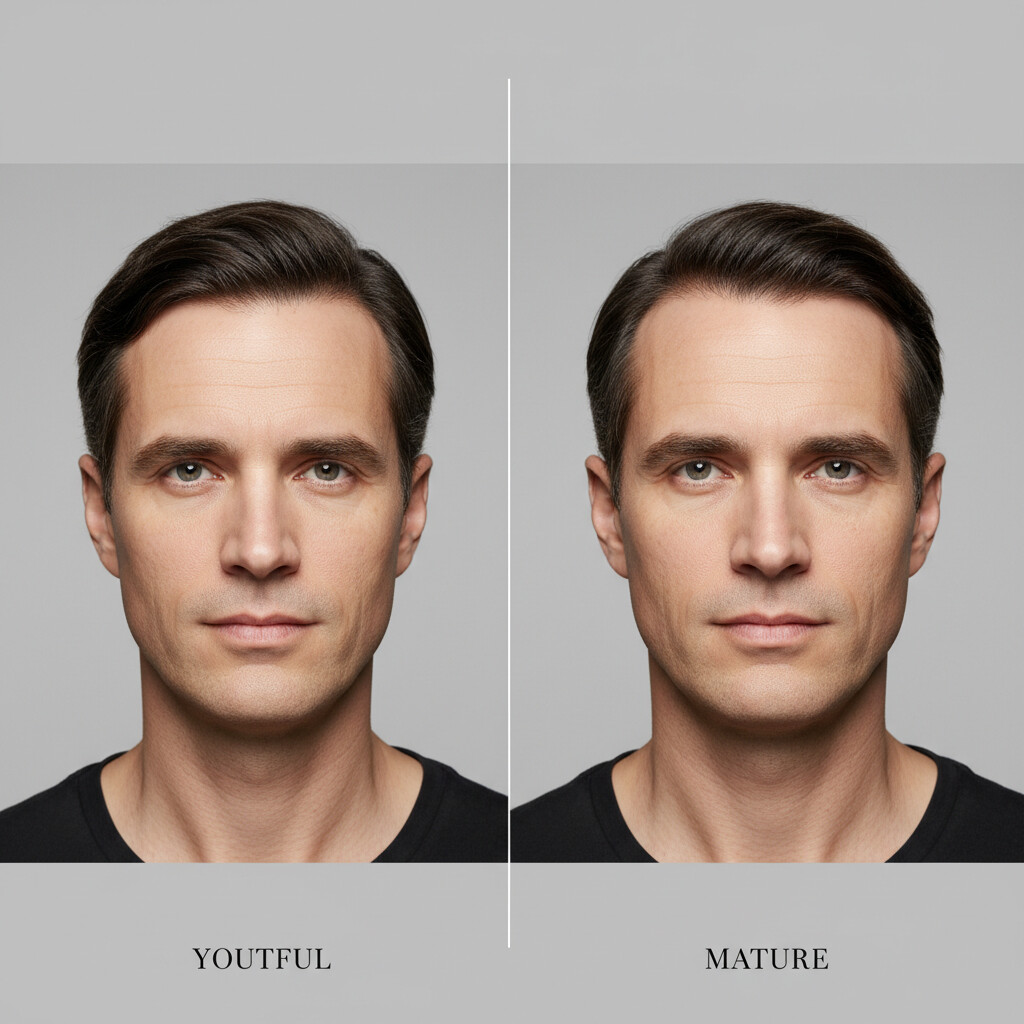
A youthful (juvenile) hairline sits low on the forehead and runs fairly straight or gently rounded across, with little or no recession at the temples. A mature hairline sits a little higher, often around a finger’s width, and the temple corners have moved back slightly to form a soft “M” or rounded shape. Most men develop a mature hairline between their late teens and late twenties. It is a normal change, not necessarily the start of balding. In hair transplant planning, a mature hairline is usually the safer target because it still looks natural as you age and hair loss progresses.
Key takeaways
- A mature hairline is a small, stable rise with gently receded temples. Pattern hair loss keeps progressing and usually comes with thinning hairs.
- It can be hard to tell the two apart early on. Family history, the speed of change, and whether hairs are becoming finer are the most useful clues.
- Most surgeons design transplanted hairlines in a mature position, especially for younger patients, to keep the result natural and to protect the donor supply.
- A low, straight, juvenile hairline can look unnatural later if the hair behind it keeps receding.
- Women usually keep a rounder, lower hairline than men and are planned differently.
What a youthful hairline looks like
The hairline most boys and young men have in their teens usually:
- Sits low on the forehead
- Runs fairly straight or in a gentle curve across the front
- Has little or no recession at the temples, so the corners are “filled in”
- Is often dense right to the edge
Many women keep a similar low, rounded hairline throughout life.
What a mature hairline looks like
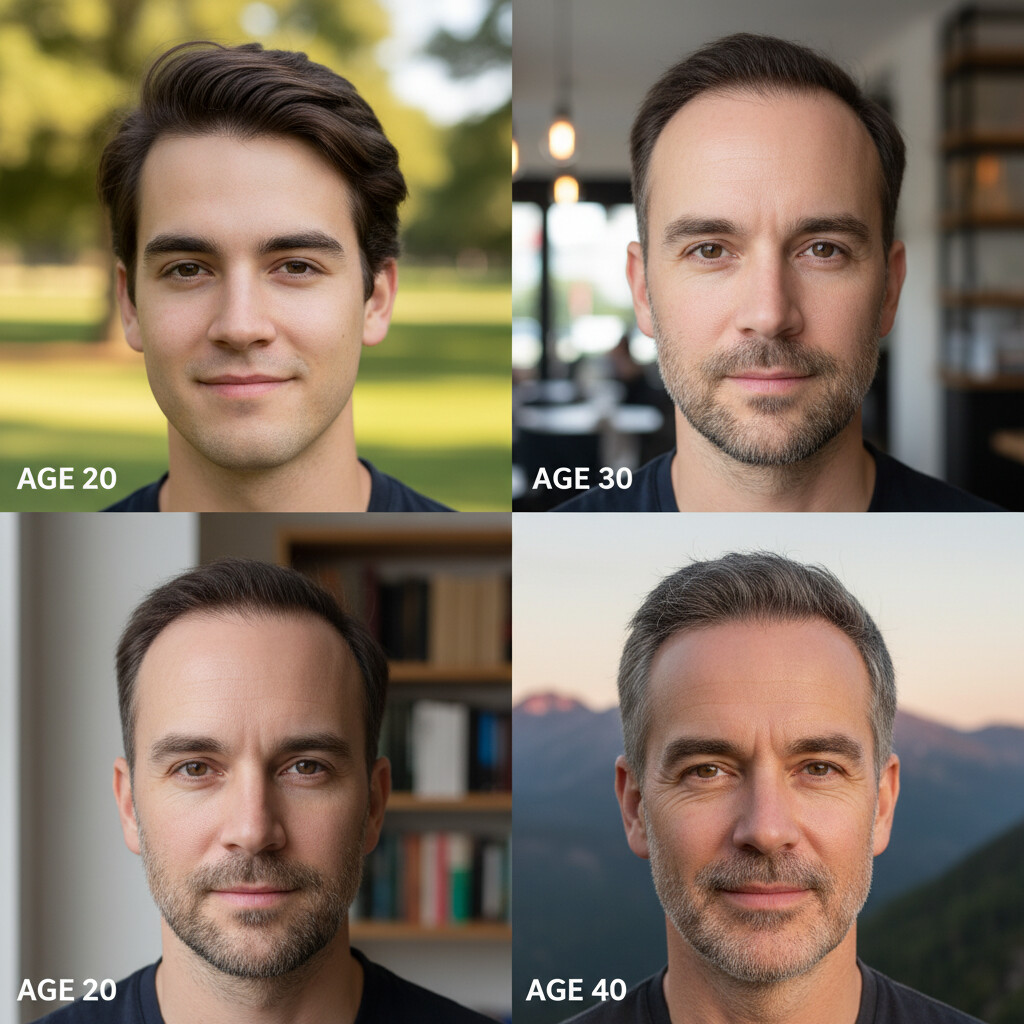
As most men move out of their teens, the hairline changes a little:
- It moves up slightly, often by around one to two centimetres at most
- The temple corners recede a little, giving a soft “M” or rounded corners
- The edge becomes less abrupt, with finer hairs at the very front
- It then usually stays roughly stable for years
Hormones play a role, and it happens in most men, including many who never go on to develop significant balding. It is simply the adult hairline.
Maturing hairline or pattern hair loss?
This is the question many men in their twenties worry about, and it is not always easy to answer early. Some useful signs:
More likely a mature hairline
- The change was modest and has slowed or stopped
- Both sides look similar
- The hairs at the front are as thick as those elsewhere
- The crown looks unchanged
More likely pattern hair loss (androgenetic alopecia)
- The temples keep moving back year after year
- Hairs at the front are becoming finer, shorter or more see-through
- The crown is thinning as well
- Close family members have significant hair loss
A doctor can examine the scalp under magnification to look for miniaturised (thinning) hairs, which point to pattern hair loss. Comparing photos taken in the same light every six to twelve months also helps. For more on recession, see our guide on hair transplants for a receding hairline.
Why surgeons usually recommend a mature hairline
When a surgeon designs a hairline, they are planning for how it will look in 10-20 years, not just at the one-year mark.
- Hair loss may continue. If the native hair behind a low, juvenile hairline keeps thinning, the transplanted line can end up isolated, with a thinner area behind it.
- The donor supply is limited. A lower, straighter hairline covers more area and uses more grafts, leaving fewer for the crown or future sessions.
- Age-appropriate looks natural. A hairline suited to a teenager can look odd on a man in his forties or fifties.
- Facial proportions matter. The right position depends on the forehead height, face shape and brow position. See facial proportions and hairline planning.
This does not mean every patient gets the same high hairline. Some people with strong donor hair, limited expected loss and the right face shape can have a slightly lower or more defined line. But surgeons tend to be more conservative with younger patients, because their future hair loss is harder to predict.
What makes a transplanted hairline look natural
Whatever its position, a natural hairline usually has:
- An irregular front edge, not a straight line
- Single-hair grafts at the very front, with thicker grafts further back
- A gradual transition from fine to denser hair
- Correct angle and direction, with hairs growing forward and slightly to the sides
- Temple corners that suit your age, rather than completely filled-in temples
Our guide on how a natural hairline is designed covers the design process, and Does Transplanted Hair Look Natural? explains what patients and others actually notice.
Hairlines for older patients
For people in their forties, fifties and beyond, the hairline is usually placed higher and softer again, with a more natural recession at the temples. The aim is to frame the face, not to recreate a look from decades ago. Our guide on hair transplants and the aging face covers this in more detail.
What to expect after a hairline transplant
- The transplanted hairs usually shed between weeks 2 and 8. This is expected.
- Some people also notice temporary loss of native hair near the treated area, called shock loss. It usually recovers over a few months.
- New growth typically starts around months 3-4. The front often fills in earlier than the crown, but the final result usually takes 12-18 months.
- Early growth can look fine and uneven. Judge the shape and density only once it has matured.
Common questions
Can I get my teenage hairline back?
Technically a surgeon can place a hairline low, but most will advise against a fully juvenile line in an adult, especially if hair loss is still progressing. A well-designed mature hairline is usually more natural and more sustainable.
At what age does the hairline mature?
For most men, somewhere between the late teens and the late twenties. The timing and amount vary from person to person.
Is a widow’s peak a sign of a mature hairline?
Not necessarily. A widow’s peak is a V-shaped point in the centre of the hairline and can be present from childhood. It can become more visible as the temples recede, but on its own it does not tell you whether you are losing hair.
Should I have a transplant if I’m not sure whether I’m balding?
It is usually better to wait, take regular photos and get a medical assessment first. A transplant is harder to plan well when the pattern of loss is still unclear. See What Is the Best Age for a Hair Transplant?

Discussion
How did you and your surgeon decide on your hairline position? If you had a transplant several years ago, share whether you are happy with the height you chose now that you are older.
Related guides
- How Is a Natural Hairline Designed for a Hair Transplant?
- How Do Facial Proportions Guide Hair Transplant Hairline Design?
- Hair Transplant and the Aging Face: A Guide for Mature Adults
- How to Style Transplanted Hair: Tips for Natural-Looking Results
- Hair Transplant for a Receding Hairline: What to Know
About this guide: ForumHairTransplant.com is an independent patient community. We are not affiliated with any clinic or surgeon, and we don’t accept payment for rankings, reviews or recommendations. This article is general information, not medical advice. Talk to a qualified doctor about your own situation.