
By ForumHairTransplant Editorial Team · Prepared with AI assistance · Sources checked: 19 October 2026
Swelling (edema) after a hair transplant is common and usually harmless. It is mainly caused by the fluid and local anaesthetic injected into the scalp during surgery, plus the body’s normal healing response. Gravity pulls that fluid down into the forehead and sometimes around the eyes. Swelling typically appears within the first two or three days, peaks around day three to five, and is mostly gone within about a week. Keeping your head raised, avoiding bending and exertion, and following your surgeon’s instructions are the main ways to limit it.
Key takeaways
- Swelling is an expected part of recovery for many patients. It does not by itself mean the grafts are at risk.
- It usually starts on the forehead within 1-3 days, may reach the eyes by day 3-4, and fades over the following days.
- Sleeping with your head raised and avoiding bending forward or heavy exertion are the most useful self-care steps.
- Only use pressure bands, cold packs or medication in the way your clinic advises. Never put ice on the grafts.
- Contact your surgeon about swelling that is severe, one-sided, getting worse after day 5, or comes with increasing pain, fever or pus.
Why swelling happens
During a hair transplant, the scalp is numbed with local anaesthetic, and extra fluid (usually a saline-based solution) is often injected to firm up the skin and reduce bleeding. This fluid, called tumescent fluid, takes a few days to be absorbed.
At the same time, the many tiny wounds in the donor and recipient areas trigger a normal inflammatory response. Extra fluid moves into the tissues as part of healing.
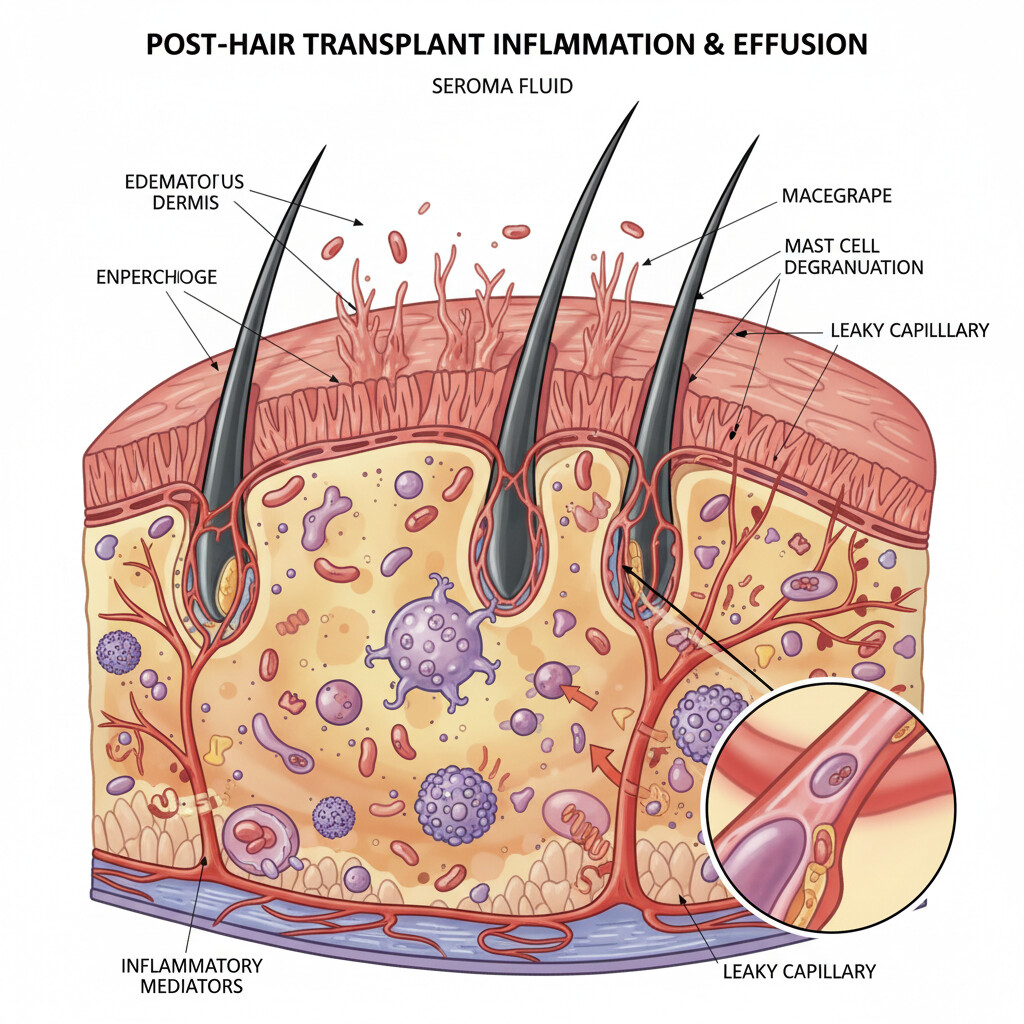
The forehead and the skin around the eyes are loose and sit directly below the scalp. So the fluid tends to drift downwards with gravity and collect there. That is why many people see little swelling on the scalp itself but wake up on day three with a puffy forehead or eyelids.
What is normal: the typical timeline
Everyone is different, and some people have almost no visible swelling. A common pattern is:
- Day 1-2: a feeling of tightness in the scalp. Mild puffiness may start on the forehead.
- Day 3-4: swelling is usually at its most visible. It can move down to the eyes and occasionally the cheeks. Some people get mild bruising or a “black eye” look.
- Day 5-7: swelling fades steadily as the fluid is absorbed, often from the top down.
- After a week: most people have little or no visible swelling. Slight puffiness can linger a few days longer, especially after large sessions.
Some people also notice swelling or tightness at the back of the head or neck below the donor area. This usually settles on the same timescale.
What makes swelling worse or better
Swelling tends to be more noticeable when:
- the session is large, with more grafts and more anaesthetic fluid,
- the hairline and front of the scalp are treated, because the fluid has a short path to the forehead,
- you spend a lot of time bending forward, lying flat or doing strenuous activity in the first days,
- you drink alcohol or eat very salty food in the first days, both of which encourage fluid retention.
Individual factors play a big part too. Two people with the same procedure can swell quite differently. Some clinics add a steroid to the anaesthetic fluid or prescribe a short course afterwards to reduce swelling. Practice varies, so don’t take any medication for swelling unless your surgeon prescribes or approves it.
How to reduce swelling
Keep your head raised
This is the most useful step. For the first few nights, sleep with your head and shoulders raised on two or three pillows or in a reclining chair, at roughly 45 degrees. A travel neck pillow helps you stay on your back and keeps the grafts off the pillow. Sleeping after a hair transplant covers positions in more detail.

During the day, stay upright as much as possible. Avoid bending down with your head below your heart, for example to tie shoelaces or pick things up. Squat instead.
Take it easy
Heavy lifting, workouts and anything that raises your blood pressure can increase swelling and risk bleeding in the first days. Most surgeons advise light activity only for at least the first week. Exercising after a hair transplant explains when you can build up again.
Cold packs, used carefully
A cold pack wrapped in a clean cloth can ease forehead or eye swelling. Hold it on the forehead or around the eyes for short periods. Keep it well away from the grafts and never press on the transplanted area. Don’t put ice directly on the skin, and don’t let a cold pack drip onto the scalp. If your clinic advises against cold packs, follow that.
Pressure bands and forehead massage
Some clinics apply a band or bandage across the forehead for the first day or two to stop fluid from travelling down. Others show patients how to gently stroke the forehead outwards, towards the temples, to move fluid away. Only do either if your clinic recommends it and shows you how. Pressing or rubbing near the hairline in the first days can dislodge grafts.
Drink water, go easy on salt and alcohol
Staying well hydrated supports normal recovery. Limiting very salty foods and avoiding alcohol in the first days may help reduce fluid retention. Alcohol can also increase bleeding.
Medication only as prescribed
If your surgeon prescribes a steroid, anti-inflammatory or other medication, take it exactly as directed. Don’t add your own anti-inflammatory painkillers without checking. Some surgeons prefer to avoid certain painkillers in the first days because of bleeding risk. Managing pain after a hair transplant explains the usual options.
Does swelling affect the grafts?
Ordinary swelling does not usually harm the grafts. The grafts are most vulnerable in the first few days, when they can be dislodged by rubbing, scratching or pressure. That is why you shouldn’t press on the recipient area when dealing with swelling. For how long this fragile period lasts, see how long until grafts are secure.
Swelling can go hand in hand with other short-term effects, such as tightness, redness and numbness. Temporary numbness after a hair transplant explains why the scalp can feel strange for weeks or months.
Planning around swelling
Because swelling usually peaks around day three or four, it is worth planning for it:
- Allow for a few days away from work or social commitments, especially if the hairline was treated.
- If you are flying home after surgery abroad, ask your clinic about the best timing. Swelling can be more noticeable after a long flight, and sitting upright helps.
- Swollen eyelids may make wearing contact lenses uncomfortable for a few days. Bring your glasses.
For the full list of dos and don’ts in the first weeks, see our post-transplant care guide.
When to contact your surgeon
Most swelling is harmless, but contact your surgeon or clinic promptly if you notice:
- swelling that is severe, clearly one-sided, or keeps getting worse after day 4-5 instead of settling,
- swelling around the eyes that affects your vision, or eye pain,
- a hard, tense, painful lump or area, which can be a collection of blood,
- increasing pain, redness, warmth or pus in the donor or recipient areas, or a fever. These can be signs of infection,
- swelling that has not clearly improved after about 10 days.
Seek emergency help immediately if you develop swelling of the lips, tongue or throat, difficulty breathing or a widespread rash. These can be signs of a serious allergic reaction.
Common questions
Will everyone get swelling after a hair transplant?
No. Many patients have only mild puffiness and some have none. It is more common after large sessions and after hairline work.
My eyes were swollen on day 4. Is that normal?
Swelling that moves down to the eyelids around days 3-4 is a common pattern and usually fades over the next few days. Contact your clinic if it affects your vision, is very painful or gets worse after day 5.
Can I reduce swelling by massaging my forehead?
Only if your clinic tells you to and shows you how. Gentle strokes away from the hairline are sometimes recommended. Rubbing close to the grafts can dislodge them.
Discussion
Did you get swelling after your transplant? On which day was it worst, how far down did it go, and what helped you most? If you had almost none, share what you did in the first few days. It helps others know what to expect.
Sources
- Hair transplant, NHS
- Hair Transplant: How Does It Work, Success Rates, Cleveland Clinic
- Hair Transplantation: Preventing Post-operative Oedema (Abbasi et al.), Journal of Cutaneous and Aesthetic Surgery, 2009
- Complications in Hair Transplantation (Kerure and Patwardhan), Journal of Cutaneous and Aesthetic Surgery
These sources cover the general topic. They do not answer every detail in this guide, so follow your surgeon’s written instructions.
Related guides
- Hair Transplant Aftercare: What to Do From Day 1 to Month 12
- How Long Until Hair Grafts Are Secure After a Transplant?
- How to Sleep After a Hair Transplant
- When Can I Go Back to Work After a Hair Transplant?
- Is a Hair Transplant Painful? Anesthesia and Sedation Explained
About this guide: ForumHairTransplant.com is an independent patient community. We are not affiliated with any clinic or surgeon, and we don’t accept payment for rankings, reviews or recommendations. This article is general information, not medical advice. Talk to a qualified doctor about your own situation.